
The Marching Band film review — Hollywood should watch and learn how to do this kind of feelgood movie

Stay informed with free updates
Simply sign up to the Film myFT Digest — delivered directly to your inbox.
How does The Marching Band get it so right? As you read this, the global film business is massed in Cannes, pulling its hair out over Donald Trump and the industry’s general malaise. But not everyone will be glum. The makers of deft French crowd-pleaser The Marching Band had their premiere at last year’s festival. Over winter, it then became a domestic smash to the tune of €18mn (against a budget of €6mn). If all things must now come down to nationalist jostling, among the box office vanquished was Hollywood blockbuster musical Wicked. On its French opening weekend last December, it was beaten out by this bittersweet yarn of long-lost brothers, class and fate.
Music is in the air here too. But in place of Broadway deafeners, The Marching Band has orchestral favourites and brassy riffs on French crooner Charles Aznavour. Warm and sure-footed, the film has the feel of a richly satisfying meal in an excellent neighbourhood bistro. Old world pleasures of character and story are generously apportioned.
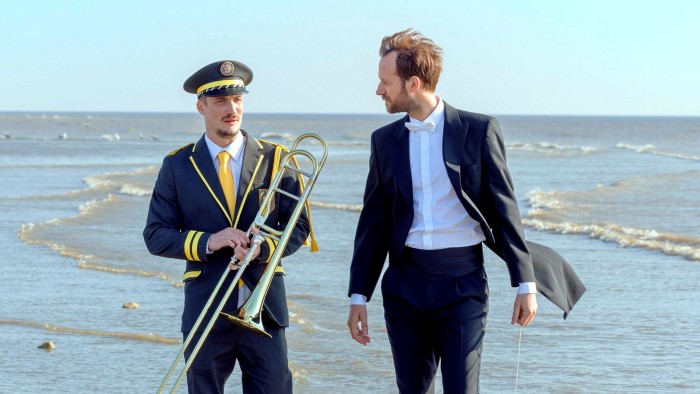
The first of the principals is Thibaut (Benjamin Lavernhe), a famous and urbane young classical conductor. Early in the film, he is diagnosed with leukaemia. But that hammer blow also brings revelation. In the search for a bone marrow donor, he learns he was adopted, with a brother he never knew existed: Jimmy (Pierre Lottin), a rough-edged canteen worker in scuffed northern small town Walincourt. A surprise reunion is followed by a transplant. Success. Thibaut is saved.
Obviously, you will now be writing an angry email about my having spoiled the entire film. Not guilty. In fact, all of the above is briskly wrapped up in the first 15 minutes. Director Emmanuel Courcol is just getting started. Life now comes fast at both siblings. Genetics harmonise. As Thibaut returns to his concert halls, Jimmy also proves a music lover, albeit in the less splendid surroundings of the Walincourt marching band, playing trombone on those Aznavour standards I mentioned.
Much plot ensues. The past is always present as Jimmy and Thibaut make sense of their new relationship, shadowed by their childhood separation and the wildly different lives it bound them for. The current moment is no less pressing, in a Walincourt where the newly shuttered local factory is the site of angry protests.
Is it now a political statement to enjoy a French movie? Oh well. What remains of Hollywood should watch and learn how to do this kind of poignant, mainstream feelgood, with its messy family histories, social context, and colour pops of romance and comic high-jinks. So too British cinema, which once often made films like this, before making whatever it does now.
The sheer sense of never-a-dull-moment asks a lot of the leads, who need to handle some abrupt tonal swerves. But Lavernhe and Lottin take everything in their stride. And if Courcol is no grand visual stylist, he clearly likes his characters — and us.
The Marching Band is not a film afraid of a big crescendo. But no one on screen or in the audience is being talked down to. For all the broad strokes, there is also restraint at work. Honesty too. Characters are likeable but nobody’s perfect. Not every crisis has a fix. And though mostly the story goes precisely where you expect, at others, like a great song, the next note catches you wholly off-guard. And you find yourself singing along.
★★★★☆
In UK cinemas from May 16
Read the full article here