

Unlock the Editor’s Digest for free
Roula Khalaf, Editor of the FT, selects her favourite stories in this weekly newsletter.
“Ripeness is all,” muses Edith, the protagonist of Sarah Moss’s ninth novel. It’s a quotation from King Lear, spoken by Edgar as he reflects on life’s passage: “Men must endure their going hence, even as their coming hither.” Our exit and entrance to the world are life’s two certainties.
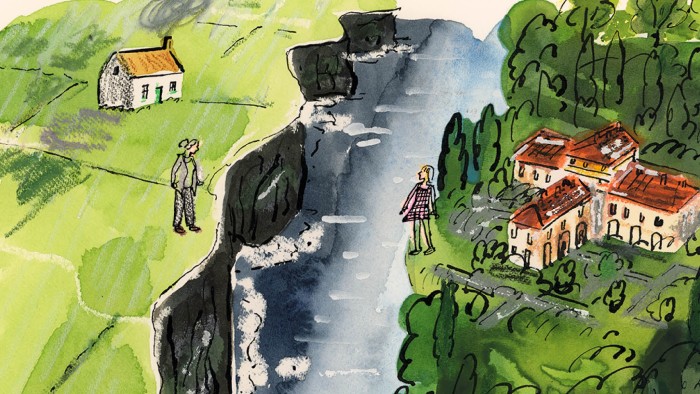
In Moss’s luminous book, through alternating chapters we switch between two points in Edith’s life. The first is aged 73, in Ireland, happily divorced, living alone, having tea with friends and casual sex with a local potter. The second is aged 17, recently accepted to Oxford — she used the Lear quote as part of her entrance exam — but sent by her mother to rural Italy to see her sister through the final weeks of a mysterious pregnancy.
In her most recent novels, Summerwater and The Fell, Moss tended towards polyphony, bending the light of a third-person narration towards the minds of a handful of different characters, allowing us to hear the thoughts of disparate people brought close together, whether in a Scottish campsite or under Covid-19 quarantine.
Ripeness limits us to one person — Edith — but ranges across two distinct narrative styles: a free indirect third-person for Ireland in 2023 and a first-person account for Italy in 1967. This is one person, but layered through different perspectives, geographies and periods in history. Pivoting between the “I” of the past and the “she” of the present opens up questions of how the self is articulated at different stages of life, although the relationship between youth and age is not as straightforward as it might first seem.
History’s way of pursuing the present has always been a major idea in Moss’s writing. From her debut, 2009’s Cold Earth, where six archeologists meet at a dig in Greenland, through to her brilliant 2018 novel, Ghost Wall and its brutal tale of an Iron Age “experiential archaeology” camping trip, the ghosts of the past often cause trouble for her characters. Ripeness is a departure in more ways than one; the warmth of late-summer Italy markedly different from the stark moorland and rainy lakes of previous work. The most interesting change is how Moss directs her archaeological impulse towards the individual. One of the novel’s greatest pleasures is in piecing together the gulf between these distinct perspectives — both the same person yet difficult to reconcile while events from one ripple towards the other.
In the 1960s, Edith travels to a large villa in Lombardy, directed by her mother to locate her sister and stay with her until a child is born. Afterwards, she is told to call a number — arrangements have been made. Her sister, Lydia, is a ballet dancer and the villa belongs to the head of her dance company. During Edith’s visit other dancers will come to keep her sister company. The dancers and their way of being in the world become a source of deep fascination for the teenage Edith. “Dance, I thought, is presence,” she comments as she watches the troupe train in a converted barn, “it is movement in the absence of past and future time.”
In her seventies in County Clare, Edith’s thoughts also often turn to bodies. “Can we think or speak of our bodies without metaphor?” she considers during a yoga lesson, and throughout the book Moss artfully layers personal and social elements to this question. Elsewhere, Edith reflects on the concept of the kinesphere, coined by the Hungarian choreographer Rudolf Laban to describe the space claimed by bodily movement. Breathing has a small kinesphere, ballet has a large kinesphere. The idea of bodies taking up space turns political when there is a protest outside of an old hotel. “Locals Only” reads a placard. A busload of young men from Africa have been brought down from Dublin, someone tells her: “The Ukrainians are one thing, women and kids, we all understand that, but this — The place is just already full.”
What is the kinesphere of the immigrant? Of the asylum seeker? How much space are different people permitted to take up in a society that feels its resources dwindling? Summerwater was set in the wake of Brexit, The Fell during the pandemic, and Moss continues to locate her action amid the turmoil of the contemporary world. As with Ali Smith’s seasonal quartet of novels (2016-20), this has given Moss’s recent work the quality of a chronicle. The risk of writing a volatile present is that it moves faster than the pace of publishing, the particulars of one political moment squashed beneath another. Yet by drawing a line between the 2020s and the 1960s, Ripeness avoids for the most part being usurped by the present, eschewing social commentary for what is ultimately a broader meditation on borders, bodies and autonomy.
If ripeness is all, does it make us passive to the passage of time? It doesn’t matter if you are ready, or where you happen to be: we will ripen and we will decay. Edith is herself an immigrant, daughter to a Jewish refugee whose own parents were murdered in the Holocaust. In a café in Ireland, Edith sees a refugee cook a traditional Ukrainian cake that she knows comes from a Jewish recipe. “One generation conducts a pogrom, one flees invasion,” Edith observes. In Ripeness, Moss spins a sense of belonging in the flux of history into a rich and complex matter.
Ripeness by Sarah Moss Picador £20, 304 pages
Join our online book group on Facebook at FT Books Café and follow FT Weekend on Instagram, Bluesky and X
Read the full article here