

This article is part of FT Globetrotter’s guide to Paris
I live in Paris and have been attending my hometown tennis Grand Slam on and off for over 20 years. Wimbledon, the US Open and probably even the Australian Open have their defenders, but I’ve come to think of Roland-Garros — the French Open (though more often referred to by the stadium at which it is held) — as the most beautiful Grand Slam. It’s held in the loveliest Parisian season (this year from May 25 to June 8) when it really is springtime in Paris. It’s in an atypically striking corner of the city. And it’s the only Grand Slam played on clay.
This year, there’s a centenary to draw the attention to Roland-Garros’s picturesque and often dark history: in 1925, the Championnats de France turned into an international competition when it began admitting foreign players. There’ll be all the usual little dramas to follow: can Carlos Alcaraz defend his title and secure his place as the dominant male player of his generation? Might the waning Novak Djokovic, about to turn 38, have one last surprise left in him? Can Iga Świątek, the clay-specialist of her generation, win her fifth French Open? Or could a French player delight the home nation by winning a singles title here for the first time in 25 years? There is still more to appreciate about the tournament off court.
The history
The tournament is a product of French tennis’s 1920s heyday. The world’s leading female player — and reputedly the most famous woman in Europe at the time — was France’s own Suzanne Lenglen, the six-time winner of both Wimbledon and the French Open (where she liked to arrive in a fur coat). Her trademark matchwear of short pleated skirts and bare arms was designed by renowned couturiers, and her “dancing game” inspired a ballet by Claude Debussy. She died of leukaemia aged 39, and today her sculpture marks the entrance of the Court Suzanne Lenglen, Roland-Garros’s second biggest court.
Lenglen’s male peers were France’s “Four Musketeers”: René Lacoste, Jean Borotra, Henri Cochet and Jacques Brugnon. Parisians flocked to their matches. When the men won the Davis Cup in 1927, and had to defend the trophy at home in 1928, it was decided to build a new stadium. Previously the French Open had been played at other venues in around and Paris, and once even in Bordeaux.
The tournament’s new home was in Paris’s leafy south-western 16th arrondissement, expanding fast in the 1920s. Dotted with art deco architecture, the seizième has a look distinct from Baron Haussmann’s grand 19th-century central Paris.
The stadium was completed in eight months, and opened in May 1928. With France still mourning its dead of the Great War, it was named not after an athlete but for a fighter pilot killed in 1918.
The Musketeers won six straight Davis Cups up to 1932, and lifted 18 major singles titles between them. Two of the men went on to bigger things. Lacoste, nicknamed “The Crocodile”, created the clothes brand featuring the green reptile. Borotra served as commissioner for education and sports under Marshal Pétain’s collaborationist Vichy regime from 1940 to 1942, before being imprisoned by the Germans. Though Wimbledon banned him in 1946, he remained a hero in France, where he was the only senior Vichy politician not tried after the war. In 1976, Borotra became president of the Association for Defending the Memory of Marshall Pétain.
Roland-Garros itself mostly ignored the German occupation. The author Henry D Fetter wrote: “In July 1942, the national junior championship was played out on its red clay courts while thousands of Jews were being rounded up and held in the infamous Vélodrome d’Hiver just across the Seine. [ . . . ] In August 1944, [Yvon] Petra was defending his French singles title before large crowds even as Allied and German armies battled in Normandy less than 150 miles from Paris.”
Today, bronzes of the Musketeers adorn Roland-Garros’s Jardin des Mousquetaires. They and Lenglen live on in French memory partly because of the tennis-loving country’s modern failure: since 1948, French men and women have won just three singles titles there. “Le syndrome Roland-Garros” stalks today’s French players.
The stadium’s modern history has been dominated by a Mallorcan, Rafael Nadal, since the day in 2005 that the 19-year-old won his first Roland-Garros and leapt into the stands to hug his family. Winner of 14 French Opens, now retired, Nadal has his own statue at Roland-Garros. The organisers will honour him on this year’s opening day.
Nadal embodies the virtues needed to win (and perhaps even watch) Roland-Garros: stamina and patience. On slow clay, baseline rallies can last for ever. Serena Williams, winner of three French Opens, told me during one tournament: “The [key to the] whole thing is just to be like Nadal.”
The mood
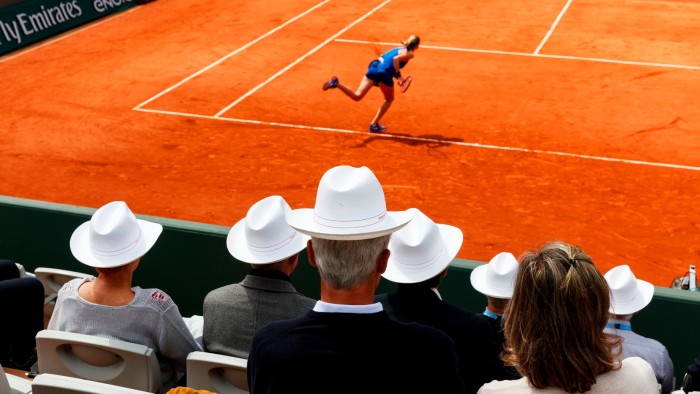
The high-bourgeois vibe of the 16th arrondissement pervades Roland-Garros, where you’ll typically see more cashmere sweaters swung over shoulders than non-white people from the suburbs. This isn’t the place to dress down. Keep your sports-themed T-shirts for the US Open. You’re in Paris, and are expected to dress in the classic conservative style of the arrondissement. The tournament is also a hangout for French celebrities. The most serious spectators are the French Tennis Federation members. With special access to tickets, they cluster in their own block in the central Court Philippe-Chatrier (named after a tennis administrator) and weigh the nuances of each top-spun backhand as if attending a graduate seminar.
On the show courts, you can feel far from the action and get distracted by the magnificently landscaped flora and glimpses of the Eiffel Tower. There’s more intimacy on the outer courts, where from a few yards away you can hear players insult themselves under their breath or admire the muscles in their legs with the clarity of an autopsy.
What to see besides the tennis (and the statues)
The complex has expanded since 1928, but it’s still the smallest Grand Slam venue, and easily strollable. There’s the Tenniseum museum — this year with an “immersive” exhibition on Nadal — fruit plantations and even beehives.
If you qualify as a VIP or have expensive corporate seats, you can gawk at celebrities in the hospitality tents of Le Village. Otherwise, you can pop out between matches to the adjoining botanical garden or the nearby Bois de Boulogne.
How to get tickets
This isn’t an impossible event to crack, certainly not if you are willing to watch lesser matches. At the time of writing there were still some tickets available on the official website. Otherwise, the usual ticketing resale websites sell at inflated prices, or you can brave the touts loitering outside the stadium. If you can’t get in for the climactic days from June 4 onwards, you could watch on big screens at the new free fanzone on Place de la Concorde. The fanzone’s moment suprême is scheduled for June 9, the day after the tournament, when the winners can display their trophies to the masses, a practice popularised by last year’s Paris Olympics.
Where to stay
Most hotels in western Paris are within a comfortable metro or rental-bike ride of Roland-Garros. (Cars move slower in today’s city.) Savers could book in Boulogne-Billancourt, the suburb that adjoins the 16th arrondissement and Roland-Garros. Most hotels in “BB” are cheaper than in Paris proper, which is largely sheer address snobbery.
Where to eat
Roland-Garros has better food stalls than most sports venues, but you’re in Paris so you can do better than that. Here are some tips near the stadium.
Hôtel Molitor
Five minutes’ walk from Roland-Garros, the Molitor is a hotel built around a swimming pool. It opened in 1929 as a great public pool; the future Tarzan actor, Johnny Weissmuller, worked here as a lifeguard. The world’s first bikini was modelled poolside in 1946 by nude dancer Micheline Bernardini, still with us today aged 97. After the pool closed in 1989, the building became a graffitied underground arts venue. It reopened in 2014 as the Hotel Molitor, with the stupendous pool and changing cabins rebuilt in a perfect facsimile of the art deco original. There’s a restaurant with poolside seats, and another on the roof overlooking Roland-Garros’s practice courts, so close that you can hear balls ticking on the clay. 13 Rue Nungesser et Coli, 75016 Paris. Website; Directions
Brasserie d’Auteuil
A vast white building in a former railway station on a busy roundabout about half a mile from Roland-Garros. The food is mostly Italian, and though the rooftop doesn’t have a view, it’s an airy spot to watch people and hear the newest French tracks on early summer nights. 78 Rue d’Auteuil, 75016 Paris. Website; Directions
Amalthée
This all-day-dining brasserie, opened in 2024 by an uncle-and-nephew team based in middle-class “BB”, is a more modest address than the others on this list but has a pleasant little terrasse and reasonable prices. It specialises in modern versions of traditional dishes, such as snails, moules, beef tartare and a giant île flottante dessert. 32 Avenue Jean Baptiste Clement, 92100 Boulogne-Billancourt. Website; Directions
Le Pré Catelan
For those with sufficient funds, this is a three-star Michelin restaurant in a Belle Époque mansion in the woods a short taxi ride from Roland-Garros. Bois de Boulogne, 75016 Paris. Website; Directions
rolandgarros.com
Share your Roland-Garros recommendations in the comments below. And follow FT Globetrotter on Instagram to find out about our latest stories first
Read the full article here