

Unlock the Editor’s Digest for free
Roula Khalaf, Editor of the FT, selects her favourite stories in this weekly newsletter.
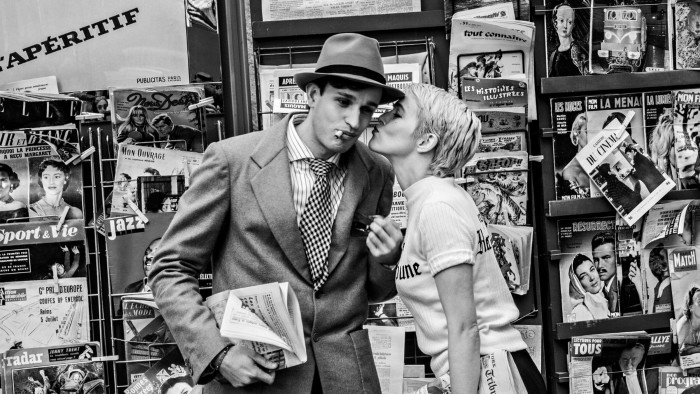
It takes a serious amount of chutzpah for an American to bring a film about the French New Wave to Cannes — the cinematic equivalent of bringing croissants to the Croisette. But Richard Linklater, whose affinity and affection for Europe has been evident since 1995’s Before Sunrise, does so with aplomb with his delightfully giddy making-of-Breathless movie Nouvelle Vague. It’s a welcome breath of fresh air and fun in a festival that has already brought us childhood trauma, spiralling addiction and small-town civil war.
Guillaume Marbeck is marvellous as a young Jean-Luc Godard, his voice a lisping staccato, his visage constantly obscured by dark glasses and a plume of cigarette smoke. He is intellectually cocksure, yet insecure about making his first film, fretting that, in 1959, he has already “missed the wave”. He speaks his mind frankly and constantly, yet, rather like the Bob Dylan of A Complete Unknown, he remains fundamentally unknowable; these days there might be speculative talk of the spectrum.
Around him are many soon-to-be-feted faces, Linklater’s busy camera freezing momentarily to present them facing us like captioned waxworks in a Madame Tussauds of cinema history: François Truffaut, Jacques Rivette, Claude Chabrol and even the odd woman — Suzanne Schiffman, Agnès Varda. At the offices of Cahiers du Cinéma, Godard and his fellow critics-cum-filmmakers bash away at typewriters until Jean-Luc plunders the petty cash and heads to Cannes — a curious meta moment for those of us here now.
He will need more than a fistful of francs to fund his debut opus — but not that much more. Everything about his radical approach is minimalist, guerrilla and therefore cheap: mostly single takes, no lights, no permits, often no script. Still, he regularly tussles with portly producer Georges de Beauregard, at one point on the floor of a Paris café when the moneyman discovers him hunched over a pinball machine rather than a camera or tomorrow’s pages. The sparring with his American star Jean Seberg remains verbal, Zoey Deutch given plenty of witty comebacks, sometimes reducing her quip-ready director to an admiring “touché”. Meanwhile Aubry Dullin fits glove-like into the role of boxer and Bogart-imitating leading man, a ringer for Jean-Paul Belmondo.
The zippy script by Holly Gent and Vincent Palmo is replete with the quick-fire quotations and knowing winks of which the postmodernist Godard was so fond. It’s less of a caricature than 2017’s Redoubtable, which portrayed a more buffoonish and embittered version of late-1960s Godard, though not by much. Yet even at its most irreverent — “Your film is a piece of shit,” his fellow critics declare after the first screening — Linklater’s mostly French-language, black-and-white homage remains deeply reverential.
His awe is forgivable. The great disrupter of the New Wave inspired the New Hollywood that followed only a few years after Breathless and continued to inspire directors for decades afterwards. An effervescent Quentin Tarantino was spotted coming out of the very first Cannes press screening of Nouvelle Vague, a longtime devotee who branded his production company A Band Apart after another early Godard film.
Yes, Nouvelle Vague is a romantic retread of cinema lore often documented before — and as such Godard, who died in 2022, would surely have hated it — but it might be well-timed. But with Hollywood facing existential threats, it would do well to take a long look at its bloated $200mn-plus budgets, take a leaf out of Godard’s cahier and remember what you can do with a girl, a gun and a few thousand francs.
★★★★☆
Festival continues to May 24, festival-cannes.com
Read the full article here