

Unlock the Editor’s Digest for free
Roula Khalaf, Editor of the FT, selects her favourite stories in this weekly newsletter.
Back in 1934, John Christie’s idea of starting an opera festival deep in the English countryside must have seemed an impossible dream. His ambition to open with Wagner’s Parsifal in the first year was especially a step too far and the founder of Glyndebourne was never to see Wagner there in his lifetime.
It has taken 90 years, but Parsifal has finally arrived. Even in the much larger, “new” theatre, opened in 1994, Wagner’s last opera is a tight fit, but there is potentially something to be gained from an intimate encounter with an opera that explores the deepest, innermost emotions.
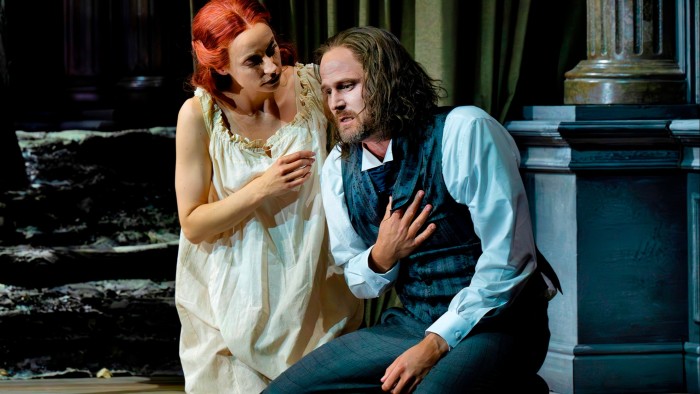
In Jetske Mijnssen’s new production that intimacy plays out as a family affair. Her setting, designed by Ben Baur, is the grand drawing room of a Victorian mansion, its imposing columns and bay window seemingly referencing both historic productions of the act one grail scene at Bayreuth and Wagner’s music room at Wahnfried. The shutters are always drawn in this gloomy, claustrophobic world.
There is a strong sense of atmosphere, not least as the household gathers for the candlelit grail ritual, but how many servants does this family have? Buckingham Palace would be lucky to employ so many flunkies.
The idea of cutting Wagner’s mythological characters down to size, of making them human, is the trend of the moment. Bayreuth’s current Ring is similar in many respects. That came unstuck when it tried to fit the supernatural and timeless elements into its scenario, and Mijnssen’s Parsifal falls at the same hurdle.
Her central idea is that Amfortas and Klingsor are brothers, Amfortas’s wound that will not heal coming from a knife attack long ago in their youth. In theory, it was a reasonable idea to show the back story being enacted by multiple versions of the singers, but having three Kundrys and three Klingsors in action is overdoing it, making the stage crowded and confusing.
In this storyline, who is the hangdog Parsifal? He looks neither much of an outsider nor an innocent, though Daniel Johansson’s clean, focused singing is on the right lines. As Kundry, Kristina Stanek has a trenchant mezzo, strong on the lower notes, weaker with vibrato at the top. The misdemeanour of this Kundry was merely being in a love triangle with the two brothers, which rather short-changes Wagner’s centuries-long curse, born from the biblical sin of laughing at Christ on the cross.
John Relyea sings a sturdy, reliable Gurnemanz, a family friend and cleric who leads the grail service. With a voice of Wagnerian expansiveness, Audun Iversen sings a marvellously lyrical Amfortas and Ryan Speedo Green makes a gripping, potent Klingsor. At 78, John Tomlinson, inimitable as ever, shows off his decibels proudly as Titurel. The interplay of this group of four, so intimate and real, was where Mijnssen’s production found its heart.
The high point of the performance, though, lay elsewhere. After a Tristan und Isolde of blistering passion last year, Robin Ticciati and the London Philharmonic Orchestra are back with an enthralling Parsifal that is well paced, beautifully balanced and with a palpable feel for Wagner’s many-layered, floating clouds of sound. If the stage picture starts to get tiresome, listen to the perfect ensemble and tuning of the wind chords. The London Philharmonic can never have played better at Glyndebourne.
As the final reconciliations within the family are made, the performance reaches a moving conclusion, albeit one the production has arguably not earned. If John Christie is looking down, he might nod in gratitude for that and — more important — for hearing Wagner sound so great at his own festival.
★★★★☆
To June 24, glyndebourne.com
Read the full article here