

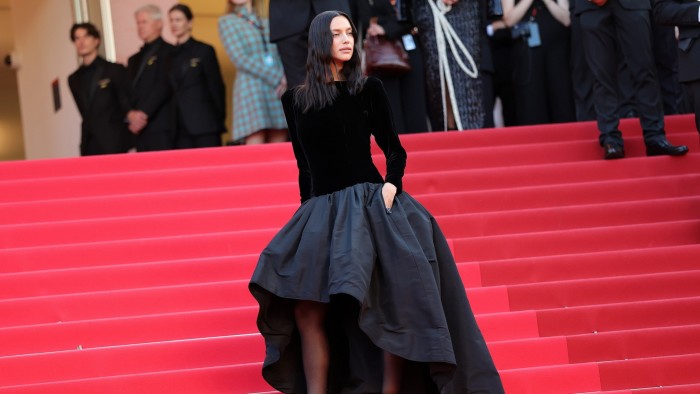
Madonna’s Jean Paul Gaultier cone bra in 1991. Milla Jovovich’s beaded John Galliano loincloth dress in 1997. Julia Roberts’ bare feet with haute couture in 2016. Look at photographs from past Cannes Film Festivals and it’s clear that this is one red-carpet event where guests make up their own rules.
Not in 2025, they don’t. Whether the above looks would fly at this year’s festival is anyone’s guess, thanks to a new dress code prohibiting “nudity” and “voluminous outfits” for gala screenings at the Grand Théâtre Lumière. In a statement released on the eve of the festival’s official opening, organisers cited “decency reasons” for the no-nudity stipulation. The prohibition on full-skirted gowns and long trains is more logistical — these elements could “hinder the proper flow of traffic of guests and complicate seating in the theater”.
The late-breaking rules left stylists, designers and talent scrambling — and in search of clarification.
“They announced the rules two days before, which did cause a bit of a stir,” says Jenny Kennedy, who styled Hayley Atwell in Giambattista Valli’s red silk faille Venus gown for the Mission: Impossible — The Final Reckoning gala screening. The design, from Valli’s latest couture collection, was a case of love at first fitting when Atwell tried it on in London a few months ago. Its not-insignificant skirt radius never came into consideration. At least, not until about 48 hours before Atwell was due to wear it. “It was quite voluminous, so when I first read the rules I was worried. I wondered how it worked and whether it would affect us,” says Kennedy. (It didn’t.)
What constitutes nudity or excessive volume remains subjective, because, unhelpfully for anyone who genuinely needs to know, the festival’s official statement doesn’t stipulate acceptable train length or transparency. But, it warns: “The Festival welcoming teams will be obligated to prohibit Red Carpet access to anyone not respecting these rules.”
On one hand, citing “decency” as the basis of the no-nudity clause could stem from a desire to elevate the Cannes red carpet above the arena of tawdry clickbait. The rule seems calculated to eliminate provocative-for-the-sake-of-it stunts such as the almost invisible “dress” that Bianca Censori, architect and wife of Kanye West, wore to the 2025 Grammy Awards, which consisted of an entirely transparent scrim of fabric, concealing nothing; or the gown that actress Massiel Taveras wore to Cannes in 2024, which featured a vast train hand-painted with an image of Jesus Christ. On the other hand, it also (perhaps unwittingly) connects the festival to the global tide of cultural conservatism. Or, more cynically, the rule could serve as a hedge against critiques that at Cannes — a festival with a history of underrepresentation for female directors — women are primarily decorative.
Whatever the reasoning behind the new rules, many invested parties spent the early days of the festival making last-minute alterations. Halle Berry, one of nine jurors tasked with awarding the prestigious Palme d’Or, said that she had set one of her red-carpet looks aside to conform to the dress code.
Designer Zuhair Murad and his team had been planning and fitting Cannes red-carpet looks months in advance. Once the rules were announced, they sprinted to modify the sheer, gold-embroidered gown that model and influencer Chloe Lecareux was to wear to the premiere of The Phoenician Scheme, sewing in a lining overnight. (Spare a thought for the people who really bear the brunt of the last-minute decree — the expert seamstresses and tailors whose meticulous stitches have to stand up to zoom-in HD scrutiny.)
“This new regulation took us by surprise,” Murad says, adding that the rules “call into question the entire creative balance” and render the red carpet “a space without risk”.
“One could understand a decision to tone down excesses, but imposing these rules disregards freedom of expression and the talent of designers.”
Cannes has a more outré reputation than, say, the Venice Film Festival or the Oscars. The Riviera setting, the top-tier talent, the yachts, the schmoozing, the constant premieres and parties and the sheer duration (nearly two weeks!) — all of it coalesces to make the festival a marathon of razzmatazz. “Cannes can feel over the top,” says stylist Nicky Yates, just back from the festival with client Naomi Ackie. The Hôtel Martinez, the hub of fashion and jewellery activity on the Croisette, tends to be a particularly frenzied setting. “It’s so chaotic. Every time a door opens or you go down the stairs, you see about a dozen photo shoots.”
A few days ago, Yates was waiting for the lift next to a woman who wore only the top half of her dress. The skirt was detached, its 8ft train extending down the corridor. “It was so huge she couldn’t fit into the lift with it. I don’t know how they managed to get downstairs, but once she did, hotel staff had to rope off the foyer to leave space for her to get through.
“It was an incredible spectacle and amazing to see, but I was so happy I didn’t have to figure that out logistically. It must be quite tedious for organisers to navigate multiple situations like that at a premiere, when they need to get so many people inside and seated for the film to start on time.”
Yates says there was an upswing in black dresses and “more streamlined” looks, including Ackie’s black sequin Balenciaga gown and Julianne Moore’s tasselled Bottega Veneta column dress. And many attendees have played it safe by wearing vintage dresses or replicas of mid-century designs. Jennifer Lawrence and Natalie Portman wore new versions of historic Christian Dior dresses dating from 1949 and 1951 respectively, while Zoey Deutch wore a copy of a Chanel dress from 1956. Plenty of other stalwarts of best-dressed lists wore designs that were either true vintage (Irina Shayk in wintry YSL) or that looked as if they had come from the archives (Alexa Chung’s full-skirted drop-waist Celine).
Attendees are aware that more extreme or risk-taking looks often garner the most coverage and attention, and some guests tested the boundaries — namely model Heidi Klum in an Elie Saab gown with a floral organza train that certainly seemed to contravene the “voluminous” rule. Nicole Kidman, Dakota Johnson and Julia Garner, perhaps feeling that transparency hasn’t really been considered tantamount to nudity for years now, took their chances with sheer gowns. Imogen Poots seemed the most at risk of being turned away from a screening in her black lace Rodarte. She got in (and looked fabulous).
Many participants expressed some degree of understanding for the real logistical considerations behind at least one of the dress code points. It’s a film festival, after all — even if fashion at times seems like the main event. “When I read the rules more closely, I understood that the one concerning voluminous dresses was more aimed at dresses that clog up the red carpet and stop traffic,” Kennedy says. “Which, fair enough — you shouldn’t get in the way of people watching the movie when that’s why you’re all there.”
Still, no one wants the spectacle smoothed over entirely. “Sometimes it’s fun seeing something like that woman in the huge dress,” Yates says. “Sure, it was a bit crazy, but where else are you going to see that but at Cannes?”
Follow us on Instagram and sign up for Fashion Matters, your weekly newsletter about the fashion industry
Read the full article here