

One of the greatest Italian exports is the lore of the nonna. These formidable women, with hugs that smell like pasta water and strong opinions on going outside with wet hair, are deeply revered, particularly when it comes to food.
I can’t say the stereotypes are untrue. My nonna, a refugee to Canada, lived just a few blocks from where I grew up on the west coast. She was a constant presence in the upbringing of my brother and me, whether picking us up from swimming lessons bearing cold cafè latte, or during afternoons at her house, where she would read to us for hours. Best of all, was when she would cook. She made handmade fusi (a penne-like pasta), sticky polenta, gnocchi, calamari fritti and sweet treats like frìtole (Venetian-style doughnuts), and we would consume everything in abundance and with gusto. “Mangia!” she demanded, until we could eat no more.
Sundays were the most special. These were the days when our whole family would go to hers for slow-cooked sugo. She would toil over the tomato-based sauce all day, braising unloved cuts of beef until the meat softened into something spectacular, while she rolled, cut and folded fresh pasta. Dinner was always served using the same crockery: ceramic bowls, made in Italy, with stripes around the rim reflecting il Tricolore, and the word “pasta” scrawled across the centre. My father would open a bottle of red, usually something he had made himself — a pastime inherited from his father, along with the insistence that the wine was good — and three generations would dine together.
This is a familiar scene across the Italian diaspora. The Sabbath centres around slow-cooking a pasta sauce and culminates in a large family feast. This is particularly true in North America, where it is affectionately known as “Sunday sauce” or “Sunday gravy”. It remains an essential and beloved means to celebrate family and culture, surviving the test of time even as other customs have waned. In fact, one of the most-viewed films on Netflix at the time of writing is Nonnas, in which a character played by Vince Vaughn (the actor’s mother hails from Naples) desperately seeks to recreate the family sugo after his mother’s death.
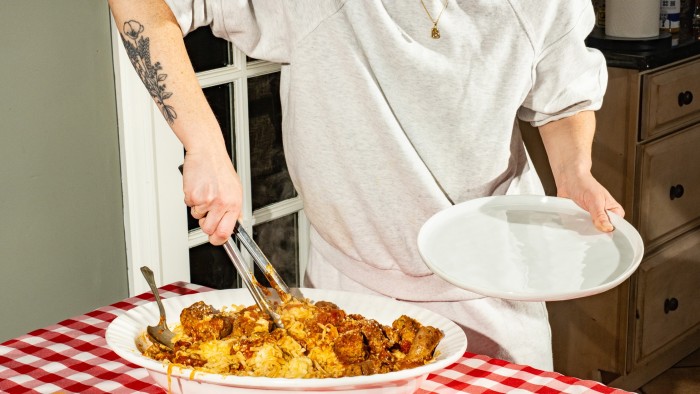
Sunday sauces vary between families and recipes are often passed down between generations. But the basic idea is the same: the sugo or ragù (the latter must have meat in) is started in the morning, before or after church, and simmers on the stove for hours, allowing the flavours to develop. Protein might be in the form of meatballs (beef, pork, veal, or a mix), pork sausages, or various cuts of lamb or beef that cook down until they fall apart. It could also be, per Neapolitan tradition, a combination of all the above, slowly braised, then removed from the sauce and served on the side.
Almost all of Italy’s 20 regions have their own version of ragù. In North America, the recipe often stems from ragù Napoletano, the traditional Sunday lunch served across southern Italy.
Italian immigration to North America surged in the late 19th and early 20th centuries, and again following the second world war. The first wave of migration was largely driven by economic hardship at home, particularly among those from the southern regions of Abruzzo, Campania, Apulia, Basilicata, Calabria and Sicily, who mostly came from agrarian backgrounds and were impoverished after centuries of foreign rule and neglect. The new world offered the prospect of a better life, with jobs building roads, bridges and other construction projects that unskilled male labourers could do. (Women were predominantly homemakers, or could find work as seamstresses or housekeepers.)
Between 1880 and the start of the first world war, some four million Italians arrived in America, and by the early 1920s had overtaken the Irish as the country’s second-largest foreign-born population. They mostly settled in New York and other large cities in the north-eastern US, or in the Canadian metropolises of Toronto and Montreal, in neighbourhoods that became known as “Little Italys”, establishing coffee shops, mutual-aid societies and social clubs.
The arrival of so many Italians alarmed the white, Protestant majority. Many of these old-world interlopers had dark complexions, spoke a strange language and were feared to be criminals and mafia. Worst of all, they were Catholic. As Italophobia swept across North America, Italians were targeted by hate groups and violently attacked. Anti-Italianism even formed part of the anti-Catholic, white-supremacist dogma of the Ku Klux Klan.
The Catholic Church, meanwhile, worried about the Americanisation of these immigrants. It sent priests and missionaries to the US to set up Italian parishes, which became crucial hubs for people to connect, speak their native language and preserve their ethnic identity. At the same time, cooking and gathering for food together in private homes took on a greater meaning: it was a way to safely celebrate Italian culture. Sunday service and Sunday sauce went hand-in-hand.
Today, only a fraction of Italian-Americans speak the language of their ancestors and the influence of the Church is in decline, but worship of the other Holy Trinity — carbs, cheese and sauce — remains.
“In Italian families, you all sit down to have dinner together — no questions asked — and it leads back to these times when being a unit and sticking together was how you would [survive],” says Stefano Secchi, 43, the widely acclaimed chef-patron of Rezdôra and Massara restaurants in New York. A first-generation Italian-American born in Dallas, Texas, he is a modern-day preacher for the gospel of Sunday sauce. “It was paramount for us growing up,” he says of the tradition he is now passing on to his own children. “My kids only want to eat pasta,” he says with a laugh. “I’m very much just like them, and my dad was very much like that.”
Secchi’s parents both moved to the US in the 1970s. His mother is from England, and his father from Sardinia, where Secchi would spend every summer holiday. “I was kind of resentful because I wanted to be around my American friends,” he says. Sundays were an exception.
“We were one of probably five Italian families in Dallas. All of the kids, all of the parents would come over to our house,” he says. The day might first start at church, or Secchi, his brothers and father would play soccer, before they went downtown to the farmer’s market to pick up ingredients for the sugo. His father was in charge of the cooking, usually making a low-and-slow pomodoro, with loads of olive oil and onions, often served with lamb. After dinner, all of the families would stay to play bocce and drink grappa until two in the morning, “every week, without question”.
For Mario Carbone, 45, chef-owner of the eponymous restaurants and co-founder of Major Food Group, the Sunday sauce of his youth in Queens, New York, was a smaller affair. His father worked in restaurants and on the weekends had a landscaping business, which Carbone helped with when he was old enough to. “When [we] were on the last job on a Sunday, [my father] would always call home and tell my mom to put the water on for the pasta,” he says. His mom either made an Italian-American bolognese or a stew with sausages, meatballs or beef brasciole (shoulder that is pounded thin and rolled with parsley, garlic and pine nuts), braised in sauce and served on a platter. “We had one big pot that was pulled out every week to cook all the pasta,” he says. Only on Sundays would they also have ricotta, in addition to grated parmesan. “I always loved putting a scoop of the cold ricotta on my hot pasta and mixing it up with grated cheese,” he says. The ricotta tortellini al ragù on the menu at the celebrity favourite Carbone, a modern red-sauce joint that has been described as “The Sopranos, but with a glam filter”, is based on those flavours. “When you eat the whole bite, it just reminds me of Sundays.”
Carbone now lives in Miami and cooks Sunday sauce for friends about twice a month. When he’s in New York, he always aims to visit his parents on a Sunday, when “by law it’s what we eat”. He suspects his mom has always cooked out of a sense of duty, which I believe was the same in my family and for many others. “With every generation, you become more American and less Italian, so keeping these traditions going is important,” he says. “It’s the thread-line to the immigrants that came to this place for the betterment of us.”
My paternal grandparents are from what was the Italian region of Istria, overlooking the cerulean waters of the Adriatic Sea. During the second world war, the region was caught in the fighting between occupying German forces and insurgent communist partisans. The end of the war did not bring peace: the Italo-Yugoslav border remained in flux until 1947, when the region was conclusively ceded to Yugoslavia and the borders were closed. Istrian Italians were subject to ethnic cleansing, mass killings and deportations, both during and after the war, in what became known as the Foibe massacres, leading to an exodus of hundreds of thousands from the region, including my grandparents. They made it to Trieste, in north-eastern Italy, where my father was born, later landing in Canada as refugees with a few belongings, hope for the future and my nonna’s family recipes. While they started a new life, my nonna’s cooking stayed the same — steadfast in tradition.
Lidia Bastianich, 78, the vivacious chef-restaurateur who is widely considered the “Queen of Italian-American cuisine”, also fled communist Yugoslavia, when she was a child.
After quizzing me over video call on whether I am related to the Istrian Blasinas on her radar in New York (I am), she tells me that when she was growing up, Sunday sauce was usually chicken based. She would chase the animals around their courtyard and later help her nonna pluck the chosen (or slowest) one, before it was cooked in sugo for two or three hours, while they milked a goat for ricotta and kneaded dough for pasta. “It was always with fresh pasta, gnocchi or fusi,” she says. She learnt about southern Italian-style Sunday sauce after moving to the US, where using dry pasta was more common. Italian-American sauces also tend to use more garlic and dry oregano. “The early immigrants didn’t have all the ingredients that they needed so they used what they found,” she says. She attributes the typically lengthy cook time to this too: “The tomatoes in America are big and acidic, while Italy has the sun, so tomatoes are sweeter and more delicious,” she says. “Italian-American sauce must cook for a long time to get the acidity and the juice out, which also might mean adding a bit of sugar.”
I ask her what it is about Sunday sauce that has kept it so integral to Italian immigrant culture. “With so much insecurity, what brings security is the unity of the family, and food is a big part of that,” she says. Now, as a nonna to five grandchildren, all in their twenties, she’s working to ensure the tradition isn’t lost, encouraging them to cook for her. She has travelled often around Italy with her children and grandchildren, and has taken them to the refugee camp in Trieste (which is now a museum) where she spent her tweens. “It’s important that they know their heritage, their roots,” she says.
I now have my own immigrant story, moving from my birthplace, Vancouver, to New York and settling in London, where I have lived for 11 years, a city that is home to a thriving Italian and Italian-heritage community of hundreds of thousands. Across the UK, many eschew the traditional Sunday lunch in Britain — the roast — and remain dedicated to Sunday sauce, though some sources suggest that the Italian-British tradition has been influenced by Italian-American recipes. Go figure.
For me, there are few things in life that offer me the same joy as a slow-cooked ragù. I savour the process of spending a Sunday finely dicing vegetables, gently sweating the soffritto and eventually adding my other ingredients for heat, time and chemistry to complete their magic. Sometimes I use Italian fennel sausages, a recipe I learnt from my mother — a Serbian refugee to Canada who took cooking classes at our local Italian cultural centre for her cibo Italiano-obsessed children (and perhaps to satisfy her mother-in-law too).
But it is my iteration on the original — beef shin or short rib (with diced pancetta and a bit of sausage meat for additional flavour) — that takes the most patience and offers the greatest reward. I’ll often cook this sauce in bulk, with two pots simmering on the stove and one going in the oven, so I can stock my freezer for rainy or lazy days, or make batches of other ragù-based dishes. My “lasagne project” Sundays offer me a marathon runner’s high, without the chafing.
Sunday sauce will forever be my favourite dish to cook and share with family and friends (or eat alone, in excess). Aside from the sheer deliciousness, it offers a hit of nostalgia that is difficult to express.
My nonna died two years ago at the age of 95. Stacked in the cupboards of my home kitchen are her set of green, white and red-striped bowls, which once cradled her handmade pasta, braised meat and slow-cooked sugo. On Sundays, they now hold mine.
Find out about our latest stories first — follow FT Weekend Magazine on X and FT Weekend on Instagram
Read the full article here