

On a mid-June morning in 2020, shortly after finishing a masters degree in politics in Copenhagen, Fiona Ross sailed her converted fishing boat across the Baltic to the island of Bornholm. She made landfall at Allinge only to find its small harbour full of boats, its shoreline thronged with people. Among them was Denmark’s political elite.
“Prime minister Mette Frederiksen was in the crowd with just one bodyguard and the defence minister was sitting there,” Ross, who is Scottish, points at a picnic table by the water. “He was chatting to anyone who wanted to talk. I thought: ‘Wow, this is mad.’”
You’d probably have to be Scandinavian to see democracy festival Folkemødet (literally, “People’s meeting”) as anything but extraordinary. It arrives each June with lofty ideals “to diminish distance and enhance trust between citizens and decision makers”, but is best understood as a sort of political Glastonbury. Over three days, Denmark’s political ecosystem takes over this small town of half-timbered buildings: politicians and ex-politicians, IGOs, NGOs and lobby groups, religious organisations and anti-religious organisations.
Around 3,800 events — speeches, debates, presentations and workshops — are held across multiple stages, covering subjects from immigration and green energy to the role of clowns in hospitals, from the future of the EU and limits of capitalism to how to get better sleep. Food trucks fill cobbled lanes. Tents pop up like spring flowers in dedicated campsites. Ferries shuttle to talks held aboard tall ships anchored offshore. Bornholm police estimate 60,000 members of the public attend but no one knows because unlike Glastonbury, no tickets are required.
“The way it happens is magical,” Ross, now Folkemødet’s volunteer co-ordinator, says as we stand among holidaymakers eating ice creams at the harbour. “You could shout at the immigration minister in the street but you’d be stared at as weird. People are more likely to chat it out over a can of Tuborg. It’s a sort of utopia.”
Thoughts of utopia were what had brought me to Bornholm. If Folkemødet seems peak Denmark to outsiders, Bornholm represents peak Denmark to Danes. They voted it their favourite domestic destination last year, just as they had the year before and the year before that. Reminiscing about her holidays before my visit, a friend told me of beach days (the sunniest location in Denmark, Bornholm is nicknamed “Sunshine Island”) and lunches of “Sun over Gudhjem” — rye bread open sandwiches with smoked herring, onion and chives drizzled with egg yolk — from the island’s dozen smokehouses.
Since the pandemic, downshifters have arrived on Bornholm, in search of personal utopias, I guess. From newcomer to old-timer, everyone I meet over my four-day visit earlier this month speaks about the island with a sort of pinch-me wonder. Bornholm is not a place, a waitress tells me, it’s a feeling.
It’s easy to roll your eyes at all this until you stay somewhere like Nordlandet hotel. My room has wooden floors, a slatted-wood ceiling, minimalist lamps and bathroom tiles in mossy greens and slate-greys. It’s a slice of Scandi minimalism that’s impeccably tasteful and entirely wasted because you’re transfixed by the view. Beyond a sliding glass wall, the sea shifts from pewter to silver in mercurial light, while ducks arrow across vast skies.
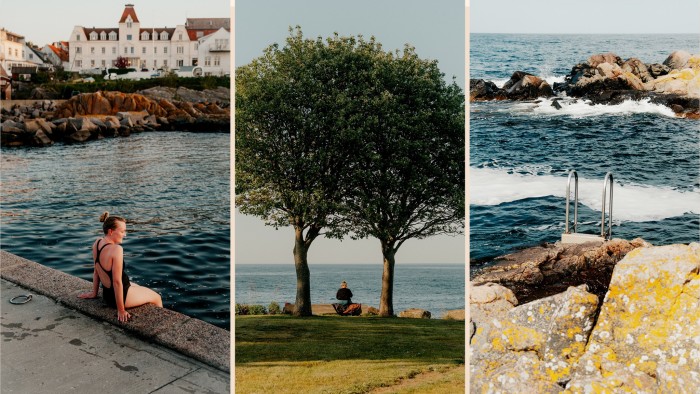
On a wild shoreline beneath, wicker loungers are set on a scrap of white sand. There’s also a sauna and a “pool”, which turns out to be an inlet notched in the pink granite shoreline. Each morning I superheat in the sauna then plunge into sea cold enough to make your skin crackle. It is deeply satisfying. If Bornholm is a feeling, here it’s one of serenity.
In the late 1800s artists discovered the island. In the sea-lashed ruins of Hammershus castle or Helligdomsklipperne’s pillar-like cliffs, painters like Holger Drachmann found a Romantic fusion of nature and spirituality. A few decades later modernists were drawn here by the luminous light — Bornholm became a Nordic Provence. Karl Oscar Isakson painted the fishing village of Gudhjem as Cézanne might have.
Squint and you can almost make out what he saw but the harbour today has too many gift shops for my liking. Having rented a car, I drive instead to Svaneke where, among houses painted shades of oxblood red and buttercup yellow, I find glass artist Pernille Bülow waiting in her studio. Around her, pendant lights hang like soap bubbles ready to pop.
Since Bülow opened the town’s first studio in a derelict garage in 1982, the fishing town has emerged as a crafts hub — at least a dozen artists operate in its vicinity. Bornholm today has more professional artists than anywhere in Denmark, roughly one per 380 residents. The World Crafts Council accredited it Europe’s first World Craft Region in 2017 and Copenhagen’s Royal Danish Academy of Fine Arts bases its ceramics and glass faculty here. Browse the excellent Center for Arts and Crafts at Hasle and you notice a shared aesthetic of organic shapes and natural colours. Eat at Noma, or one of Copenhagen’s many other stellar restaurants and the tableware will likely be from Bornholm.
“Bornholm as the trendy one leading Copenhagen? I didn’t expect that when I moved here but it’s happening,” Bülow tells me. She describes an artistic utopia of cheap rents, plentiful tourist krone, communal ethos and ubiquitous beauty. “The light, the nature — I find inspiration in every season. Bornholm does something to you. Every time I return from Copenhagen, I’m like . . . ”, then she exhales deeply.
Well obviously, I think afterwards. In Paradisbakkerne (literally “Paradise Hills”) I stroll through beech and birch forest. Gold coins of sunlight are scattered across its floor. The canopy ripples overhead in the breeze like the surface of the sea. Rather than walking, I have the sense of swimming underwater in nature. It’s extraordinarily beautiful.
At Dueodde I follow a boardwalk through a fuzz of birch and pines to arrive on a beach like white icing sugar. It arcs for two kilometres, empty except for ducks and the distant specks of a couple walking hand in hand.
Later I take a meandering drive through the centre. Lanes bend and drop, through green swells of hill. Outside farmhouses are honesty boxes with rhubarb and honey but also handmade terracotta bells and granite vases. Now and then I turn a corner to see the cobalt-blue Baltic filling the space between hills ablaze with yellow rapeseed. Occasionally I pass another car. Mostly I don’t.
Over the past decade, the island has quietly acquired a reputation for rural sophistication. The game-changer was Kadeau, a beach-shack restaurant created by three islanders that was awarded its second Michelin star in 2018. Co-owner and chef Nicolai Nørregaard is off-island when I call him, frantically finalising new menus for his Copenhagen offshoot. Everything starts in Bornholm, he tells me; the ingredients from the restaurant’s vast garden (10 tons of ingredients are preserved annually) and the ethos of terroir which dictates 15-course menus. Bornholm has its own identity, he says: “It’s a testing ground for Copenhagen.”
I start to think Folkemødet works because Bornholm feels so distinct, a place apart. In an age of fast politics and fractious social media there’s something radical about 60,000 people politely discussing their differences over three days. Wondering if it’s just a publicity stunt for politicians, I email Denmark’s minister for culture Jakob Engel-Schmidt. He replies describing the importance of “a space where citizens and politicians meet face to face . . . to listen and reflect, and take part in respectful political dialogue”. How “in times like these politicians carry a greater responsibility than ever to act as a counterweight to division. In that context Folkemødet serves a timely and meaningful role.”
It helps that Danes have an unspoken code known as Janteloven which prizes collective achievement above individual success, plus a habit of direct speaking — what quasi-academic book Danish Humour: Sink or Swim describes as a “campfire mentality”.
What matters most, though, is the island location. Prime minister or punter, everyone arrives in Bornholm via an 80-minute ferry from Ystad, Sweden, or a 30-minute flight from Copenhagen. To attend requires commitment, both time and mental. Imagine Westminster had decamped to the island of Jersey, or Washington to Nantucket, and you’re close.
The longer I stay the more I feel myself drawn into Bornholm’s myth. Did Napoleon really have an hourglass made of Dueodde sand as a local tale says? Did the Knights Templar really build Bornholm’s 12th-century round churches to conceal the Holy Grail (a case made by author and journalist Erling Haagensen’s book, The Templars’ Secret Island)?
On my last day I detour down a dead-end lane on the west coast to the hamlets of Helligpeder and Tegelkås. Behind tiny harbours are old smokehouses and tar-black shelters containing fishing nets. Oil lamps, pot plants and sculpture are displayed in the windows of half-timbered houses. A woman swishes her legs in the water. A couple sit beside the reedy shore at a makeshift table.
Where the road ends a path continues into woodland. A few hundred metres along it, I find an A-frame shelter, a stack of firewood at its opening, the sea sloshing softly on pale pink sand beneath. A sign informs me that, although privately owned, Gines Minde shelter is free for public use. If the soul of Bornholm lies anywhere it’s here, I think, at a site of quiet beauty offered for the communal good.
“Please keep the area clean,” the sign adds. I’ve no idea why. The site is, of course, immaculate.
Read the full article here