

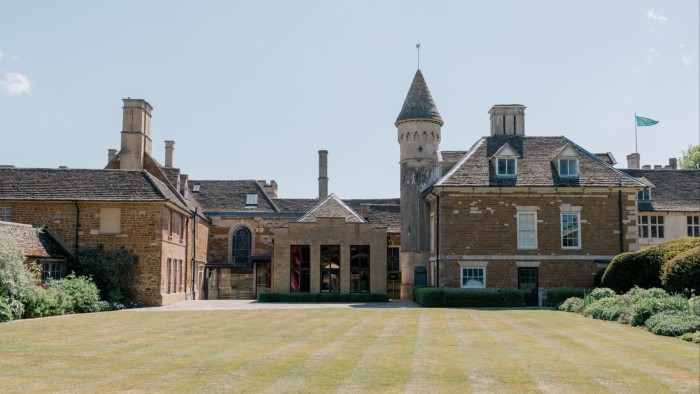
Down a narrow country lane, its edges lined with cow parsley, the imposing iron gates of Nevill Holt Hall glide open. There is only the briefest moment on the crunchy gravel drive before the dramatic view hits — first, the monumental bronze sculpture of a horse’s head by Nic Fiddian-Green, then, beyond the manicured lawn, a vast patchwork of rolling hills, fields and hedgerows.
The Grade I-listed ironstone hall, in Leicestershire’s Welland Valley, is no less impressive, with its crenellations, church and clock tower. The 2,000-acre estate is owned by the telecoms tycoon and philanthropist David Ross, and is where he has hosted an acclaimed opera festival for more than a decade.
Once known as “the Glyndebourne of the Midlands”, it was relaunched last year as the Nevill Holt Festival, a wider celebration of arts and culture. Marquees stand on the grass in readiness for the crowds soon arriving, from next week, to see more than 80 performances, talks and activities from musicians, artists, writers and public figures including Richard E Grant, Prue Leith, Yinka Shonibare, Russell Tovey and Boris Johnson. (Ross, a donor to the Conservative party, gave £10,000 to Johnson’s leadership campaign.)
Yet, while the 20,000 festival-goers can admire the grounds, church and auditorium, none are permitted through the terracotta-coloured porch to see inside the home that Ross has painstakingly restored over the past 25 years. Although he has properties in London and on the Caribbean island of Mustique, this is where the businessman spends most of his time.
Wilf, a wire-haired rescue dog, pads into the great hall first. A short time later a tanned Ross, casually dressed in a hoodie and orange sneakers, emerges through an ornately carved wooden door. Blond, blue-eyed and energetic (he’s “trying to forget” that he turns 60 this summer), he launches straight into an enthusiastic history and brisk tour, delivered in his booming baritone.
The great hall, with its long wooden table and beamed, vaulted ceiling, is where Nevill Holt originated in about 1250, as a hunting lodge. The house then extended in “a rather sprawling way” under different owners. For 400 years it was the home of the recusant Nevill family — who gave it their name and various additions, including parts of the church — and was bought in 1876 by the Cunard shipping dynasty, who left their own elaborate stamps on the property. The estate was a prep school for much of the 20th century and was put up for sale in 1999. Ross bought it the following year. “I was at school and university locally and always thought that somewhere between London, where I was working, and Grimsby, where I’d grown up, would be home,” he says. “That’s how I ended up here.” (His Instagram handle is @rosso_from_grimsby.)
Educated at Uppingham School, in nearby Oakham, Ross studied law at the University of Nottingham and went on to qualify as an accountant. In 1991, he joined his school friend Charles Dunstone as finance director of Carphone Warehouse, which became Europe’s biggest mobile communications retailer and turned Ross into one of the richest people in Britain. His fortune has, at times, been estimated to exceed £1bn.
While he maintains various business interests, much of Ross’s wealth and time is now spent on arts, music and charities. The David Ross Education Trust runs 36 academy schools and, until October, he’s chair of the National Portrait Gallery’s board of trustees (he donated £4mn to its recent renovation). Ross has also amassed an extensive art collection. Focused on British pop art since the early 1960s, it has been described by Sotheby’s as “one of the most important assemblages of late-20th-century and contemporary British art in private hands”.
A gallery’s worth of canvases and sculptures by the likes of Marc Quinn, Bridget Riley, Richard Hamilton and Allen Jones adorn Nevill Holt — given the property footprint extends over some 30,000 sq ft, there is a lot of space to fill. “If you end up with a house like this, you do have to put something on the walls — so you might as well do it nicely,” Ross laughs. He has nurtured relationships with almost every artist whose work he’s bought and wonders if his interest in collecting is genetic. “My father was an obsessive collector,” he says. “He started with a collection of maps and then moved on to all sorts of things.”
Entrepreneurship is in Ross’s blood too: his grandfather was John Carl Ross, who turned a small family fishing firm in Grimsby into the Ross Group, for years one of the UK’s major fish suppliers and manufacturers. The Ross Group ensign — a white star against a green background — flies from the flagpole of Nevill Holt.
The hall was empty and unloved when he took ownership, with many of its original features obscured. Ross wanted to respect its history without being stuffy. “I didn’t want it to look like my grandmother’s house,” he says. “I think that through the art, through the furniture, through the colours, we managed to turn it into something that is old at the same time as being contemporary. That is a nice juxtaposition. Not only interesting, but in a way quite surprising.”
Nowhere is this juxtaposition more apparent than in the dining room. The ornate, Pugin-style ceiling glistens with gold leaf and the pale green-yellow of the panelled walls offsets the views into the garden. On the walls hang six of Riley’s Op Art canvases, a medley of colourful stripes and spots.
It took a total of about 18 months for the conservator Alexandra Carrington and a colleague to restore the ceiling and walls. Carrington, whose clients include the National Trust, English Heritage and Historic Royal Palaces, has worked with Ross to revive several rooms in the house, helping him to choose historically appropriate colours based on paint scrapings.
Elsewhere, Witherford Watson Mann’s transformation of an old stable block into the 400-seater opera theatre — a space that will shortly stage Mozart’s Così fan tutte — was shortlisted for the RIBA Stirling Prize in 2019. Most recently, Woldon Architects created the Font House, a two-bedroom pavilion guest house, built on the site of an old school bungalow.
Designer Ann Boyd has helped oversee most of the interiors in both the Font House and main building. The feel is chic country house hotel (one bedroom has a roll-top bath in front of the window), but drill down a little and the choices are an interesting mix of lavish and canny: the kitchen, pantry and laundry, for example, were installed last year by the affordable manufacturer Wren. “I bought it from the showroom on the Leicester ring road,” says Ross with a grin. “No one I spoke to believed that Wren Kitchens could create a kitchen of such beauty. I’m very proud of it.”
Ten acres of gardens were landscaped by the Chelsea gold medal-winner Rupert Golby. The Italian walled garden features old English roses and clipped holm oaks, while the kitchen garden provides food for the estate and the festival — when I visit, the peonies are about to bloom and it’s brimming with asparagus (head gardener Andy Bretherick manages a team of five.
The grounds also serve as a vast outdoor gallery: there’s a fire-engine red sculpture by Allen Jones, as well as a bronze rendering of a man by Antony Gormley, standing ankle-deep in a pond, and three huge stone spheres, the work of Peter Randall-Page.
It’s clear that Ross never stops. He relaxes by doing “anything that gets me outdoors” and especially likes skiing and hiking. His love of the latter inspired him to commission the artist Andy Goldsworthy to create an ambitious project on his 12,000-acre estate in Rosedale, in the North York Moors National Park. Hanging Stones comprises nine existing buildings (and one new building) reimagined as works of land art; experiencing them as one artwork involves embarking on a challenging six-mile walk through moorland.
The work on his home never stops, either. During our tour, he spots slipped roof tiles and takes photos on his phone so he can arrange for them to be fixed. His next project is to restore the low wall around the church, the railings of which were removed and used as part of the war effort. “I’d spent 20 years wandering past that wall never even thinking about it. But now I’ve noticed it . . . I’m obsessing about it,” he says. “The thing is you can’t stand still. You have to keep doing something to keep the whole thing ticking forward.”
The Nevill Holt Festival 2025, May 30-June 22; nevillholtfestival.com
Find out about our latest stories first — follow @ft_houseandhome on Instagram
Read the full article here