

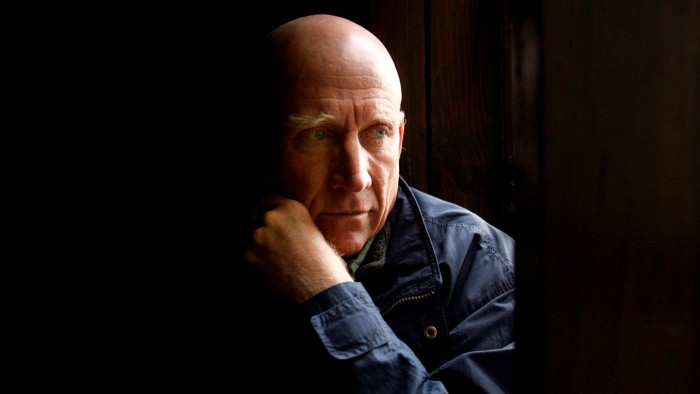
As he had done for so many years, in so many places, the photographer Sebastião Salgado stared at human life unblinkingly — this time his own. “We die,” he said when I spoke to him last year, shortly after his 80th birthday. “If I start a story now, I probably cannot finish it, because I’ll be dead.” Last week, the Brazilian, who will be remembered as one of the great documentary photographers of the age, died of leukaemia in Paris at the age of 81.
In a long career that began in the early 1970s, Salgado shot defining images of war and famine, of migration, labour and resilience. His 1986 photographs of men pouring down ladders into the Serra Pelada gold mine in Brazil still inspire a sense of awe. The drama of his photographs is unmistakable. Black and white, with violent contrasts of light and shadow created by shooting into the sun. Intimate and full of expression, yet epic in scope. The people in Salgado’s photographs, the animals, the land, the trees, exist in a world of forces more powerful than they are. Salgado was driven by compassion and a need to bear witness; he talked of being “inside” his images.
His work was politically and emotionally challenging. Salgado has been criticised by some for the beauty of composition with which he depicted people in extreme states of suffering. Salgado said that he sought to preserve the dignity of his subjects, and that he didn’t know how to shoot an “un-composition”. He also said there had been instances when he had put his camera down rather than take a particular shot. He once described seeing 10,000 people die from cholera in a single day in a refugee camp in Goma in the Democratic Republic of Congo. John Easterby, the former director of archiving at Magnum, believed that Salgado’s images forced viewers “to look at the unlookable”.
In his later years, soul-sickened by what he had seen of humanity’s endless capacity for cruelty, he photographed the world’s pristine wildernesses and returned to Brazil to photograph the Amazon and its indigenous peoples.
Salgado grew up on an isolated cattle farm near the small town of Aimorés, in the heart of Brazil’s Atlantic Forest, 100 miles inland and “eight hours by horse” from the nearest town. While many see traces of religious iconography in his work, Salgado maintained that it was in the forest that his vision was nurtured. “It is here where I learned to see the light,” he once said.
He met his wife Lélia Wanick Salgado in 1964, the year that a US-backed coup in Brazil set the stage for more than 20 years of military dictatorship. The couple became political activists, but after the regime stepped up the repression and torture of its opponents, they left for Paris, in 1969.
There, they continued their studies — Sebastião as an economist. Amazingly, he had never held a camera until Lélia bought a “nice Pentax” in Geneva for her architecture classes — the first photograph he took, in his early twenties, was of her, sitting on a windowsill. Soon, he was borrowing the camera regularly, then buying one of his own. He began his career working as an economist for the International Coffee Organization before deciding to chance his arm as a freelance photographer.
His native Portuguese language proved to be an advantage when the Sygma agency sent him to cover the overthrow of Portugal’s authoritarian regime in the “carnation revolution” of 1974. Later that year, he was badly hurt while photographing the war of independence in Portuguese-ruled Mozambique, when the jeep he was travelling in was blown up by a landmine, resulting in a spinal injury.
Salgado talked of escaping death many times, most notably while covering the Angolan civil war, and later when he was seized by Tutsis during the Rwanda genocide in 1994. Had Salgado been from France, which had provided support for the Hutus before the slaughter, rather than “the country of Pelé”, he would have been killed, he believed. He and his translator were saved when he produced his Brazilian passport.
He was in the early years of his association with the Magnum photo agency when, in 1981, he found himself at the scene of the attempted assassination of Ronald Reagan by John Hinckley Jr outside the Hilton Hotel in Washington DC. The photographs he took that day paid for an apartment in France for the Salgados and their two young children, Juliano, born in 1974 and Rodrigo, who was born with Down syndrome in 1979.
By then, Salgado was working on his first major self-directed project, travelling around Latin America documenting life among rural communities for what would become the book Other Americas (1985). The following year, he published a book of his photographs from Mali, Sudan and Ethiopia, as starvation gripped the Sahel region of Africa (the same famine that led to the Live Aid concert in July 1985).
Other long-term projects followed. Workers (1993) compiled Salgado’s images of working people from across the globe; Exodus (2000) was a study of migrating peoples in more than 40 countries. In 1994, Salgado had broken away from Magnum; he and Lélia started their own agency, Amazonas Images, in a former coal store in the east of Paris. It was Lélia who persuaded Sebastião to move home to the family farm in Brazil when he felt unable to go on. There they began planting trees, hoping to revive a small patch of the forest, which had shrunk by 96 per cent since he was a boy, owing to over-farming and deforestation. Their efforts resulted in the miraculous return of the land’s rivers and waterfalls, crocodiles, pumas and birdlife.
Salgado revived, too, and began the project Genesis in 2004, which he saw as an attempt to bring hope — to show us what we need to preserve. After receiving the Outstanding Contribution to Photography award at the Sony World Photography Awards last year, he talked of passing the torch to a new generation of photographers. This year’s winner of the World Photography Award, Zed Nelson, has spoken of the medium’s capacity to create wonder — the thought: “Wow, that existed, that happened.” Salgado’s work has that astonishing power.
Read the full article here