
I Gave You Eyes and You Looked Toward Darkness — dicing with the devil in deepest Catalonia

The source materials cited in the author’s note of Irene Solà’s earthy, rambunctious third novel range from Catalan folktales to medieval accounts of the devil, chronicles of the mountainous Guilleries region, recipes handed down over centuries, and memoirs of the Spanish civil war.
It’s a rich, tantalising brew and Solà, best known to anglophone readers as the award-winning author of When I Sing, Mountains Dance (published in English in 2022), mixes it all up in a heady, exhilarating, compact tale that seems as old as the Catalan mountains and as fresh as a newly plucked chicken.
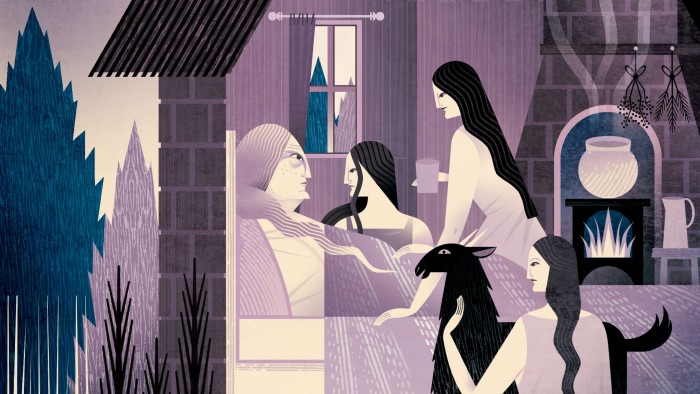
In an upstairs room of an ancient, remote farmhouse that “creaked as if cracking its knuckles”, an old woman, Bernadeta, lies dying, “her lizard lids lashless”. She is attended, or so we at first assume, by another old woman, Margarida, who sits downstairs in the kitchen in a wicker chair. Yet Margarida, like the entire polyphonic chorus of “dirty, surly women . . . grotesque and ordinary” waiting in the shadows of the house for Bernadeta to die, is herself long dead.
Solà beautifully aligns past and present. It takes a while to realise that Bernadeta’s end is occurring in contemporary times, although no one really knows how old she is. Margarida is convinced that a less than peaceful afterlife awaits Bernadeta; in fact, she fervently wishes it. The central figure, supine on her bed, moves in and out of the picture, yet gains in voice and force.
The book, arranged by chapter over a single day from dawn to night, also slides mesmerisingly back and forth across unnamed centuries, relaying the history of the house, called Mas Clavell, and its mostly female inhabitants. The kitchen is its hub, its window “narrow and deep like an ear canal”.
Solà’s imagery is unexpected and uninhibited, matched by Mara Faye Lethem’s unerring translation. This is a novel of survival, resistance, malice and cunning, set in a forest-thick land.
The landscape, in past times a haunt of bandits, highwaymen, wolves that eat children (in revenge, the creatures are hunted and viciously slain by villagers), also hosts something dark and deep that is both of this world and emphatically not. The narrative, taken up by various of the women in each chapter, dwells on a turbulent history which, for the residents of Mas Clavell, hinges on the choice made by one ancestor: Joana.
Overlooked in traditional courtship, her prayers to God unanswered, Joana takes the advice of an elderly neighbour. “If One doesn’t listen, why not ask it of the Other?” Joana makes a pact with the devil, selling her soul in order to marry “a full man” — “an heir with a patch of land and a roof over his head”. Wolf-hunter Bernadi, heir to Mas Clavell, is that man, yet on their wedding day Joana spots that he is missing a little toe. The devil has cheated her.
Catalan literature is replete with such back-and-forths — while the devil is portrayed as a figure of temptation, this is also a creature that is outmanoeuvred as often as it circumvents. In its numerous forms, simultaneously feared and taunted, it is the subject of ribald legends recalled by Joana in the present day, as she and her ghostly cohort prepare a feast to send off Bernadeta.
In her own time, Joana dismisses the fact of her husband’s missing toe, until their children begin to be born with absent limbs or organs. Of those surviving, Margarida, her daughter, has only three quarters of a heart; Blanca, another daughter, no tongue, but a forensic ability to silently observe.
Men, and their actions, are often brutal and brutalised — as with Margarida’s husband, the womaniser and outlaw Francesc, who is hunted down and publicly tortured to death by the authorities. Solà treats her human characters in much the same way as she does the ever-present animal life in the book: without sentiment.
The slaughtering of a kid goat in preparation for the feast combines horror and beauty: “They held it down. It was calm. As if it didn’t know that animals could die on a cool, fresh morning, surrounded by women’s hands . . . The basin filled with blood. So scarlet it was almost black. The kid shivered. Blanca and Elisabet held its legs. Àngela pulled up its hot, fuzzy face. ‘It’s dead,’ she said, pensive and serious.” (In the present day, Bernadeta’s relatives fret about the disappearance of their pet goat, as the women of the past, unseen and oblivious alongside them, prepare a succulent meal with its remains.)
The violence of Catalan history seeps through subsequent eras. As a young woman, Bernadeta, who gained the gift of foresight when thyme water was cast into her eyes as a childhood remedy, refuses entry to three young deserters from the Republican side during the civil war.
But the outside world rarely intrudes on Mas Clavell; it is a shock to realise that “the horseless carriage” and “little mirror” pondered over by the house’s former — or forever — occupants are respectively a car and a mobile phone. Exuding a kind of alt-magical realism, the novel refuses to distinguish between bewitcher and bewitched: this is its triumph.
I Gave You Eyes and You Looked Toward Darkness by Irene Solà, translated by Mara Faye Lethem Granta £14.99, 176 pages
Join our online book group on Facebook at FT Books Café and follow FT Weekend on Instagram, Bluesky and X
Read the full article here