

Unlock the Editor’s Digest for free
Roula Khalaf, Editor of the FT, selects her favourite stories in this weekly newsletter.
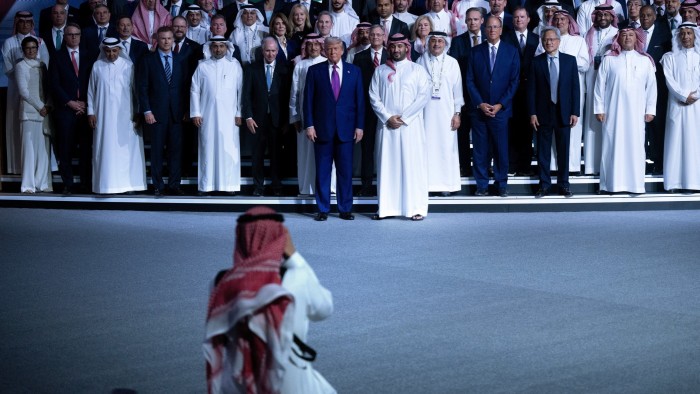
When US President Donald Trump touched down in Riyadh this month to announce a $600bn Saudi investment in the US, laud the two countries’ relationship and praise the “incredible” Crown Prince Mohammed bin Salman, it was the latest result of a decade’s effort to transform the Gulf state’s standing on the world stage.
Since 2016, a national development plan, in part driven by the need to diversify the economy away from fossil fuels, has given rise to dramatic social and economic change in the religiously conservative kingdom. Futuristic mega-projects such as Neom and The Line, entertainment and sports events on the scale of the 2034 football World Cup, and, most crucially, a shift towards female empowerment, are all tied to the crown prince’s ambitions to promote a globally relevant Saudi Arabia.
To gain a better understanding of these changes, David Commins’ Saudi Arabia: A Modern History provides a nuanced examination of the kingdom’s state formation process. The book delves into the country’s transformation from a tribal society to a modern petrostate, offering a critical analysis of the monarchy’s governance, Wahhabi religious influence, and the potential obstacles it faces in the 21st century.
Commins asserts that the success of Prince Mohammed’s plan, Vision 2030, will depend on “overturning patterns and structures rooted in layers of history dating to the rise of Saudi power in the 1740s”.
Commins, a professor of Middle Eastern history at Dickinson College in the US, begins with the 18th-century alliance between tribal leader Muhammad ibn Saud and the Wahhabi movement, a defining factor in the kingdom’s political and religious identity. He then explores the consolidation of power by Abdul Aziz Ibn Saud in the early 20th century, aided by tribal alliances, Islamic ideology and British political manoeuvring.
At an elite level, Commins contextualises how intra-familial politics led to a dominant bloc of princes from the ascension in 1964 of King Faisal to 2015. The Salman family kingship that has set up the present crown prince — widely known as MBS — to be the next in line is now giving way to the next generation of al-Saud leadership.
Commins recounts how, despite the kingdom’s instinctive inward focus, the discovery of oil in 1938 elevated its regional integration and influence. Most interesting is his description of labour activism tied to the state oil company Saudi Aramco’s treatment of foreign workers. As early as 1943, it highlighted a tension between the kingdom’s reliance on foreign labour and the leftist and nationalist ideas that were spreading across the region.
The tension between tradition and modernity is a repeated theme. On an environmental level, Commins explains that the arrival of motor vehicles led to their use in hunting gazelle, oryx and Arabian ostrich, diminishing wildlife in the desert. Today, the kingdom’s vulnerability to extreme heatwaves, water scarcity and desertification raises concerns about its habitability.
Ideologically, Commins explores how the ruling al-Saud family has sought to balance conservative religious forces with the demands of a rapidly evolving society. While the state invested in national development, fuelled by the 1970s oil boom, it also gave voice to religious revivalist movements to combat revolutionary ideas coming from Egypt’s Gamal Abdel Nasser.
Dramatic events in 1979 — the Islamic-inspired Iranian Revolution and seizure of the Grand Mosque of Mecca by Saudi militant Juhayman al Utaibi — coupled with anti-government protests in the oil-rich, Shia-dominated Eastern province, showcased the fragile balance between modernising and religious currents. The state gave way to religious impulses, although Commins points out that restrictions on female travel and dress had already begun to emerge in 1977.
Commins’ clear writing style makes complex historical events easy to grasp, and his well-researched account avoids simplistic narratives and stereotypes. Importantly, he does not shy away from critiquing the state’s human rights record, repression of dissent and reliance on religious legitimacy to suppress reformist movements.
However, the book could have expanded further on recent developments, particularly the rise of MBS and the effects of his regional policies, such as the 2015 war in Yemen. While Commins touches on Vision 2030, a deeper discussion on the implications of these reforms alongside the kingdom’s ambitions — newfound support for a Palestinian state, an eventual normalisation of relations with Israel and reconciliation with its longtime adversary Iran — would have strengthened the book’s immediate relevance.
What is clear from Commins’ analysis is that the Saudi monarchy will continue to seek alignment with the US, assert its influence over regional challenges, and will have to prepare for more active engagement with the dynamic Saudi society at the heart of the kingdom.
Saudi Arabia: A Modern History by David Commins Yale University Press £25/$35, 384 pages
Sanam Vakil is the director of Chatham House’s Middle East and North Africa Programme
Join our online book group on Facebook at FT Books Café and follow FT Weekend on Instagram, Bluesky and X
Read the full article here