

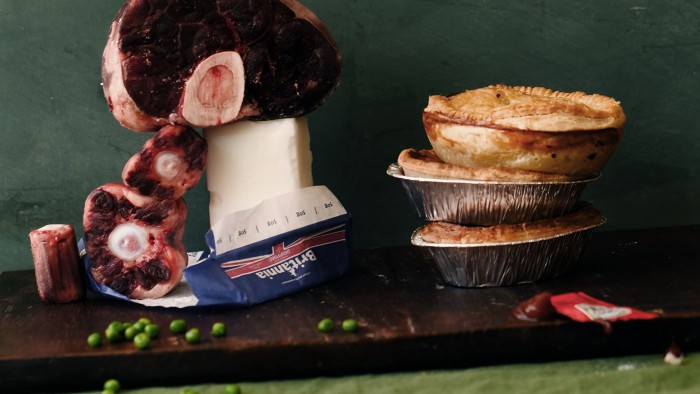
Dad loved pies and Mum disapproved. He used to keep a Fray Bentos tinned pie in the back of the larder, hidden behind the pasta and dried beans. Mum would find it regularly and ask to throw it out but Dad said it was there “just in case”. Pies loom huge not only in my heritage, but in Britain’s. When the mayor of some town caused a Great Pie to be made and distributed among the poor, when some Royal kitchen constructed a monster for a state occasion, it was felt a significant enough event to record. Myths about blackbirds and frogs in pies. Tortured folk etymologies about offal being called “umbles” and poor folk “eating humble pie”. In most of these constructions, the crust was never intended for consumption, unless it was thrown to the servants. It was a pastry pot for the ragout it contained.
But at some point, possibly as the industrial revolution drew the poor to cities, a new pie emerged: the mass-produced hand pie. Cheap, but with delicious fillings made of the cuts the wealthy did not want. Crucially, these pies needed crusts strong enough that they could be centrally baked, kept warm for hours, then taken out and sold to hungry workers, who could eat them without having to pay to sit down or use cutlery. The English hand pie is the first mass-produced ready meal, the first street food. So why does nobody celebrate it? Our books are full of recipes for hearty steak and ale pies to feed dinner parties, but the lonely, lovely, workingman’s pie is nowhere to be found. It should be as important to us as a nation as poule au pot is to the French, or pasta to the Italians.
I grew up in Bristol where the Clark’s Pie reigned supreme. Bristol gave us suspension bridges, transatlantic paddle steamers, Rolls-Royces and Concordes, but the pinnacle of the great city’s engineering was undoubtedly this tough little oval miracle — a meat pie that required no tin. Imagine. Pastry so strong it could be shaped, filled with boiling meat slurry, baked, distributed and eaten in a factory or football stadium without collapse or leakage.
A pie press would have cost a lot, but the companies that made them would offer excellent terms to entrepreneurs. The presses were supplied on generous credit terms — a bit like your local craft coffee shop gets its machine from the roasting company — and could be set up in a shed or basement. The dough could be had in bulk from local bakers, the filling from butchers. If you were really smart, you set up near the football ground and all week you’d build up stock to sell to the match crowd at the weekend.
And it brought into being not just a foodstuff but a unique state of matter previously unknown to physics: pie-bottom. During cooking, storage and reheating, pastry cooks and melds with gravy to create a flexible, resilient solid. Semi-translucent, bulging. Thrillingly apt to burst, sending scorching waves of boiling filling coursing over your chin and shirt.
I went full-on Proust and drove back to Bristol. The pies are still being made in a shopfront near the Bristol City ground. I bought a dozen in a cardboard tray, just like all the local chippies and pie shops get them.
The experience was not as I’d dreamt. Time and nostalgia may have enriched the memory of their dark, satanic filling, or, more likely, they have removed the lard, salt, offal and unidentifiable carcass trimmings from the recipe. But the crust was still there.
By now I was hopelessly hooked, obsessed with making the perfect hand pie of my own. And then, in the basement of our bakery, I found The Pie Press. Apparently, it had been there for half a century, neglected, as public tastes turned to fancy cakes.
It took eight hours with easing oil, a blowlamp and eventually a lump hammer, to get the parts moving, but there it was. A 100-year-old, John Hunt “Little Champion” pie press, with a great brass handle that you can swing down on.
The process was simple. Place a tinfoil tray into the mould on the machine’s base. Drop in four imperial ounces of dough and haul on the handle, forcing a shaped ram into the dough which rises perfectly up the sides. You spoon in the cold filling, then lay a piece of rolled dough over the top. A lever swaps the ram and the second time you pull on the lever, the lid is sealed, crimped and trimmed.
It’s the simplest piece of mechanisation and you can’t use it without feeling, up your arm and into the muscles of your back, the significance of the pie. But it’s designed to be used for huge batches. It takes two people to lift it and half an hour to clean down every time. I needed something simpler, so I chucked the project over to my daughter, a trainee engineer. Within a couple of hours she’d measured the standard pie foil and 3D-printed a “support block” to cradle it, enabling me to push dough manually into the foil without deformation. A much more 21st-century solution. (You can find a link to download the print file on my website here.) You could also use a small, light pie tin. Ceramic won’t do the job.
The Crust
To be superb, a pie must have a meltingly flaky top and a bottom substantial enough to avoid burns. How is a mortal supposed to achieve it?
I tried combinations. Hot-water pastry, flaky, suet and short bases, a commercial puff-pastry top and hand-laminated pastries of almost croissant lightness. But eventually the solution was as follows.
I buy beef dripping by the 500g block from my butcher, but they have it at decent supermarkets. Using the roughest side of a box grater, shower the stuff in a thin layer on to baking trays and place in the freezer. After an hour, you’ll have fat gravel that looks good to ski on. I freeze this in a Ziploc bag so I can measure out any quantity.
For four pies, weigh out 325g plain flour and add 125g of frozen dripping crumbs, stirring as you go with a silicon spatula. Quickly add one beaten egg, 100g of ice-cold sparkling water and continue to ply until everything just about holds together. Wrap in clingfilm and refrigerate. The dough doesn’t need to look smooth or homogenous. All that matters is distributing tiny pieces of dripping evenly through the mix without melting them.
When you’re ready to build your pies, bring out the cold dough and quickly roll it out. Fold the rolled dough in three, like a letter going into an envelope, then roll it out and “letter fold” for a second time. Roll out this “rough puff” to a 3-4mm thickness, immediately cut out your lids and put them back in the fridge.
Now here’s the bit for which the Pulitzer committee will create a Lifetime Achievement in Pie Journalism award. Collect the trimmings and remaining dough together and give it at least two further roll-and-fold cycles.
Your instincts as a baker will tell you that minimising handling and over-rolling of puff pastry keeps it light. Absolutely right. Overhandling or, God forbid, mashing the life out of it in an industrial press, will make it tougher and more elastic. Which is precisely what we need in order to achieve peak pie bottom. Ignore your refined instincts. Punish your bottom.
After that, use it to line your pie tins or foils. Because the filling is cold, you can drape the pastry into the tin quite loosely and use the filling to push it into position. Glue on your lids on with beaten egg. Crimp, however the pie muse moves you, and use the rest of the egg to glaze.
The Filling
I got back on the road and headed north, where they still claim the pie as their own. In Liverpool, I tried a Shankly, in a round tinfoil tray from Homebaked, a pie shop right by the entrance to the Anfield stadium. A conventional bakery for more than a century, it’s now a co-operative run by locals. The pastry was good, but the filling was brilliant. Juicy, loose-textured lumps of stewing steak, with gravy you could use to paint dockyard cranes, or at least sustain you through injury time.
I will not vie with Bill Shankly, either as a pie connoisseur or football manager, but my filling is usually beef cheek or rib. Cut into small pieces, browned and then long braised with a few aromatic veg, some booze and some stock. A pressure cooker is brilliant for this if you have one. With beef fillings, I also usually include some collagen-rich oxtail to ensure the gravy sets well for the ultimate “cold pie” experience.
A rough recipe would go something like this:
Brown the meat, chop and sweat the veg. Deglaze the pan with the alcohol, add the stock and low simmer until long after everything has fallen off the bone. Remove any bones. (You could also use the beef mince recipe from the article I wrote last month.)
The important things are these. The filling should be precooked. It should be allowed to cool, chill, set and mature a little before you assemble. Once you know this, you can go off-piste. Lamb shoulder braised with subtle north African or south Asian spicing. Slow-roast pork. All sorts of game. You basically need a stew of the kind that gets better the second day and is perfect by the third.
Once you’ve cooked it and you’re happy that the flavours and seasoning are at their peak, remove most of the spare liquid and keep it to pour over the pie when you serve. Gravy is delicious, but too much liquid is enemy to pie engineering.
The pie should be baked at about 180C for 25 minutes, then cooled and refrigerated overnight. Before baking, I use the lid of a kitchen marker to cut a breathing hole in the pie crust. That’s big enough that, when I pull it out of the oven, I can funnel hot gravy back into the pie for service, without compromising structural integrity. (But that’s only if you’re serving on a plate. Hot gravy in a hand pie is a shortcut to A&E.)
Serving
Reheat the pie very slowly. The Australians delight in serving pies in a pool of peas. They call it a pie floater and I have never, in decades of research, found a better alternative.
Dice the onion and/or leek finely and clarify it in a little butter. Once it softens, add the vermouth, which will further hasten the process and add aromatic notes.
Pour in the peas and add the stock. Drop everything to a simmer and keep going until the peas are almost completely cooked. While that’s going on, roughly chop the lettuce, then stir it through the hot, cooked peas, allowing it to wilt.
Spoon the peas into a pool on a plate, take your perfect pie from the low oven (you can hold it there for ages) and plonk it centrally in the pea moat. Serve with gravy and no further instruction.
In 2003, the pie floater was officially recognised as a South Australian heritage icon, while we still have established no way, at all, of officially honouring our national food culture. When Dad died, I inherited the pie. I keep it in the back of the larder behind the obscure dried seaweed and the fashionable tinned fish. Y’know, just in case.
Find out about our latest stories first — follow FT Weekend Magazine on X and FT Weekend on Instagram
Read the full article here