

Unlock the Editor’s Digest for free
Roula Khalaf, Editor of the FT, selects her favourite stories in this weekly newsletter.
“Last few remaining” at Covent Garden next Saturday (and the following Thursday) when Roberto Bolle is scheduled to dance John Cranko’s Onegin with the Royal Ballet. This will surely be London’s last chance to see the 50-year-old La Scala star in a role he has been dancing since 2001. But last weekend the focus was on a clutch of thrilling debut performances.
Injury prevented Vadim Muntagirov dancing Onegin back in 2020, but Saturday’s matinee finally showed what this fine artist would make of the role. The solos, at times almost a parody of the self-consciously elegant danse d’école, might have been tailor-made for his pure classical technique, his working leg describing a perfect circle on the floor as he spins. Cranko’s pairwork, with its constant overhead lifts and rapid changes of direction, holds no terrors for Muntagirov. His acting was every bit as strong: the world-weary sophisticate of the first act; the murderous duellist of the second; and the lost soul of the closing scenes, forever haunted by what might have been.
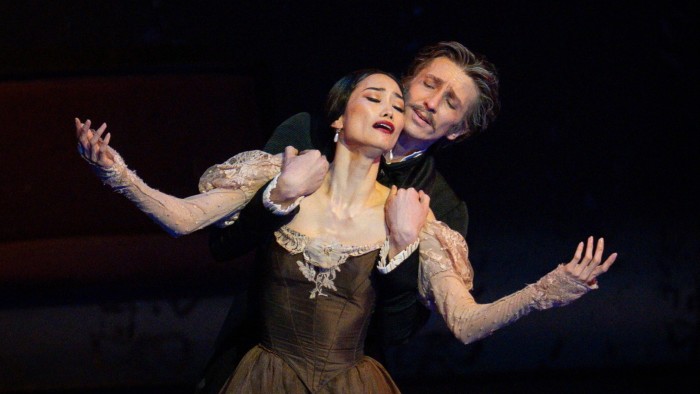
Fumi Kaneko was an equally impressive Tatiana. When the bookish teenager first meets the handsome stranger we see her blossom under his touch, the easy, skyward sweep of her extensions expressing the thrill of first love. The final moments in which the grown-up Tatiana suppresses her rekindled infatuation were superbly played, her body registering every panicky change of heart.
Sister Olga was danced by Ella Newton Severgnini, who unravelled her act one pirouettes with playful ease and brought an almost childlike petulance to the fatal ballroom quarrel between Onegin and her fiancé. Marco Masciari’s blond beauty and unforced grace make him a natural Lensky. His luscious line, sharp feet, neat landings and impressive elevation have always made him stand out in the ensembles, but once in the spotlight all these gifts are at the service of the character. He is also an excellent player off the ball, vividly alert to everyone on stage. The killer solo in which Lensky mourns the life he may never lead — all yearning arabesques and desperate falls to earth — mirrored Tchaikovsky’s Variation Triste (viola feelingly played by Lourenço Macedo Sampaio) with instinctive musicality.
Thirty-six hours earlier the house had been on its feet to salute Natalia Osipova’s shattering, richly detailed rendition of Pushkin’s heroine. Her Onegin was Norwegian first soloist Lukas Bjorneboe Brændsrød. Blessed with princely looks and manners and an enviably long line, he is also a strong and attentive partner, able to raise his ballerina aloft with barely a plié and manoeuvring her with heart-stopping legerdemain.
Tatiana’s feelings are vividly etched: preoccupied with her book to the point of rudeness, surrendering to her dream lover’s embrace with reckless intensity. In the exquisite act three duet with her adoring husband (a strong debut by Nicol Edmonds), Osipova shows us a mature woman enjoying her happy ending but, moments later, she is back in her teenage bedroom. At first clogged by Onegin’s anguished embrace, she eventually joins him in a bitter remix of those soaring lifts and swirls before she conquers her reawakened passion by a desperate effort of will, realising that the man of her dreams has become the stuff of nightmares.
★★★★★
To June 12, rbo.org.uk
Read the full article here