
Meet the Cordia Collective: ‘It’s dahlias, tulips and amazing colour, but everything’s edible’

It is a flash heatwave at the end of April and we are standing at the entrance to Borde Hill Gardens in the baking sun. “There are 13 different microclimates inside,” explains Jay Goddard, the new chatelaine of the 2,300-acre Sussex estate. “My great-great-grandfather bought the estate in 1893 because he was passionate about plants. He sponsored the great plant hunters in the early 1900s, and followed a ‘right plant, right place’ ethos, putting the plants in a mini-Andes and a mini-Himalayas. That’s why we’ve got such a special collection.”
With us is Goddard’s new collaborator. She is not someone who will be travelling continents in search of exotic species; quite the opposite. Chef Chantelle Nicholson is known for her localism and focus on waste, and four months ago she upped sticks from her Mayfair restaurant Apricity to execute a project that she and Goddard, along with garden designer Ann-Marie Powell, hope will steward the Borde Hill estate into the next generation. Named the Cordia Collective, these three women intend to set the template for a fully circular, zero waste, “edimental” (edible and ornamental) garden and food project.
The estate history stretches back to 1543; the house was built in 1598 by Stephen Borde, whose grandfather, Andrew Borde, was physician to King Henry VIII. He wrote the first ever book on medicinal plants in 1542, which is still in the house, and is the foundation of “garden as apothecary”. But rather than allow the estate to be seen as a museum, the trio of women want it to become a world-leading, fully circular, food-plant-entertainment complex: a walled kitchen garden and market garden, restaurant, wine bar, bakery and two cafés.
Nicholson is key to the vision: the first female chef to win a Michelin Green Star at her restaurant Treadwells, then again for Apricity, her circular approach uses foraged, seasonal, local food. She grew up picking fruit on her uncle’s farm in New Zealand, so is delighted to be returning to a life of natural wonder. Only yesterday she rose to bake for a group of early morning birdwatchers, to the tune of a rousing dawn chorus. “Makes a difference from the Barbican and the Lizzy line,” she grins.
The future they are building is based on the observation that experience, hospitality and sustainability are the zones of interest for today’s audiences. While other estates might be doing this at a high end (Raymond Blanc’s Le Manoir in Oxfordshire, the manicured idealisation of The Newt in Somerset), the Cordia Collective vision is more inclusive — Nicholson wants local schools involved. “I do not understand how the most important thing you can do as a person is not taught at school,” she says. “Where food comes from and how it’s cooked should be the first thing you learn.”
While the new buildings are under construction, an existing bakery is functioning as a test kitchen. We are at the tail-end of magnolia season, and the gingery flavour of the petals have already inspired a magnolia and cinnamon “curlicue” pastry. “There’s so much we can eat that has amazing flavour we don’t even know about,” says Nicholson. “That’s how Ann-Marie Powell is redesigning the kitchen garden. It won’t look like a traditional veg garden — it will be dahlias, tulips and amazing colour, but everything’s edible.”
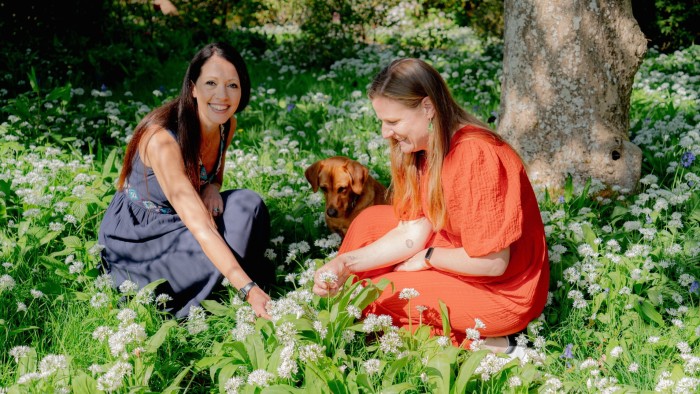
By now we’re walking through a garden of roses, which inspires a vista of syrups for the Cordia pantry. But it’s the mounds of wild garlic that are getting Nicholson excited; inside the bakery, Nicholson’s first recruit, Janine Edwards from London’s Toklas bakery, is mixing it into cheddar scones that crumble, deliciously warm, in the mouth.
Nicholson’s arrival has been something of a culture shock for the locals. The first thing to go were the takeaway coffee cups, replaced by ones that could be recycled. Next out were the packaged sandwiches, which are now freshly baked to order. “I want a wormery so kids can see, ‘Look, a worm can eat orange peel and banana skin, but it can’t eat a plastic sandwich tray’.” Leftover milk was being tipped down the sink, now it’s made into ricotta for an asparagus and milk focaccia, while the whey is used in the scones. The coffee grounds? Mixed into compost, while the eggshells are ground up for fertiliser.
Then came the reckoning for the laundry. Nicholson found someone putting aprons in the dryer. “Why would you use the dryer? We have sun! It’s efficiency from a business perspective and a resource perspective. Take just what you need. That’s the mentality.”
We enter the bakery kitchen to inspect the thyme custard and roast rhubarb tartlets, and find Edwards trimming an apple and ginger cake; she is saving the crumbs to dry for the children’s Gingerbread Gardener biscuits.
The walled kitchen garden is the nucleus of the project. Nicholson’s uncle grew Cordia cherry trees in his orchards, while “Cherry” Ingram, the wealthy Englishman who rescued many of Japan’s blossoms, donated various rare varieties to Borde Hill. A Cordia tree has just been planted by the wall facing the gate, its branches pinned out across the Victorian brick. Inside, buildings are being hollowed out for the restaurant that will open in February, with a huge glass box extension, inside which Nicholson will grow ginger and citrus.
Kitchen gardener Julia Burton is planting out Powell’s designs in a biodynamic cosmos of air, water, fire and earth. “We have daylilies, which are delicious,” Burton says, “snapdragons, which taste like chicory, and Sanguisorba, which look like raspberries on sticks — you can eat the young leaves and the flowers. [We have] dahlias, which were brought over from Mexico before we got potatoes because you can eat the tubers, and Jerusalem artichokes, which have the most fantastic high sun flowers. Such a beautiful coincidence of food and flower.”
“We’ve got valerian, too,” breaks in Nicholson, “so we can make seasonal infusions with fig leaves and nettles.” Then Burton and Nicholson are off into infrastructure talks, working out “what we can bokashi [compost], as food waste will create the compost to go full circle. It’s an ecosystem approach, closing the loop. How we incorporate circularity into the design.
“As someone who’s only worked in hospitality, it’s such a different approach in a garden,” says Nicholson. “The people have such a different energy. To be able to learn from each other and talk about Sichuan pepper trees!”
Goddard looks on approvingly: “We’re focused on making food and nature more accessible because it’s so important for the future. We are stewards of this amazing landscape, but we’ve got responsibility to make sure it’s still here in another 130 years.”
bordehill.co.uk
Find out about our latest stories first — follow @ft_houseandhome on Instagram
Read the full article here