

Stay informed with free updates
Simply sign up to the Film myFT Digest — delivered directly to your inbox.
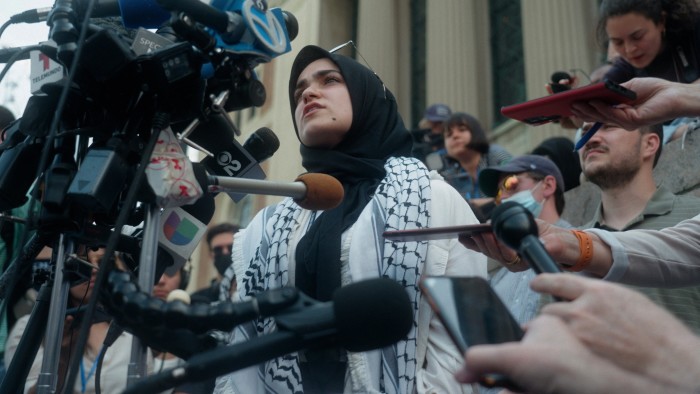
The Encampments feels unsafe. It is the story of a lightning rod, and likely to be one itself. A documentary about the 2024 pro-Palestine student protests that began at New York’s Columbia University before spreading worldwide, it is an inside job. Co-directors Kei Pritsker and Michael T Workman filmed while embedded with the Columbia students. Pritsker is an alum of the activist organisation Students for Justice for Palestine (SJP), which helped organise the protests.
And yet it is also a record, however partial, of an urgent political moment — and shifting ground in the US. Featured on camera is Mahmoud Khalil, the protest leader detained in March by US Immigration and Customs Enforcement, threatened with a deportation whose legality is still being debated.
True too is the fact many acclaimed documentaries are now better called activism. And show me the film about Israel and Palestine that could be “impartial” to everyone’s satisfaction. The Encampments is at least open about being made to rebut the likes of US Senator Tom Cotton, seen calling the protests “disgusting cesspools” of “pro-Hamas sympathisers, fanatics and freaks”.
Khalil appears measured, smiling, unfreakish. The students’ basic demand, he and others stress, was always that Columbia financially divest from Israel. The viewer may disagree, but this is not in itself the stuff of terrorism.
The film unfolds from the students’ perspective — in every sense. Cameras capture on-the-ground chants while Columbia authorities attempt what is painted as a clampdown. Here at least, the people at risk are the protesters. We see ugly counter-actions in New York, apparent police violence at UCLA.
In keeping with the sense of a corrective, reports of antisemitism among students are raised, so they can be denied. Scenes of an active Jewish presence, up to and including a rabbi, can feel self-conscious. Speaking for itself, though, is the role of student spokesperson Grant Miner, a Jewish member of the Columbia encampment.
Time, though, hamstrings the film. The story has spun on wildly since last year, when the film ends. Miner and others have now been expelled from Columbia after the Trump administration pulled $400mn in federal funding from the university, citing campus antisemitism. Khalil remains in legal limbo.
But if the film is already a relic, it also embraces its place in a context. A line is traced with archive footage back to strikingly similar Columbia protests against the Vietnam war. Those were reviled by politicians too. Now, the film asks, who is on which side of history?
The film’s real time problem is less being stranded in the past, than 80 snapshot minutes leaving no room to explore everything it raises. Another documentary must surely return to the future of American protest and Ivy League universities; the ethics of financial divestment; and, of course, the horror of Gaza. Then again, in a US where no distributor would touch the Oscar-winning documentary No Other Land, who would release it? And so, for now, there is The Encampments, an imperfect film that is still part of a history in progress and, as such, one you should see.
★★★☆☆
In UK cinemas from June 4
Read the full article here