

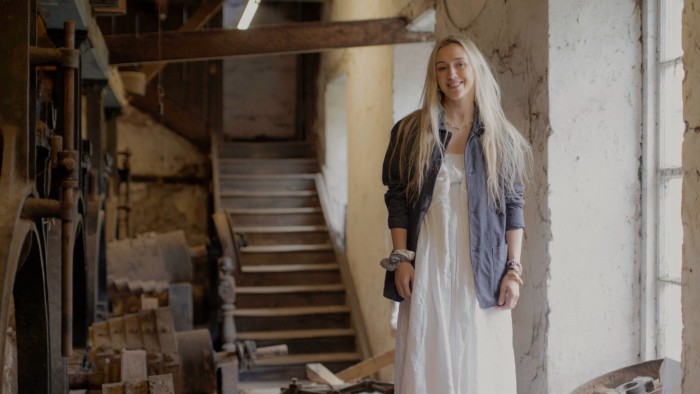
As you cross the stone footbridge into the Northern Ireland village of Upperlands, there is a peculiar and insistent swooshing noise that has been the aural backdrop to the village for the past 150 years. Close to the 18th-century stone mill tucked below, it gets louder. Inside, it’s deafening.
Huge beetle engines of cast iron and wood rotate rolls of wet, starch-impregnated cloth as 40 giant wooden hammers — the beetles — pound down in a seemingly random pattern, like the inside of an enormous piano, dangling down from a large “wiper” beam 10ft above.
William Smyth dances deftly between the machines, tugging at 10ft rolls of linen to ease creases and ensure no marks are left. He calculates times in his head to judge when each roll has to come off to be hung to dry, before being turned and put back through the machines. The whole, labour-intensive cycle takes about 20 days — a time determined by Smyth’s judgment rather than a mathematical formula.
Beetling is a process that has been used in the Irish linen industry for centuries to toughen the fabric, adding sheen. In the 18th century, workers would wear beetled linen coats in the fields, but more commonly it was used as invisible seam lining for tailors. Traditionally, beetling was done “manually by women in the home using a mallet”, says James Frazer, from the Irish Linen Centre, but in the 1720s, the process became mechanised.
“There would have been many [beetling mills] dotted down the river here,” Smyth says, leaning over the bridge outside and pointing downstream.
Smyth is the last remaining beetler in Ireland, and in fact the world. The William Clark & Sons mill in Upperlands, where he works, was founded in 1736 and is the oldest surviving linen mill in Ireland, and the only mill with a beetling machine. Smyth himself is nearly 60 and, as he says, “I’m not getting any younger”. As a consequence the charity Heritage Crafts placed beetling on its “critically endangered” list in May. “We have already lost other elements of that process, so it’s vital that we reverse the decline of these skills that encapsulate generations of accumulated knowledge,” Daniel Carpenter, executive director of Heritage Crafts, says.
Smyth, who has lived in the village for 40 years (“a newcomer,” as general manager Kevin Devlin jokes), started his career in the dye house in 1985, before taking over from “wee Sammy” (Sam Anderson) as the mill’s beetler five years ago. “He was about to retire, and someone had to pick it up,” Smyth says.
The company is currently searching for an apprentice, “but it’s a hard job to attract the younger generation into,” Devlin says. “It’s not very sexy. Willie starts at 6am and works all day; it’s very manual work.” Plus, it’s lonely. The rest of the mill’s production happens in a new, modernised site about a 10 minutes’ drive away, but the 150-year-old beetling machines cannot be physically moved from the stone building. So they, and Smyth, have to stay put. “I don’t talk to anyone all day,” Smyth says.
The Irish linen industry was once a major source of income for the nation, playing a crucial role in the growth of cities such as Belfast and villages like Upperlands, which was built by the mill’s first 18th-century owner to house workers. Today, the industry “has been really challenged by cheaper foreign alternatives,” Devlin says. The number of mills in operation is dwindling and those that still exist hang by a thread — including William Clark & Sons, which in December 2024 suddenly went into administration — a shock to employees and customers.
But faced with its extinction, saviours have emerged. Andrew Wilson, owner and director of Wilson Agri, produces cow mattresses, padded beds for cows that are designed to mimic the feeling of being in the pasture, and improve cows’ wellbeing. William Clark & Sons had previously provided a bespoke service to Wilson Agri to coat the mattresses with a special latex layer. When the mill went bust, the Wilson brothers decided to buy it.
While they only needed this one element of the mill’s production, Devlin persuaded the brothers to keep linen, including beetling production, too. “We only needed the Mars bar, but we bought the whole sweet shop,” Wilson laughs. He has since become as passionate as Devlin about the need to save beetling. “This is about saving something very special from our history, and preserving it for the future,” he says.
There would be no future, however without reinvention, which is where young designers such as Amy Anderson come in. Anderson grew up listening to stories of her grandparents working at Moygashel Linen Mills, and became fascinated with the Irish linen industry. So when she founded her own clothing label, Kindred of Ireland, in 2020, she decided to exclusively use Irish linen, all sourced from family-owned mills across Northern Ireland, and hand sewn by local seamstresses.
That same year, former Alexander McQueen artistic director Sarah Burton visited William Clark & Sons to understand the beetling process, and persuaded them to beetle finished garments for the brand’s spring/summer 2020 show.
One of the final pieces was a puff sleeve ivory linen dress, shimmering with the lustred beetled fabric. “It was so inspiring to see this nearly forgotten craft being highlighted in such a beautiful and elevated way,” Anderson says.
She started investigating what she, too, could do with beetled linen. The material makes up about 30 per cent of her collection, from a metallic dress that the presenter Edith Bowman wore to this year’s Baftas (£895, now sold out, kindredofireland.com) to a black shirt (£295, kindredofireland.com), a two-piece suit (£765, kindredofireland.com) and a range of bridal looks, including a voluminous strapless dress with a giant bow on the back (£1,555, kindredofireland.com). Anderson says there’s potential for outerwear — harking back to the workers in fields — that “could be a leather alternative”.
Carpenter, from Heritage Crafts, says that Anderson is part of a new generation of makers who “are now attempting to recover [old processes] in the realisation that locally produced textile fibres are likely to form a major part of the solution to the growing environmental and humanitarian catastrophe of fast fashion”.
That rings true for Anderson. “Kindred is inspired by the way things were done in my granny Winnie’s day,” she says. “Clothes back then were made to last — looked after, repaired, and handed down through the family. People used materials that were available locally, and everything was made with real care and skill.”
The beetling production at the mill is booked until Christmas, and Devlin says they could take more orders if some of the antiquated machines were fixed (only three of the 14 they have are operating. And if they get an apprentice.
There’s a photo on the wall of the visitor centre opposite the mill taken of the Clarks workers on their annual family day out to Portrush c1900, with scores of workers, dressed nattily in tweed suits (even the children).
“These mills have been the heartbeat of the villages and families around here for generations, and it’s really sad to see them disappear one at a time,” Devlin says, gazing at it. He — along with Anderson and Wilson, an unlikely but passionate trio — are doing their best to make sure that this mill survives.
Follow us on Instagram and sign up for Fashion Matters, your weekly newsletter about the fashion industry
Read the full article here