
The Beirut blast tore through an Artemisia Gentileschi masterpiece — now it’s back from the ruins

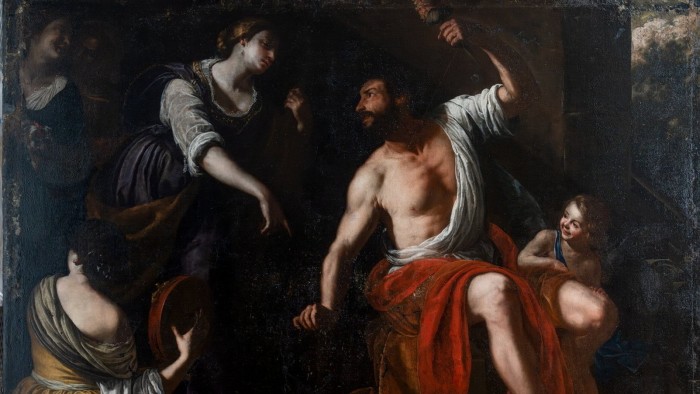
“Everyone who’s come to visit the painting has had the same reaction.” Ulrich Birkmaier, senior conservator at the Getty Museum in Los Angeles, is standing before a monumental, shadowy canvas. “This is 100 per cent an Artemisia.”
For three years, the picture — a depiction of the myth of Hercules and Omphale — has been undergoing intensive restoration in the museum’s conservation department. Now firmly attributed to the baroque master Artemisia Gentileschi, it is about to go on public display for the first time.
The exhibition Artemisia’s Strong Women: Rescuing a Masterpiece — in which the painting will appear alongside other works by Artemisia of classical and biblical scenes — marks the latest chapter in the resurrection of an artist who, a few decades ago, was little remembered beyond academic art history. In her lifetime, Artemisia achieved renown in the face of violence and prejudice — notoriously, she was raped by her tutor at the age of 17. But in the centuries following her death in 1653, her name faded from view.
“Hercules and Omphale” carries its own violent back-story. For a century, the painting hung in a private residence in Beirut — without an attribution. Then, in 2020, a double explosion ripped through the city’s port when a hoard of confiscated ammonium nitrate ignited in a fire. The blast killed 218 people and the damage to the surrounding city was catastrophic.
The Sursock Palace, home of one of Lebanon’s most eminent families, stands less than a kilometre from the port. Every window in the Venetian-style mansion was blown out. The 98-year-old owner, Lady Yvonne Cochrane Sursock, escaped with minor lacerations but died a month later.
“I think if she had realised the extent of damage to her house, she would have died of grief”, says her son Roderick. “Hercules and Omphale” was riddled with shards of glass and plaster. A foot-long piece of window frame was lodged in the painting’s centre.
Five years on, the severity of the damage becomes clear when Birkmaier shows photographs of the gashed canvas, along with an X-ray detailing losses to the paintwork. A jar contains penknife-sized shards of glass that he extracted. “The level of damage is similar to what I’ve seen elsewhere,” he says. “But the circumstances here were dramatic” — like those of a war zone.
The picture depicts Hercules, the great labouring hero, after his enslavement at the hands of Omphale, queen of Lydia. In a reversal of gender roles, the muscular hero wields a spindle while his seducer gazes down at him. The work dates from the mid-1630s, when Artemisia was in her early forties and living in Naples.
According to Davide Gasparotto, the Getty’s senior curator of paintings, the picture signifies a “high moment in Artemisia’s career”. She was often collaborating with other artists at this time, but “Hercules and Omphale” is solely her own. Its size — 200 by 250cm — reflects her growing ambition. “In Naples, she was making paintings larger than anything she’d done before,” says Gasparotto. “The picture is almost unique in its portrayal of a monumental, semi-naked male figure. Usually she painted females.”
But for the explosion, the painting might never have come to light. Credit for its attribution belongs to a Lebanese art historian and artist, Gregory Buchakjian, and yet his discovery went unnoticed for 30 years. In 1993, as a masters student, he was studying collections of European paintings in Beirut. Suspecting that the Sursock Palace contained works of note, he approached the family. “This is how I opened Pandora’s box,” he says.
The palace was built in 1860 — “a European palazzo in Beirut”, as Buchakjian describes it. The landowning Sursocks were Lebanon’s equivalent to the Gettys or Rockefellers, and by the mid-20th century their residence had evolved into a trove of art and antiques. The 1920 marriage of Alfred Bey Sursock to an Italian aristocrat, Donna Maria Teresa Serra, led to numerous art-buying trips to Naples.
“Hercules and Omphale” immediately drew Buchakjian’s attention, along with a portrait of the penitent Magdalene — both would prove to be by Artemisia. But initially he had no inkling as to their authorship. “We didn’t have Google image search, but I did have access to the image library of the Louvre.” Gradually, he reviewed the Louvre’s collection of baroque paintings made in Naples and built a “visual genealogy”. One detail in particular convinced him: a cameo brooch worn by Omphale, showing the nude Hermes. This appears in two other works by Artemisia.
“Lady Cochrane was happy that I was working on her collection, but I don’t think she took me very seriously, this 20-year-old kid,” says Buchakjian. It wasn’t until 2020, soon after the explosion, that he found himself back at the palace with friends who were assessing the damage. “When I saw the devastation, I understood that there was an emergency. I was the only person with the suspicion that these paintings were by Artemisia.”
He wrote an article about his findings for Apollo magazine. “It opened up a new chapter in the painting’s history — I received mail from all the major Artemisia scholars.” Suddenly, the picture was gaining worldwide recognition. The next summer, Gasparotto proposed including the work in the Getty’s restoration programme.
The painting arrived in Los Angeles concealed by tissue paper. The first section that Birkmaier uncovered was the knee of Hercules, disfigured by a long gash. “I saw that knee and immediately I said, ‘Oh God, this is of extraordinary quality’.”
The process of repair was painstaking. Fragments of glass and plaster had to be removed, along with the degraded lining. The application of a new lining — with the assistance of a specialist restorer from Italy, Matteo Rossi Doria — allowed the tears to be sealed. The remaining holes were filled by canvas inserts with moulded silicon “grafts” that match the original surface texture.
Meanwhile, Gasparotto went to work on the painting’s provenance. He came across the original receipt of sale, confirming that the Sursocks had acquired it from a dealer in Naples in the 1920s. A far older document located the picture in the possession of a Neapolitan family with whom Artemisia had been connected.
Artemisia tackled the theme of Hercules and Omphale twice (a version from 1628 is lost). Her work returned continually to the interlacing of power and desire. The painting is a testament to her own powers in the final decades of her life — a period that historians have often downplayed. “You have to look at what Artemisia was trying to achieve at this time,” Gasparotto says. “The 1630s were an incredibly dynamic moment. She was branding herself in a shrewd and ambitious way.”
June 10-September 14, getty.edu
Read the full article here