

Unlock the Editor’s Digest for free
Roula Khalaf, Editor of the FT, selects her favourite stories in this weekly newsletter.
In May 2015, the morning after David Cameron’s Conservative government won a majority, I was at Luton airport before dawn. I had barely slept but I was on my way to the Venice Biennale, the art world’s biannual canal-adjacent blowout. My flight was full of people like me. We called ourselves the EasyJet set: red-eyed, lowly art-world operatives en route to the main event by the cheapest means possible. We travelled to art fairs and biennials — ahead of our employers and before the collectors — to feather the nest. We were the gallery assistants and technicians; we were there to make sure everything was ready for when the money touched down. The art world is a service industry, after all.
Despite the fact that last year alone the art market recorded an estimated $57.5bn in sales, it remains hierarchical — and there are very few advantages to working in its nether regions. One perk, however, can be the lavish dinners and parties thrown for seemingly the slightest of occasions. A couple of nights after we’d arrived in Venice, on the opening night of the biennale, a colleague was a last-minute stand-in for a no-show at a dinner on a collector’s yacht. (People drop out of these dinners with astonishing ease and lower-rung personnel are often drafted in to prevent empty seat syndrome.) At the dinner, which was held not to celebrate an artist but rather the benevolent munificence of the collector, my colleague was seated next to a surgically glorified woman of indeterminate age. She turned and asked, “Tell me, did you fly here commercial?”
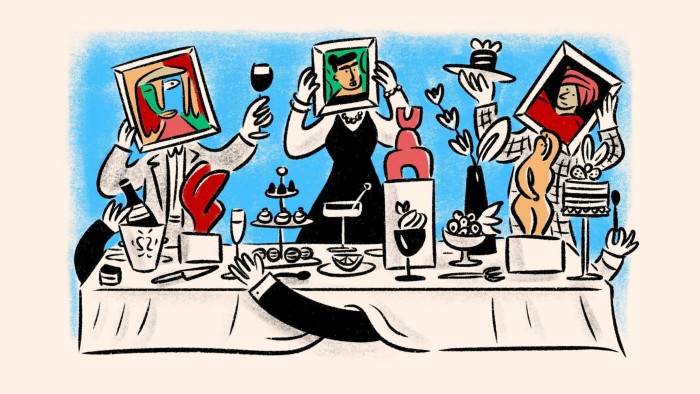
The art world is a microcosm of our stratified society, its different levels separated by one-way mirrors. You can see up, but they can’t see down. A gallery dinner, however, is one of the few places where all its layers occasionally commingle, from lowly techs all the way up to billionaire collectors. The guest lists for these dinners, which customarily happen after exhibition openings, are fraught with difficulty; who’s in and who’s out is of paramount importance, so it’s advisable not to ask who’s coming lest you embarrass your host.
If you are fortunate enough to have been invited, remember that there’s no such thing as a free meal. You’re there for a reason, whether as a seat warmer or a buyer, or something in between. But even for habitués of these dinners, their true purpose might seem difficult to parse. Principally these events are meant to celebrate the artist, but the reality is that the art world has come to rely on its social calendar. That’s why you moor your megayacht on Hydra in the summer (for the Deste Foundation’s latest show) and travel to Miami in December (for Art Basel Miami Beach). The more integral these events become to collectors’ social lives, the less likely they are to stop buying. A collector who doesn’t buy doesn’t get invited.
While rival dealers are seldom on the list (you don’t want to encourage poaching), regular guests include curators, writers, friends and the family of the artist. If you find yourself sitting next to the artist, you should compliment the work as generally as possible. Never ask what the work is “about” and never compare the work to that of another artist. The artist always thinks it’s about them — they’ve been secluded in a studio for years making the show you’ve just seen only to emerge, blinking, into a bright and shining world. And you should know when to shut up. A friend told me that he was once invited to a dinner at which he asked the man opposite if he was an arms dealer. My friend’s guess was, unfortunately, right on the money; he was not invited again.
That said, guests can behave appallingly. One art critic, a seasoned attender of such events, told me of the time she was seated next to a gallerist who began their conversation by lasciviously complimenting her on her teeth. When the food finally arrived at 10pm (these dinners always start late; fuel up beforehand) the man grabbed her plate, cut up her food and attempted to feed it to her.
While some guests’ behaviour might beggar belief, the food served at these dinners is often modish to the point of farce. When I was a dealer, white asparagus (a Basel speciality) was having a moment. Later on, sharing plates were in. These days, in London, you’re more likely to be served heritage-breed meat and heirloom vegetables from an aristocratic estate.
If people-watching is your thing then gallery dinners are heaven. There’s a story I’ve been told several times of a dinner at London’s Balthazar several years ago, at which assembled guests fell silent as Larry Gagosian — by pretty much any estimation the presiding silverback of the art market — visibly choked on his food. Within seconds, another diner had pulled Gagosian to his feet and was performing the Heimlich manoeuvre. The crowd watched on in horror for what seemed like an age. Gagosian is a market all of his own; his sudden demise would have sent a quake through the art world. For those in attendance that night though, it’s just another absurd art-world tale.
When it’s time for dessert you might be forgiven for wondering where everybody went. The moment main courses are cleared, many gallery dinners experience a mass exodus, as if someone had announced a Loro Piana sample sale round the corner. When I was starting out in the art world I remember listening aghast and hungry to a fellow junior as she told me about returning from the bathrooms at Le Caprice to find the restaurant had emptied by more than half. Restaurant staff were in the process of serving Le Caprice’s signature dessert: frozen berries with a hot white chocolate sauce. With her fellow assistants, my friend ate bowl after bowl until she felt sick.
A decade ago, before I had gone to one of these evenings, I wouldn’t have dreamt of skipping a free dessert. Now that I have been to more “free” dinners than I can count, I understand the cost. One can become very tired of generosity.
Find out about our latest stories first — follow FT Weekend on Instagram, Bluesky and X, and sign up to receive the FT Weekend newsletter every Saturday morning
Read the full article here