

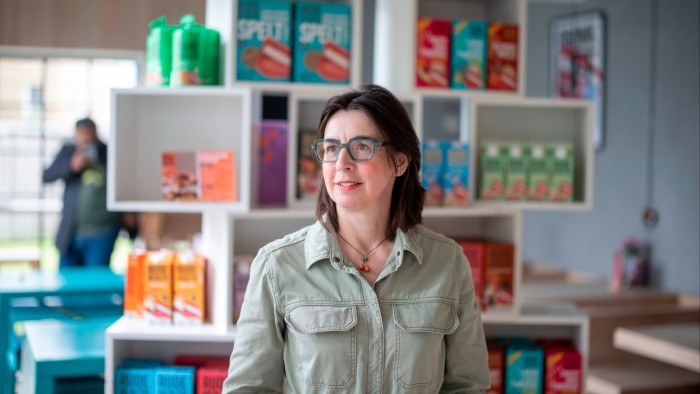
Rude Health, the organic food brand co-founded by Camilla Blench, was born in 2005 at her kitchen table as Blench, her then husband Nick and her neighbours talked about the lack of healthy, tasty food options. The brand’s signature non-dairy milks played a key role in making the “oat flat white” a ubiquitous coffee shop staple.
Rude Health went on to survive the 2008 financial crash, the ousting of the neighbours who co-founded the business with Camilla and Nick, and an influx of competition. In 2024, Rude Health generated gross revenue of more than £20mn, selling across the UK and Nordic countries.
That success caught the attention of Finnish brand Oddly Good, which last year acquired the company for an undisclosed amount. The sale of Blench’s 27 per cent stake was, she says, “completely financially transformative”. She remains a part-time consultant for the brand.
What inspired you to start your own food business?
I grew up with a pretty idyllic food culture. My mum cooked everything and we always ate around the table. There was never a sense that food was “good” or “bad” — it was just food. Only when I left home did I discover people’s relationship with eating was often really unhappy.
I wanted to create something that tasted good, looked appealing and had quality ingredients, without making it about weight loss. Back in 2005, you really did have to choose between taste and health when it came to cereals or snacks. It was the same for plant-based milks — they tasted terrible, and were gritty and grey, and had ingredients that were gut irritants.
Rude Health started as a side hustle, something we’d do in the evenings or on weekends. We didn’t have a firm business plan, and I didn’t have a business background — we just started researching. The kids were two and six months old when we started it. I was like: “Why not? How much more tired can you be?” It was chaos, really. So I was often painted with the “mumpreneur” label. But I found it so insulting, so backward. I would think, “Can’t mums just do the job like a normal human being?”
What was your first big break?
Our first client was La Fromagerie in Marylebone, which would sell our muesli. We’d mix our products at an organic café on the King’s Road and then drive up to deliver them to Patricia Michelson, La Fromagerie’s founder.
We got lucky too, as we had goji berries in our muesli just as they became a superfood trend. So we started selling the berries separately for a while, which ended up generating loads of cash.
Things then started picking up. We’d generated £1mn in total revenue by around 2008 thanks to distribution with various health food stores and delis nationwide. So we did a £150,000 friends and family fundraise. We also remortgaged our own house. The funds meant we could change from paper bags to proper packaging, make some hires, and get into supermarkets.
Then Lehman Brothers collapsed. Overnight, everything changed. Only Waitrose stuck by us, which was huge. But the next couple of years were an absolute slog. We were trying to sell premium products at a time when all anyone wanted was cheaper options. Every time the phone rang, it was like, “Please don’t be a delisting!”
What were the business lessons that stand out?
One major lesson was about focus. We launched the plant milks along with a big rebrand in 2013. They really took off. But we kept launching other products — kombucha and rice cakes. With hindsight, we should have concentrated on owning the milk sector. We barely noticed the competition coming in because we were busy doing other things.
The other big lesson was around hiring. There were times when we needed skills we didn’t have — in sales, marketing, business operations — so we’d bring in someone from a big company. But what we didn’t understand was that the skills needed in a small business are fundamentally different. People from big companies often don’t make their own decisions, but in a small company that’s literally all you do. Some people can run incredible spreadsheets and do forecasts, but can’t operate effectively when everything is hands-on. We had some real bloopers.
How did running a business with your then husband work?
It was the best of us, honestly. We had very different skills and personalities that made it work. He was the drive — we wouldn’t have got through that 2008-10 period without his determination and confidence, while I handled the brand. It was a good combination — him pushing and me holding, asking, “Who is this for? What do they want?”
But it was hard because it was all intermingled. We’d be talking about the business at our anniversary dinners. With hindsight, I can look at the relationship and say it was always about doing. There was no “being” in there. We were very functional business partners.
It was so intense there wasn’t much energy left for the relationship or for ourselves, especially during the early years when the children were small. Once they had grown up, and the business was essentially running itself, we sat down and asked, “What’s left?” I started to think: “Where am I in this?” That was the beginning of the end of the marriage.
After that, we started thinking about how to hand over the business. We still had a 27 per cent stake each at that point. It felt right because it was the end of everything. Nick and I created the company together, and for it to continue once we weren’t together felt strange.
I was also ready to let it go personally. When you’re a bigger business, you become hostage to PowerPoints. I always preferred the early, brand bit.
How did you manage the handover?
We hired a brilliant chief executive, Tim Smith, in late 2021, which was step one really. Soon after, Oddly Good appeared as a potential acquirer. We wanted someone who would get the brand and look after it. I didn’t want it to disappear or be misunderstood.
You can’t control what happens after you sell, but so far, so good. They’re complementary — they’re stronger in the Nordic regions with yoghurt alternatives, while we’re stronger in the milks category and in the UK.
What was your most difficult financial decision?
One of the most painful experiences involved our original co-founders. We started the business with our neighbours, which was like marrying someone you don’t know. After about two years, it became clear it wasn’t working. There was a decision point — do we let the business go or take it on?
The whole situation was miserable — like a business divorce. We removed them as directors. Our designer, whom we had each given a 1 per cent stake from our original four-way split, backed Nick and me. That gave us a majority. They [the neighbours] did very well financially when they eventually sold their stake years later, but they felt like we stole the business from them. I’ve always found that really difficult.
If I were to do it again, I’d be extremely careful about who I went into business with. I’d ensure super upfront communication about goals, and how much time we’re each putting in.
How has your relationship with money evolved throughout your business journey?
I’m not massively financially driven. What I love is freedom. For me, the idea of not having a mortgage was always freedom. So that was really my drive.
So in 2019, when PepsiCo bought a stake in Rude Health, we paid off our mortgage, and some. That became my pension. Before that, we just had the company pension. It made me realise that I was actually going to be free and wouldn’t have to do anything I didn’t want to. That’s success for me — it isn’t about anything I need to buy or do.
The main acquisition by Oddly Good was completely financially transformative. I never need to work again. I’m thrilled to be getting this new chapter in life, in my 50s, with this wide open space. The freedom to choose how I spend my time is the best thing.
How do you approach finances with your children?
I think it’s really important that they make their own way. They need to have their own drive and find out what it’s like to live without much money.
My son still lives with us, and I’m not charging rent because he just started working a couple of months ago. But he’s saving, which I didn’t expect! We also paid university fees upfront so there’s no huge debt, largely because I didn’t have debt myself. But otherwise, I don’t think it’s healthy to support them financially too much.
As for inheritance, I’ve set up my will so they won’t get everything until they’re a bit older. By then, they’ll know what it’s like to have to work hard.
Read the full article here