

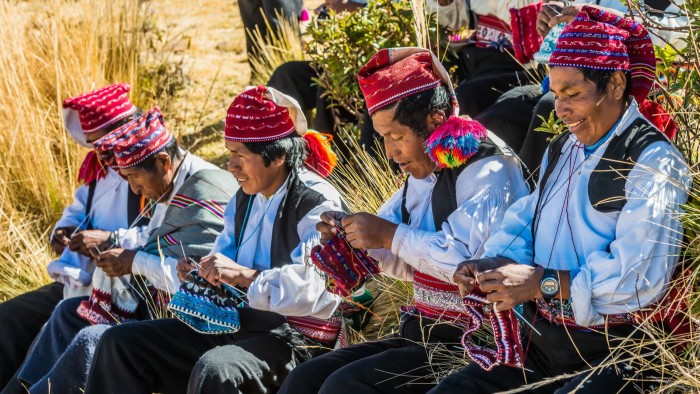
Taquile Island lies more than 6km from the shore of Lake Titicaca — far enough for it once to have been used as a place of exile for the government’s political enemies, and far enough for the island’s unique culture to be kept unusually intact. On Taquile, it is not wealth or status that help make a young man a heart-throb. It is a woolly hat, and one that he has knitted himself. Not since the Duchess of Devonshire batted her eyelashes from beneath a flamboyant Gainsborough hat has millinery been quite so key to romance.
I had come to Taquile on a travesía, or journey, in southern Peru, crossing the altiplano from Arequipa to Colca Canyon and Lake Titicaca through some of the most remarkable landscapes in South America.
Arequipa is Peru’s second-biggest city, and ringed by volcanoes. Its startling blue skies would lighten any mood after the grey of overcast Lima. A place of wide piazzas, grand villas and ornate 17th-century churches, it is gorgeous — and it knows it. Aloof and rather superior, often nursing dreams of independence, Arequipa looks down on the grubby machinations and chaotic life of the capital.
Even in the urban sophistication of Arequipa, hats are a big thing. I saw men wearing flat caps, woolly toques, the occasional cowboy hat. But it was women here who had cornered the market in the flamboyant millinery — bowler hats, rakish fedoras, colourful knitted bonnets with dangling ear flaps, glamorous affairs like tasselled lamp shades. Hats are a serious business: they can tell the observer where the wearer is from, as well as their social, marital and cultural status.
To fit in, I bought a hat at a market stall, a wide-brimmed Indiana Jones number. I thought it looked rather dashing, but the blank looks of Peruvians told me otherwise. To them it merely revealed that I was someone from nowhere of any consequence, without any status or cultural depth, and no understanding of hat etiquette.
Perhaps I might have been better off with a monk’s cowl. I was, after all, staying in a former monastery. Dating back to 1540 and the founding of the city, the building has had a chequered history — Dominicans, earthquakes, secret catacombs, builders, more earthquakes, a long spell as a mouldering atmospheric ruin — before it was acquired by Andean, a company developing a small but growing portfolio of boutique hotels across Peru. My itinerary would connect three of them.
With its hushed courtyard, once the monastic cloisters, and its striking stone walls, Cirqa is a designer’s delight. My room felt like a royal chamber in a medieval palace, candlelit beneath a barrel-vaulted ceiling with alpaca fleeces draped liberally, a chaise longue, a Spanish chest acting as a safe-deposit box, a freestanding bath at the end of the bed, and fire crackling in the evenings in an enormous fireplace.
From Arequipa, I headed north across the altiplano in royal splendour — or at any rate in a luxurious chauffeur-driven 4×4. Once clear of the city and a series of twisting ravines, the landscape stretched out to treeless infinities, a high-altitude world of boulder and cactus framed by volcanoes. Cloud shadows marched in slow procession over empty landscapes that were bleak, magnificent and vast. Among the yellow grasses, ruddy-faced children watched over herds of woolly alpacas.
At a mirador (or lookout point), the guide named the volcanoes hugging the horizons — Ubinas at 5,608 metres, El Misti at 5,822 metres, Nevado Chacani at 6,057 metres and Sabancaya at 5,960 metres, the last still active, smoking in the distance — while a herd of vicunas drifted past. Then the road turned suddenly downward, and we seemed to be in free fall, dropping a kilometre in altitude as we descended into the depths of Colca Canyon in a spectacular series of hairpins.
Last year, Andean opened a new property close to the village of Yanque. Puqio is a tented camp perched on a ledge above the river with a splendid Victorian safari vibe, as if you were suddenly on a particularly well-funded expedition in the wilds of Africa. My tent had a wood-burning cast-iron stove, a wing chair with a footstool, another chaise longue, a writing desk, and an outdoor freestanding bathtub from which I could stargaze beneath the clearest of skies.
In the main lounge, by armchairs overlooking the canyon, a faded National Geographic magazine from 1934 told the story of one of the first American expeditions into the canyon. A succession of delicious dishes of indigenous flavours emerged from Puqio’s kitchens, served with an old-fashioned elegance worthy of a country house.
Colca is one of the world’s deepest canyons, in places twice the depth of the Grand Canyon. On its flanks, above the Rio Colca, is a fine agricultural world of pre-Inca stone terraces, still in use, while in the small towns dotted down the length of the canyon, colossal colonial-era churches are moored like galleons among colourful one-storey houses.
The canyon’s most famous inhabitants are the condors. Up close, like most vultures, the Andean condor is not the most appealing bird — its bald head covered in wrinkled skin. But in flight, with a wingspan of more than three metres, they are creatures of balletic elegance, soaring on the canyon thermals. Charles Darwin reported watching them for half an hour without witnessing a single wing beat. I spent twice that time, watching them from a precipitous viewpoint, entranced by their flight as they passed and repassed at eye level. Above me, beyond the high rim of the canyon, volcanoes shouldered the sky, among them Mismi, its summit at 5,597 metres. A glacial stream from the mountain has recently been declared the highest source of the Amazon.
My guide, the wonderful Fredy Huaracha, was excited by the history of his canyon home, by the ancient jigsaw of terraces on its steep flanks and by the Inca roads — the Inca were the first Conquistadors here — snaking between the terraces. Huaracha remembers as a child seeing caravans of llama on these roads, carrying live turkeys, alpaca wool and dozens of different kinds of potatoes to Cusco.
We hiked up to Uyo Uyo, a jumble of pre-Inca ruins on the far side of the canyon, thought once to have been the regional capital. An oxen was ploughing a nearby terrace; most are too narrow for tractors. Far below the river snaked through the canyon depths. As we sat in the sun, Huaracha explained that before the arrival of the Inca, two ancient peoples had lived in the canyon: the Collaguas and Cabanas, distinguishable not by headgear but by head shapes.
Many Andean cultures practised the curious art of cranial deformation — binding a child’s head to achieve a particular shape. Living at opposite ends of the canyon, the Collaguas and the Cabanas traced their origins back to different mountains and their ideal head shapes reflected the profiles of those peaks. The Collaguas tried to achieve a pointed shape, like the summits of the Collaguas mountains, while the Cabanas wanted more of a flat-top look like the volcano Ampato.
The last stop on my itinerary was Titicaca, that mysterious high-altitude lake from which the Incas believed their divine ancestors first emerged into the world. I was staying at yet another Andean property, Titilaka Lodge, set on a promontory overlooking the lake, about 30km to the east of Puno. Floor-to-ceiling windows turned the whole property outward to watery panoramas. Andean summits rose on the far shores of the lake, clouds curled like mantles round their shoulders. To the east, the peaks of the Cordillera Real marched away into Bolivia.
With a guide, I set off to the island of Taquile. The morning was bright with sun, the lake as flat as a mirror, carrying the reflections of drifting clouds. The crossing took a couple of hours. Out on the water, the horizons seemed to tilt away from us into broad reaches of blue sky. At 3,810 metres, Titicaca is only 1,000 metres short of the summit of Mont Blanc. On shining days like this, it felt like the top of the world.
Many of the 2,000-plus islanders still wear traditional dress: men have black woollen trousers with a colourful cummerbund, while the women are keen on wide full-length colourful skirts, so keen that they wear up to eight of them at one time, one on top of the other, so they look like moving pyramids. Everyone wears a hat.
On Taquile, headgear is a kind of biography with all the usual hat messages — family origin, marital status, even occupation. Not for the Taquilians any store-bought rubbish; their hats are all made on the island. One of the features of Taquile culture is an illustrious tradition of weaving and knitting, recognised by Unesco on its register of the world’s “intangible cultural heritage”. The women do the weaving, spinning alpaca wool on drop spindles and working looms staked out on grassy banks. The men, seated on stone walls, do the knitting.
Their knitting education begins in childhood when, at about the age of six or seven, boys are traditionally presented with a gift of knitting needles. Fathers teach their sons the art of knitting, and their youth is marked by the stages of this education. Over the course of their adolescence, boys move from two-tone Andean hats to hats incorporating more colours to ever more elaborate designs so that by the age of 18, they are expected to be knitting complicated ceremonial hats, the patterns packed with a rich symbolism.
When a young man sets his cap at a girl, my guide explained, he knits her a chullo, a long hat with a tassel on the end, like an elongated toque. The hat is presented to the girl to win her affections. On Taquile, the hat seems to carry as much romantic weight as a cute smile, a ripped six-pack or a bulging bank account might do in other cultures.
When the time comes to declare their attachment to her parents, the chullo is central to proceedings. A meeting of the families is arranged. Relatives arrive in a good mood and a hat. The boy will have brought gifts, usually coca leaves and plenty of alcohol. A party ensues, and when it appears that the girl’s father is sufficiently lubricated, the chullo is brought forth for careful examination. A hush falls over the assembly, possibly interrupted by a rude remark from an uncle at the back.
The potential father-in-law carefully inspects the young man’s chullo. The tightness of the knitting is the thing here; young men often knit their chullo with wire-thin needles to get the tightest weave. Would-be fathers-in-law will roll the hat to get a sense of its quality, checking how easily it will stand up straight without flopping to the side. Finally, with considerable ceremony, water is poured into the cap, and the father-in-law will walk among the guests with the cap full of water. How long the chullo retains the water before it starts to leak out is the ultimate test.
Assuming the young man gets a pass-mark for his hat, the girl then comes forward with a belt she has made. Locks of her hair will be woven among the wool, and on the belt will be symbols representing the couple’s wishes for the future: a home, plentiful livestock, the number of children they hope for. She will tie and knot the belt round his waist, solemnising the relationship, and then everyone can get back to partying.
“It is like this for all of us,” my guide said. “Every man on the island must eventually prove his worth by knitting.”
Find out about our latest stories first — follow FT Weekend on Instagram, Bluesky and X, and sign up to receive the FT Weekend newsletter every Saturday morning
Read the full article here