

Unlock the Editor’s Digest for free
Roula Khalaf, Editor of the FT, selects her favourite stories in this weekly newsletter.
There is a reason why, particularly playing Teams, many expert auctions appear somewhat prosaic: the more information proffered in the auction, the more likely it is that the defence will find the winning action.
Bidding
Dealer: South
Game All
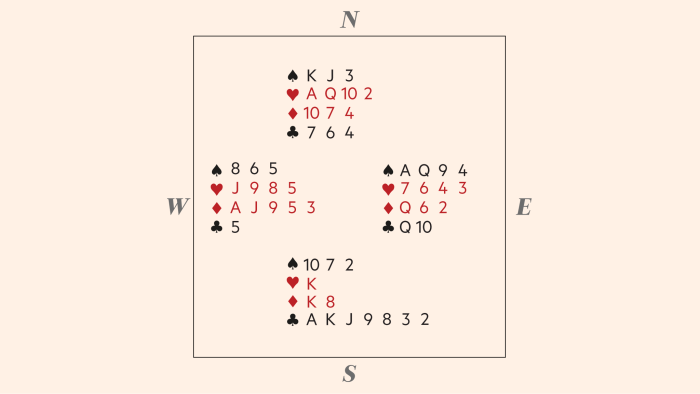
When, following South’s 3C rebid, when North bid 3NT directly, East sometimes led a spade, allowing N/S to score their game. Where North used a more scientific method, 3S showed a stopper in spades. Whenever a minor suit is agreed or emphasised, the partnership should investigate 3NT thoroughly before capitulating to five of a minor. In these situations, any new suits at the 2 or 3-level should be considered as stopper-showing for no-trumps. In this way, South discovers that North has the spade suit covered and, with his K♦ protected on the lead, he can chance 3NT. At the table, West led 7♦ and declarer ended up scoring ten tricks, whilst 5C fails.
However, the greater number of bids, the more opportunity for opponents to counter. Here, East could have doubled North’s 3S, indicating the best lead. South would still probably have chanced 3NT but, now, on a spade lead, East can win and return 2♦. Assuming that South plays low, if West appreciates that his partner’s low card must be from three to an honour, he can win with J♦, cash A♦ — felling declarer’s stiff king — and lead to East’s Q♦. This, together with two spade tricks, defeats the contract.
Read the full article here