

Unlock the Editor’s Digest for free
Roula Khalaf, Editor of the FT, selects her favourite stories in this weekly newsletter.
Food and Drink
by Harriet Fitch Little
The Kitchen Shrink: How the Food We Eat Reveals Who We Are — And How We Love by Andrea Oskis (Bloomsbury)
“Tell me what you eat and I’ll tell you who you are.” The great French food writer Jean Anthelme Brillat-Savarin’s aphorism motivates this diverting book, which takes as base material years of therapy sessions conducted by Oskis. Not to be confused with a study of disordered eating, her focus is on what food can teach us — in particular how the “cupboard love” of one’s childhood might affect future relationships. Easy-going and anecdotal in a way readers of Esther Perel will recognise.
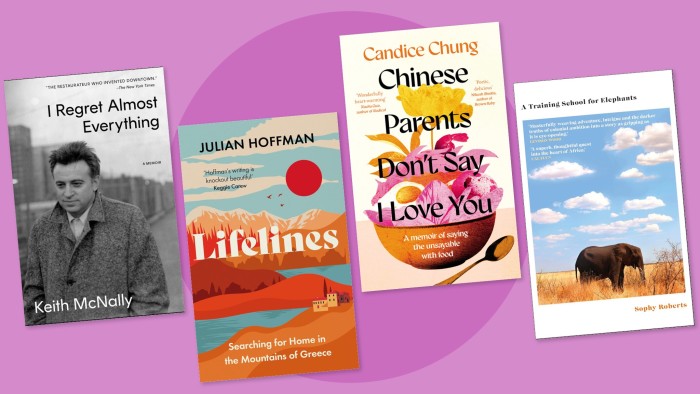
Chinese Parents Don’t Say I Love You: A Memoir of Saying the Unsayable with Food by Candice Chung (Elliott & Thompson/Allen & Unwin)
Chung writes with arch but never chilly wit about the years spent eating out with her parents in her capacity as restaurant reviewer for Sydney’s The Sun-Herald. Her book is a window on to this peculiar art, but will also interest anyone who has struggled to make themselves understood across the parent/adult child divide.
Repast: The Story of Food by Jenny Linford (Thames & Hudson)
This is a coffee-table book based around objects in the British Museum’s collection that tell stories about food: the ancient antecedent to takeaway packaging; the salt bar used as legal tender; the unflattering French caricature of British diners. The essays are lively, and the many plates useful for anyone who needs to see to learn.
I Regret Almost Everything: A Memoir by Keith McNally (Simon & Schuster)
Son of an East End dockworker, McNally has become perhaps the best-known restaurateur in New York — including at The Odeon, Minetta Tavern and celeb-packing Balthazar. His memoir is not quite the joyride followers of his famously rude Instagram account might be expecting, perhaps because it was typed up left-handed following a life-altering stroke. But a picture of 1980s New York builds in the background.
The Heart-Shaped Tin: Love, Loss and Kitchen Objects by Bee Wilson (4th Estate)
Object lessons from the kitchen, beginning with the heart-shaped cake tin that Wilson felt haunted by during her divorce and followed by other stories — from what it means to use “the good china” to the internet virality of an apparently bombproof kitchen cabinet in Ukraine. Beautifully written and surprisingly anthropological. As Wilson writes, “Magical thinking is a much bigger feature of human life than most of us usually allow for.”
Travel
by Tom Robbins
A Training School for Elephants by Sophy Roberts (Doubleday)
While much modern travel writing has become inward looking — a quest for self-discovery, a struggle to conquer demons through the power of wild swimming — Roberts goes in a different direction, seeking out forgotten stories in distant parts. This meticulously researched book sees the author, who also writes for the FT, in Tanzania, tracing a 19th-century Belgian expedition that sought to domesticate African elephants and use them to help plunder the region. It’s an illuminating tale of imperial ambition and ineptitude.
The North Road by Rob Cowen (Hutchinson Heinemann)
Cowen’s subject will be more familiar — at least to Britons, many of whom will have sat in traffic on the A1, aka the Great North Road, which runs from central London to Edinburgh. Although the topic might seem humdrum, the book — a history of the road, the nation and Cowen’s family — has been rapturously received. “Cowen thinks as a punk and writes as a poet,” wrote Jerry Brotton in the FT.
Lifelines: Searching for Home in the Mountains of Greece by Julian Hoffman (Elliott & Thompson)
Fed up with London and looking for holiday inspiration, Hoffman and his wife Julia spend an evening reading about Prespa, a remote, mountainous area of northern Greece. That night, they ditch the holiday plan in favour of moving there permanently. Don’t expect Peter Mayle, though — this is a serious account of new lives abroad, greatly concerned with humans’ relationship with the natural world. Prespa is much wilder than Provence too, home to pelicans, otters and bears, all lyrically described.
Rock Idols: A Guide to Dartmoor in 28 Tors by Sophie Pierce and Alex Murdin (Wild Things Publishing)
This is a guidebook in the Alfred Wainwright school — evocative and full of anecdote rather than purely practical. So while there are maps and advice on where to park, the book is a hymn to the mysterious tors (rock outcrops that are the “serrated stumps” of ancient mountains) and brings a sense of Dartmoor’s wild expanses to the armchair reader: “granite beneath the feet, rain on the face, lichen crisp to the touch”.
Lone Wolf: Walking the Faultlines of Europe by Adam Weymouth (Hutchinson Heinemann)
Almost driven to extinction in Europe by the mid 20th century, wolves are making a comeback, helped by hunting bans, and now number more than 20,000. But their renaissance is causing resentment among rural communities who feel it has been imposed on them from afar. Weymouth has hit on the perfect conceit to frame his investigation — following a wolf called Slavc, who had been fitted with a tracker before making a 2,000km journey, arcing from Slovenia through Austria to Italy.
Join our online book group on Facebook at FT Books Café
Read the full article here