

Unlock the Editor’s Digest for free
Roula Khalaf, Editor of the FT, selects her favourite stories in this weekly newsletter.
In 2001, Leonard Lauder coined the now famous phrase “the lipstick index”. It described his observation that although the US was in recession, lipstick sales at Estée Lauder were rising. Lauder concluded that in an uncertain environment, women buy beauty products as an affordable treat. It is frequently used to track the relationship between economics and cosmetics, but few people understood the impulses behind splashing out on a little stick of wax and pigment like Lauder.
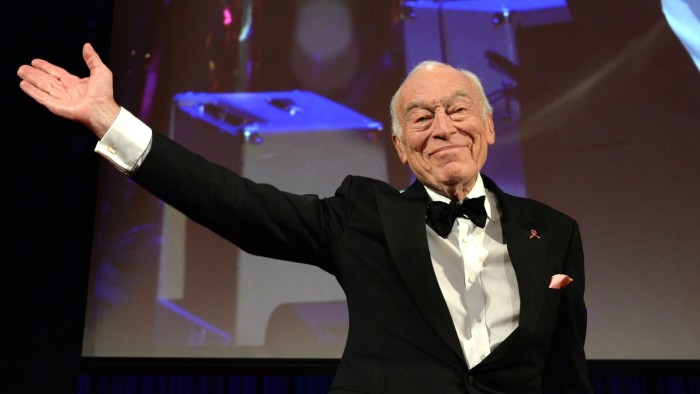
The visionary of The Estée Lauder Companies, who has died aged 92, was instrumental in shaping the modern beauty industry. An apt visual metaphor for his ability to think outside the box — or rather the case — comes from how he reimagined the twist-up lipstick in 1959. As he wrote in his 2020 memoir, The Company I Keep, “lipsticks were bullet-shaped, so that a woman had to purse her lips around the stick to apply the color, which often left lipstick on her teeth or smeared her lip line”. He sliced the top of the stick at an angle with a razor, making application more effective. “I didn’t even think to trademark it: I just did it. And now it’s the industry standard.”
Leonard Lauder was born in New York City in 1933, the oldest son of Estée and Joseph H Lauder, founders of The Estée Lauder Companies. Estée officially started her enterprise in 1946. Lauder attended the Bronx High School of Science, and after class would spend afternoons at the factory filling bottles of cleansing oil, among other jobs, fuelling a self-sufficient attitude.
After an undergraduate degree in business at the University of Pennsylvania’s Wharton School, he joined the US Navy in the mid-1950s. He loved the experience, redesigning the store on board his anti-submarine aircraft carrier to stock things men could buy for their families, such as luxury perfume.
He began working at Estée Lauder in 1958, alongside his mother who was the face of the company. Lauder served as president of The Estée Lauder Companies, chief executive, chair, and then in 2009 became chair emeritus.
He said in his memoir that his ambition was to “transform Estée Lauder into the General Motors of the luxury beauty industry” with a “global portfolio of prestige beauty brands” — which he did. In 1958, the company was making less than $1mn in annual sales; in 2024 it reported sales of $15.61bn. Landmark moments include the launch of Aramis, the first luxury men’s fragrance brand sold from department stores, and Clinique, with its custard-yellow Dramatically Different moisturiser. In 1995, it fuelled the trend for brands led by make-up artists by acquiring Bobbi Brown. The same year it went public on the New York Stock Exchange; the family kept 97.7 per cent ownership.
Of his immediate family, his late wife Evelyn and one of their two children, William, entered the business.
Brown, the founder of the brand Jones Road, recalls to the FT: “Our relationship began in the mid-1990s with a phone call. I had never met him, but on the call, he told me that Bobbi Brown Cosmetics was beating the Estée Lauder brands at the retail stores and that he’d like to buy us. I told him we were not for sale. Then, he invited me to dinner at his beautiful apartment on Central Park . . . He was so real and normal.”
Brown believes Leonard “created the blueprint for the beauty business as we know it”. She remembers him as “the most open, insightful, creative and brilliant thinker . . . He was always as excited to hear about my innovations as he was about the bottom line.”
Others echo Brown’s view of him as a charismatic man whose legacy “extends far beyond beauty. He was a gentleman, a teacher, a generous philanthropist . . . an extraordinary son, husband, father, mentor and friend.”
As well as supporting Alzheimer’s and cancer charities, Lauder made big donations of art to public museums. In 2013, he pledged 78 pieces of cubist art to New York’s Metropolitan Museum of Art, estimated in 2013 to be worth $1bn — its largest single philanthropic gift. In 2008 he donated $131mn to the Whitney Museum of American Art, where he was chair emeritus.
Scott Rothkopf, the Alice Pratt Brown director of the Whitney Museum of American Art, tells the FT: “Ever the self-described ‘lipstick salesman’, Leonard challenged us to dream big, be excellent, and make a splash . . . Towards the end of his life, he surprised me by saying he wanted the Whitney to be ‘the most adventurous museum in America.’
“He understood that modern art was ultimately about innovation, and that’s what America meant to him, too . . . His business meant the world to him, but his family and philanthropy meant even more.” Carola Long
Read the full article here