

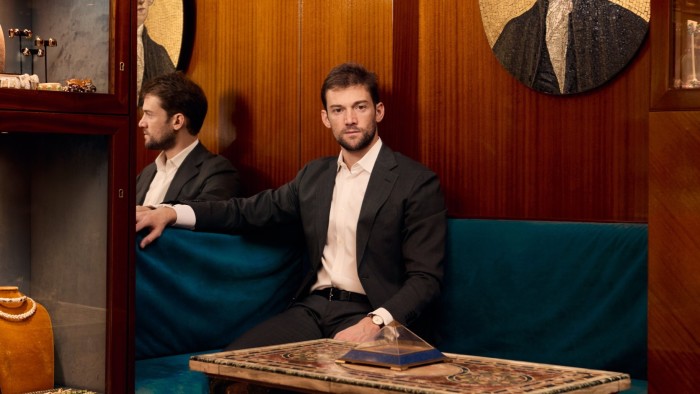
Late one evening in the early 2000s, Silvio Berlusconi, prime minister of Italy, rang up Carlo Eleuteri, a Roman dealer of jewellery and antiques, to ask a favour. “He told me, ‘Carlo I know it’s impossible, but tomorrow morning I’m taking my mother to see the pope, do you have anything I can give him as a gift?’” Eleuteri recounts over the phone from Rome. “So we opened the store at midnight and saw what was out of the safe,” he continues. “Luckily, I managed to find him three items and he selected one.” The winning object was a 19th-century Neapolitan cameo made of Vesuvian lava stone, representing the profile of Jesus Christ.
Eleuteri has been selling rare objects and vintage jewellery since 1960, with prices from €1,000 to more than €1mn, and has scores of such anecdotes. For Berlusconi, he procured a 19th-century book on Russian costumes as a gift for Vladimir Putin’s ex-wife Lyudmila Ocheretnaya, and a silver ink pot destined for the late Libyan dictator Muammer Gaddafi. There are also the many gifts that Giancarlo Giammetti has given to his business partner Valentino Garavani. “In fashion, the only one who has not been a client is [Giorgio] Armani,” Eleuteri says.
Clients can be demanding. A few years ago, Moza bint Nasser al-Missned, one of the consorts of Sheikh Hamad bin Khalifa al-Thani, the former emir of Qatar, spotted a Bvlgari Serpenti belt necklace once owned by Diana Vreeland at the Bvlgari museum in Rome, where it was on loan. She was determined to have it in her jewellery box the next day. “She came into the shop and said, ‘I’ll buy these three things only if you sell me that Bvlgari necklace,’” recalls Carlo’s son, Wagner, who joined the eponymous family business in 2012. “I told her, ‘It’s at the museum, what can we do?’ And she said, ‘Call them, have it here for me tomorrow,’ and so we did. She’s been a client for years now.”
Eleuteri continues to count heads of state, celebrities and aristocrats among its clients, with shops in Rome, Venice, New York, London and Doha, as well as seasonal outposts in destinations such as St Moritz and Porto Cervo.
“We are a small multinational of vintage,” says Wagner, who spearheaded Eleuteri’s expansion outside of Italy in 2015 with the opening of the New York store. In the decade since, revenue has tripled, reaching €13mn in 2024, up 11 per cent from 2023. The company remains fully family-owned with no external financing, and father and son source all the jewellery and objects they trade, relying on a sales team of about 15 people across all locations. “Economically we are dwarfs, we are not giants,” admits Carlo. “But there is no one [else] in vintage that has this international reach.”
Before becoming synonymous with vintage jewellery and antiques, Eleuteri was mostly associated with sweets and pastries. Egidio Eleuteri, Carlo’s grandfather, opened Gran Bar Eleuteri, a café on Via del Gambero in Rome in 1894. His son, Pietro took over in the 1930s and displayed his love for collecting inside the café before opening the first antique shop in 1960. Carlo inherited his father’s passion for antiques and after Pietro died, he decided to permanently change the family trade. The business took off in the 1980s, its ascent sanctioned by the opening of a store in Rome’s fashionable Via Condotti.
Back then, Eleuteri catered to a mostly Italian, upper middle-class clientele. “The ’80s in Italy were very productive, there was the famous ‘Milano da bere’ and perhaps Rome was also ‘da bere,’” Carlo recalls, citing the nickname Milan earned in that decade, which was characterised by a financial boom, careerism and excess (it can be translated as “Milan is for drinking” or “Swinging Milan”). “Up until ’92, it was a very, very intense decade.” The company quickly expanded to Milan, Venice, Florence and Cortina d’Ampezzo, a socialite resort in the Italian Alps.
When the Italian economy started to weaken in the early 2000s, Eleuteri began to hone its relationships with foreign tourists. “At some point, my son said, ‘Instead of waiting for the Americans to come to Rome, let’s go meet them,’ and so we opened in New York,” says Carlo. Today the company’s client base is mostly foreign, with Americans and shoppers from the Gulf countries taking the lead. “We have customers who boast of having bought in all of our stores, because they are jet-setters,” says Wagner. “And then we have customers who are more local, like the Upper East Siders in New York.”
The change in Eleuteri’s client demographic has been mirrored by rising interest in vintage jewellery from the broader public, rather than just collectors. Social media has helped foster this change and further broaden Eleuteri’s reach. “During Covid we focused a lot on Instagram and Instagram has become a shop in itself,” says Wagner.
What hasn’t changed across the decades is the appeal of vintage and antique pieces from Cartier, Van Cleef & Arpels and Bvlgari, which remain the most sought-after brands. “They are the staples, the market icons, the points of reference, and they gain value over time,” says Wagner. Shoppers also look for names such as Boucheron, Mauboussin, Cazzaniga, Fasano, Codognato, Nardi and Buccellati, as well as unsigned pieces, with slight regional differences in preferences.
“Americans are more into pieces from the ’60s, ’70s and ’80s, Europeans focus on art nouveau and art deco, while Asian customers focus more on intrinsic value, such as [the value of] stones, and less on design and collectability,” he explains.
Father and son have their eyes set on further international expansion, with Dubai, Paris or Hong Kong as their next target, but there isn’t a strict timeline. “We don’t necessarily have to open a store in Dubai, but if the right opportunity comes along, the right rent, in the right location, in the right mall, then yes. It depends on how the wind is blowing.”
They are both confident that Eleuteri will remain family-owned and run, despite receiving unsolicited offers for the business. “I’m 75. I like this job, I owe everything to my work. It’s not about the value of the company, it’s the personal relationships that are established with the customers,” says Carlo. “So when they made us offers we consulted each other and said, ‘We’re not interested.’”
In the meantime, this summer is busy with a trunk show with luxury retailer Joyce in Hong Kong in June and an exhibition at the Hôtel Hermitage in Monte-Carlo in July. “We are still active, despite our age,” jokes Carlo.
Read the full article here