

Unlock the Editor’s Digest for free
Roula Khalaf, Editor of the FT, selects her favourite stories in this weekly newsletter.
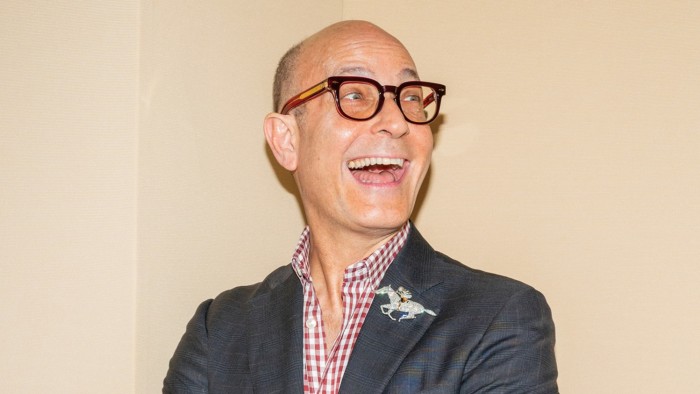
For more than a decade, Frank Everett, Sotheby’s vice-chair of jewellery, has been heralding the return of the brooch. “I kept saying they were back because I had so many to sell,” he says in a video call from his office in New York, a large diamond brooch in the form of a horse and jockey pinned to the lapel of his blue suit. “But now they are definitely back.”
I remain sceptical — a brooch is a rare sighting, wherever one might travel. Few designers make them, and relative to necklaces, earrings and rings, vintage versions are a bargain at auction.
But one area where brooches are trending is on men’s suits and shirts. Mariana Vergara, a vintage fashion and jewellery dealer and founder of Merci, C’est Vintage in Paris, recently attended a four-day pop-up in New York with 200 brooches to sell priced between $150 and $300. “I think I came back with 30,” she says. What surprised her was the number of men asking for them, who had arrived with their girlfriends or wives with no intention of shopping for themselves. They gravitated towards “the little animals and fish”, she says.
At Sotheby’s, Everett estimates that 20-25 per cent of brooches are now being bought by men. They tend to be drawn to smaller pieces from the art deco period. “Most men are not wearing a big David Webb amethyst and jade thing from the ’60s,” he says. But they are still having fun. Recently a client picked up a 1930s diamond brooch of a dog in a doghouse, which he intends to wear whenever he is out of favour with his wife.
Many young women steer clear of brooches because they associate them with their grandmothers. “But on a man it’s completely different. It’s very out of the box [thinking],” says Everett.
The trend for men’s brooches didn’t bubble up from nowhere. Jewellery houses, keen to persuade more men to get into jewellery, have been carefully seeding jewels on to the jackets of film and sport stars. Adrien Brody appeared at this year’s Oscars sporting an unmissable diamond feather brooch from Elsa Jin; pins and brooches also appeared on the chests of Robert Downey Jr (Jean Schlumberger for Tiffany & Co), Dwyane Wade (same), Omar Apollo (a lizard by Chopard), Kieran Culkin (custom Fred Leighton) and Mick Jagger, among at least a dozen others.
Historians date brooches to the Bronze Age, when simple pins of flint or metal were used to fasten cloaks and tunics. Over time, they evolved into ornamental status symbols, but still with the purpose of holding together a scarf or a shawl. Mourning brooches became fashionable during the 18th and 19th centuries, particularly during the Victorian period after the death of Prince Albert. By then, brooches were worn purely for ornament — not only on the front of a dress or coat but also affixed to hats or hair, or attached to a skirt at the hip.
There is little consensus among jewellery historians about when the brooch fell out of fashion. Some attribute its demise to the simpler, graphic clothes of the 1960s; others to the light, synthetic fabrics introduced in the 1970s, which couldn’t support a heavy brooch without tearing. But certainly by that decade young women were not wearing them — a trend that has continued to this day. “There are still legions of women who say it’s too ageing,” says Everett. Those bought at auction are often converted into pendants or rings, or earrings when a pair presents itself, he adds.
But some women are leaning into the granny connection — also known as “nonnacore” or “grandmacore”. Leandra Medine Cohen, the Manhattan-based writer of the fashion newsletter The Cereal Aisle, has recently been sporting an array of brooches that are eccentric and glamorous in a grande-doyenne-of-the-Upper-East-Side kind of way.
She pins them to coats, jackets and white vests, on lapels, hips and sleeves; she has even convincingly placed a glittering buckle brooch on the straps or hips of swimsuits styled as sleeveless tops. Some are large and feathery, but the two that sent me down an Etsy rabbit hole were a 1930s Jean Cocteau fish pin, used to fashion a pair of sweater sleeves into a scarf, and a vintage tassel pin worn on a black turtleneck in a newsletter where she wrote about “How to wear black without looking boring.” (It worked.)
“Every so often we say, ‘They’re back!’ But they’re not,” says Rachel Garrahan, co-curator of the Cartier exhibition currently at the Victoria and Albert Museum. For the exhibition’s opening, she donned a borrowed pair of geometric Cartier diamond clips from the 1930s and pinned them on each side of her collar. “They totally transformed my plain black dress.”
To wear a brooch now signals conscious effort: “It’s not just like slipping on a bracelet or ring; it’s ‘how am I going to make that sit properly and look good?’” says Garrahan. In her research for the show, she came across pictures of women wearing brooches on the back of dresses or clipped, in pairs, on each shoulder. The Queen Mother pinned one to a handbag.
They all provide evidence that brooches, styled creatively, can be “out of the box” for women too — perhaps more so, says Garrahan, who thinks the brooch for men has reached saturation point, at least on the red carpet. For those who dress to stand apart from the crowd, it may therefore be a good thing if brooches never become “definitely back” in fashion.
Read the full article here