
Beauford Delaney — luminous painter admired by James Baldwin, Henry Miller and Georgia O’Keeffe

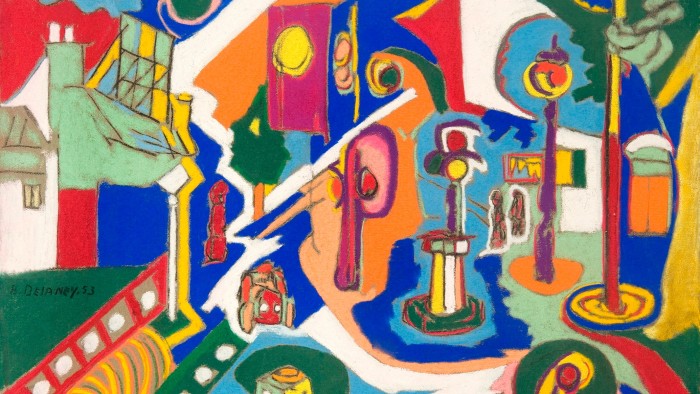
The Drawing Center’s lively and astonishing Beauford Delaney retrospective feels like a one-man group show. His artistic trajectory began in the Jim Crow South and ended in a Parisian asylum, but in between he danced through styles and phases, his step lightened by talent and the support of fervent friends. “You are the artist through and through, not just in the medium of paint but in the medium of life, which is more important,” Henry Miller wrote to Delaney. “You are one of those rare, beautiful saints who will never be canonised, alas!”
Even without beatification, this rhapsodic exhibition, with its paean to the stained glass at Chartres Cathedral, its tangles of light executed in gouache and its vignettes from a seeker’s life, verges on hagiography. Delaney was certainly a fisher of men — and women — gathering whole schools of famous friends and admirers. Georgia O’Keeffe didn’t “do” portraits as a rule, but she made his five times. He popped up in Harlem at the tail-end of its Renaissance, hanging out with Norman Lewis, Jacob Lawrence and Romare Bearden. He wasn’t a local though; from 1936 on, he lived in the Village, where his bohemian friends included Alfred Stieglitz.
And then there was James Baldwin, a precocious 15-year-old when he first climbed the stairs to Delaney’s loft on Greene Street in 1940, initiating a life-long (apparently platonic) companionship. The future literary titan found a father figure and a revelation: “the first living, walking proof . . . that a Black man could be an artist”. He was, Baldwin added, the person who taught him “how to see, and how to trust what I saw”.
What the nearly 40-year-old Delaney got out of that encounter was a like-minded muse, whom he drew and painted many times. The exhibition includes a gorgeous pastel of Baldwin at 21, alight with lavender and gold. Dabs of pink highlight a tender, slightly timid smile. The age difference was nothing compared to what they had in common. Both were the Black, gay sons of ministers, and both grew up in the church and tore themselves from their upbringing, with all the pain and freedom that entails.
Delaney’s mother, a seamstress who had been born into slavery, and his father, a barber and itinerant preacher, raised the family in Knoxville, Tennessee, and southern Appalachia. Beauford might have spent his life there, had his sketches not caught the eye of a white painter who nudged him into art school in Boston.
Delaney landed in Manhattan in 1929, armed with an academic training that led him to draw realistic portraits infused with Fauvist colours. There was no shortage of subjects in the Savoy Ballroom in Harlem or the bars around Washington Square. But he didn’t specialise: influenced by his new buddy, the painter Stuart Davis, he also produced haunted New York scenes that transfigured ordinary street lights into spiritual orbs and Central Park’s trees into towering, spooky staffs.
After the war, when the centre of the art world migrated to New York, Delaney headed in the opposite direction. Baldwin had moved to Paris in 1948 in search of a less repressive atmosphere for Black Americans, and he encouraged his older friend to come along. Delaney dithered for a while but finally made the leap in 1953; he was 52 and ready for a new chapter.
You can feel the glee of discovery in “Paris”, a pastel crammed with jaunty chimneys, humanoid traffic lights, speeding automobiles and pools of indigo shade. The thrill wore off quickly, though. Short of cash, frequently on a bender and in tenuous mental health, Delaney threatened to spiral. Baldwin came to the rescue and, in 1955, helped him settle in the serene suburb of Clamart.
There, unencumbered by the art scene’s rivalries or by the constraints of trendy isms, Delaney took a sharp stylistic turn. Maybe it was the French light, or Baldwin’s friendship, or some more inchoate form of Parisian magic, but he eventually veered into all-out abstraction. In the 1956 pastel “Abstract Circles”, orbits and swirls spin clear across the page, roiling a fruity surface of red, magenta, orange and purple.
Always a painter of light, he finally allowed it to claim the visual field entirely. The various “Untitleds” of the early 1960s dissolve into lambent fields of colour. They evoke skies glimpsed though windows or dappled with glinting leaves and trembling branches. The setting sun melts horizon and firmament together into cascades of gold and crimson.
Sometimes he indulged in an orgy of monochromatic nuance. “Untitled 1960” conjures a meadow caressed by sunlight. Greens lighten towards yellow or shade into purple without ever surrendering their verdancy. There is no horizon, no topography, just a vast, translucent landscape.
Baldwin observed that in Clamart, Delaney’s work underwent “a most striking metamorphosis into freedom”. The painter Paul Jenkins described that period’s paintings as “churches of no denomination”. Delaney had to put some distance between himself and the City of Light to discover sunshine as an agent of revelation and a metaphor for healing. In the work of those years, atmosphere is all.
The idyll didn’t last. Delaney’s rapt labours took their toll on his emotional life and his imagination, and in 1961 he went to Greece to recuperate. He never got there — or not in the way he intended. He jumped off the ship on its way to Patras, was rescued, and then committed to the first in a long series of mental hospitals. He had lucid stretches after that but never fully regained his balance.
Illness didn’t completely quash his creativity, though; he continued producing work of uncanny luminosity, and his 1963 “Untitled” erupts like a psychedelic version of the northern lights, blurry squiggles of colour all ablaze. Delaney’s suffering shows up in his art as a sublime resistance to melancholy. “He became, for me, an example of courage and integrity,” Baldwin wrote. “I saw him shaken many times and I lived to see him broken, but I never saw him bow.”
To September 14, drawingcenter.org
Read the full article here