

When British designer Stuart Vevers left Loewe, the Spanish luxury leather goods maker, for the mid-tier American leather goods brand Coach in 2013, many in the industry were puzzled by the move.
Loewe is owned by LVMH, and though it was then one of the quieter and arguably underinvested brands in the portfolio, it stood in the upper echelons of the luxury pyramid and was revered for its craftsmanship. Coach, on the other hand, was in a shambles, a suburban mall fixture whose image had been badly tarnished by Great Recession-era discounting and had just parted ways with Reed Krakoff, the designer who’d made it covetable for 16 years.
Twelve years and four CEOs later, Coach is stealing market share from Europe’s top luxury brands and Vevers’ move is looking wise — or at least fortuitous. Savvy influencer marketing and a steady pipeline of new handbag designs such as the Tabby and the Brooklyn, priced in the £350 to £375 range, have been a hit with Gen Z and young millennials, pushing Coach’s annual revenues past the $5bn mark and doubling parent company Tapestry’s share price over the past year even as its proposed merger with Capri Holdings was blocked by the Federal Trade Commission.
Sales were up 15 per cent on a constant currency basis in the most recent quarter year-on-year as demand for premium leather goods stalled in North America. And appetite for the brand’s £150 Soho Sneakers and £950 Empire 48 carryall recently catapulted the brand to number four on Lyst’s index of the most sought-after fashion brands, ahead of Prada and The Row.
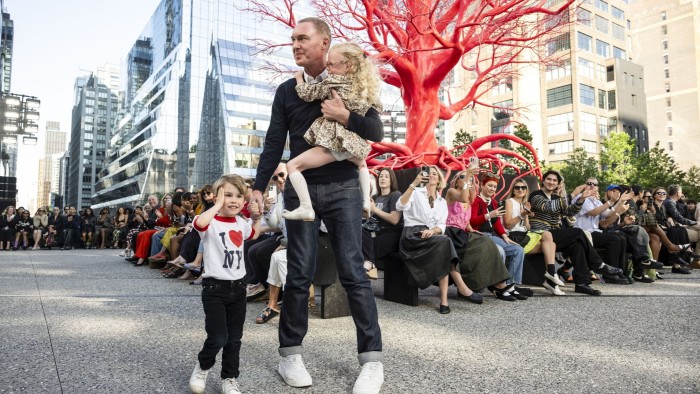
As Coach’s fortunes have risen, so has its designer’s profile, and on Thursday morning Princess Anne pinned an Order of the British Empire (OBE) medal to Vevers’ dark suit jacket at Buckingham Palace in recognition of his services to fashion. He was flanked by his husband Benjamin Seidler, an accessories designer at Gabriela Hearst, and five-year-old twins River and Vivienne.
The OBE was “mostly” a surprise, Vevers says over tea at the American Bar at the Savoy, where his husband and children are sleeping off a red-eye flight (the latter were “too excited to sleep” on the plane). After he received the call from the American embassy, “the first people I wanted to call were my mom and dad. Because I knew it was something they would understand. So much of what we do in fashion can go over their heads. Even though I feel like they’re proud of me, it’s not a world they really know.”
Vevers, 51, is earnest and vigorously polite, dressed unobtrusively in his uniform of a navy jumper, dark jeans and Nike Air Force 1s. He is more relaxed with reporters now than when he first joined Coach, and he defaults to the American vernacular though he has not entirely shed his Yorkshire accent. To him, the award feels like “a recognition” of the good things fashion has to offer: “Sometimes our industry is perceived as lightweight. But it brings people joy. It brings people confidence. And I love visiting factories. That’s a part of the industry that’s often forgotten, the people’s livelihoods who depend on the skills and craftsmanship that goes into the things that we do.”
Vevers was born into a working-class family in Yorkshire in 1973. Art was his best subject at school, but it was nightclubs that drew him to fashion. “From [age] 14, 15 I was tall and I could get into nightclubs with fake IDs. I would go to Manchester and Leeds and Newcastle and I started dressing up.” He scoured The Face and i-D magazine for outfit inspiration, and his grandmother stitched up his ideas. “She was a very cool grandma. Pretty wild.”
But in the twilight years of Margaret Thatcher’s premiership, “being a teenage gay kid where I lived was really hard. I just wanted to get out.” Vevers enrolled at the University of Westminster in London to study fashion design, where he spent his “first year clubbing and almost failed. And I realised it’s a tough industry. I went back in my second year and just worked, worked, worked.”
Ahead of his graduation he “talked his way into an interview” at Calvin Klein, landed a design job, and moved to New York. It was 1996, Vevers was 23 and the brand was at the peak of its fame. He often passed Carolyn Bessette-Kennedy, then employed at Calvin Klein as a publicist, in the corridors. He poured himself into his work, and never stopped. “Part of it is a passion, and part of it is some working-class fear as the outsider, finding my place,” he says.
After two years Vevers moved to Milan to work at the discrete, luxe leather goods brand Bottega Veneta, and then to Paris to the ateliers of Givenchy and Marc Jacobs’s Louis Vuitton before he was made creative director of British brand Mulberry and then Loewe.
An accessories designer by background, Vevers’ first task at Coach was to create a ready-to-wear line for the label, which was founded in New York City in 1941 and remains America’s only leather goods brand of scale. His first collection was modestly pitched: just 18 looks in mostly black and brown leather and shearling, shown in a black-box showroom during New York Fashion Week. It was an immediate hit, and within weeks stylish young women began pulling their mothers’ ’90s Coach bags out of storage and wearing them around the city. A few years Coach joined the New York Fashion Week schedule, hosting high-budget shows packed with celebrities.
Critical reviews of those collections were mixed and never, perhaps, as universally effusive as that afforded to the first collection. But celebrities were wearing Coach — a $695 T-Rex intarsia sweater worn by Selena Gomez in 2017 was a viral hit — and the brand was both visible and recognisable again. A consistent focus on youth and countercultures of the ’50s through the ’90s made it dynamic.
The pandemic was a turning point for Vevers and for Coach. In September 2022 Coach returned to the catwalk with a show that was acutely pitched to Gen Z — an eclectic, grunge-influenced collection that combined tan shearling parkas with biker boots, bralette tops, graphic tees, pleated baby-doll dresses and wide-leg trousers in grape and acid green corduroy. Over dinner shortly afterwards, Vevers told Todd Kahn, Coach’s CEO since 2020, that he wanted to make that cohort his “absolute focus”. Kahn agreed.
In public they began speaking about Coach as an “expressive luxury” brand, balking its longtime categorisation as “accessible luxury”.
Sustainability moved up the agenda. In 2023 the company launched Coachtopia, a sub-brand offering leather goods and clothing made from scrap and recycled materials. Bags in the collection are crafted from a single material with detachable handles and hardware so that they can be further recycled.
“I care about sustainability because I care about the future of our planet and I feel there is an opportunity to change and do things differently,” says Vevers, an antiques enthusiast who has ornamented his houses in New York, Connecticut and Cumbria with second-hand finds. “I was very fearful of talking about sustainability. I think it leads to inaction when you do that, you’re afraid of getting things wrong and getting called out. You’ve got to just try.”
The luxury sector has lost about 50mn customers in the last two years, according to Bain & Co, many of them young people turned off by the sector’s increasingly high prices. Vevers says that what people want from a handbag has changed: “The idea of status has shifted. Design is becoming increasingly important. People are interested in the new. In new brands. You cannot stand still.”
He and his team continue to mine the archives for hits like its £375 Tabby bag and sold-out £695 Kisslock Frame bag (which has a 25,000-person waiting list). But the success of last year’s Brooklyn style, a pared-back hobo bag that was an entirely new design, has encouraged Vevers to be more inventive — and trust his gut.
“There were so many industry rules that bag [broke],” he says. “It’s unlined, it’s super simple, it has such discrete branding. It has very little functionality, just a simple magnetic snap and you can only wear it one way, over your shoulder. If we’d looked back at our history or at what our competitors [were doing], we would not have believed in it. But we just felt instinctively that it was really right for us.
“So now when we’re exploring our new ideas, I’m very conscious that we’re looking for something new, something different,” he continues. “There’s no point trying to design Brooklyn 2.”
I ask Vevers how he has adapted to American work culture. “I’ve had to adjust my language. [As a British person] there are a lot of times where you are apologising [when giving feedback], or not really saying [what you mean]. ‘The sandwich’ is an American thing I was introduced to very early on, where you sandwich something negative in the middle of two positive things,” he says, laughing.
He used to apologise when he had to speak in front of large groups at Coach, but he’s become used to public speaking now. One thing he does miss about European office life? “I had gotten quite used to the August vacations.”
Follow us on Instagram and sign up for Fashion Matters, your weekly newsletter about the fashion industry
Read the full article here