

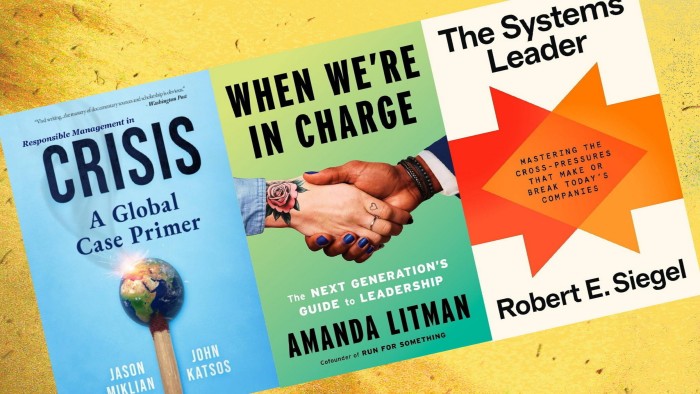
‘Crisis: A Global Case Primer’, by Jason Miklian and John Katsos
If timeliness is your key criterion for selecting a business title, then a book about “how to be a true leader when things fall apart . . . and more importantly, for a world that might never return to normal” ought to be a must-read.
Professors Miklian and Katsos draw on their experience of working with leaders managing through crisis to assemble a practical guide for leadership in uncertain times and a series of eight compact case studies for workshop or classroom discussion.
The cases are admirably broad and global, even if the authors sometimes overdo the novelistic retelling of the stories. Some are well-known, such as the backlash against yoghurt-maker Chobani’s policy of hiring refugees, or Paul Polman’s attempt to turn crisis into opportunity at Unilever. But the book also tackle less familiar examples, including how Starbucks championed sustainability in Sumatra, or what Montauk Brewing Company did when faced with a boycott after it showed solidarity with the Black Lives Matter movement.
Miklian and Katsos write that effective leadership in a polycrisis should be based on authentically held values, deep community relationships, purpose-aligned systems and clear communication. The practice of their model is far easier said than done, but this primer is a useful starting point. Andrew Hill
‘The Systems Leader: Mastering the Cross-Pressures that Make or Break Today’s Companies’, by Robert E Siegel
Success in business is not just about hitting the hockey stick curve of rapid growth, but avoiding a smack in the face from the garden rake of failure. Robert Siegel, a Silicon Valley MBA graduate, management lecturer and tech investor, has produced a book to help founders and CEOs navigate what is the more common snakes and ladders challenge of business leadership. “Even great companies face cross pressures,” Siegel writes.
This could be seen as a textbook for the students Siegel teaches management practice at Stanford Graduate School of Business, in the leafy start-up ground zero of Palo Alto. There are plenty of meaty case studies, including some written from personal experience, and insights from interviews with chief executives Siegel describes as “systems leaders”, navigating the consequences of both their own decisions and outside forces buffeting their businesses. The author picks out five major recurring cross pressures — priorities, people, sphere of influence, geography and purpose — and gives his perspectives on how to deal with them.
His core argument is that running a business is more difficult today than it has ever been, but that by approaching leadership in the right way, the job can still be rewarding and worth the effort. Jonathan Moules
‘The Dark Pattern: The Hidden Dynamics of Corporate Scandals,’ by Guido Palazzo and Ulrich Hoffrage
From the implosion of Enron to the rot at Wells Fargo, the authors of The Dark Pattern argue corporate disasters are rarely the work of lone villains or bad apples. Instead, they offer an unsettling central thesis: “when bad things happen, usually people like us are doing it.”
Problems are systemic, and shaped by incentives, organisational context, and “ethical blindness” — when people make decisions that deviate from their own values, taking them “over the moral cliff.”
Palazzo and Hoffrage’s research, corroborated by accounts from company insiders, shows how people with no ill intent normalise wrongdoing, using a range of mechanisms to morally disengage. We socialise unethical behaviour (torture to obtain information necessary to protect others, for example), engage in euphemistic labelling (“surgical strikes” to describe military action), put our own harmful behaviour in a better light by comparing to others or minimising detrimental consequences.
Fear, vanity, and self-doubt are familiar emotions. But in toxic workplaces, they create “the recipe for moral and legal disaster”. The authors decry the “culture of extreme individualism” often fostered at business schools, saying it detaches leaders from the consequences of their actions.
The so-called “dark pattern” in the book refers to hidden dynamics like ambiguous ethical codes, distorted incentives or manipulative language that pave the way to a disastrous outcome.
The book also looks at how managers can prevent ethical lapses and what to do “after the fall”. It calls for a deeper reckoning with how we structure organisations, delegate responsibility, and define accountability — a cautionary map of how we lose our way and how we might find our footing again. Anjli Raval
‘When We’re in charge: The Next Generation’s Guide to Leadership,’ by Amanda Litman
What will leadership look like in 10, or even 20 years? What does it mean to be a good leader now, when many are working from home and traditional civic spaces are in decline? Should you be on Bluesky? If these questions keep you up at night, Amanda Litman has answers.
In When We’re in Charge, the millennial co-founder of Run For Something, which supports young progressives to run for political office in the US, takes on the challenge of redefining leadership for a new generation. The result is an ambitious and refreshingly practical examination of modern management that is deeply, and sometimes painfully, millennial in its outlook and prose.
Written primarily for 20 to 40-something-year-old executives and executives-in-waiting, the book is both a reflection on how leadership has changed, told through the trials and mis-steps of its author, and a call to action. Litman argues that traditional leadership playbooks are ill-equipped to guide a workforce whose early years were shaped by economic instability, institutional failure, and the digital age. Next generation leaders are changing the look, feel and function of power, she says, and the old rules no longer apply.
In their place, she offers a framework for success grounded in equitable inclusion, digital immersion and ambition beyond work. Litman outlines familiar concepts, such as rest and work-life balance, as well as newer ideas such as “strategic authenticity”, that can feel at odds with themselves. Still, When We’re in Charge stands out for its original mix of values and modern practicality.
Even the moments of tension feel necessary, and show how leadership now demands both emotional intelligence and operational discipline. Litman doesn’t just ask leaders to be revolutionary, she shows it is possible with an actionable road map for 21st-century governance. Cordu Krubally-N’Diaye
Read the full article here