

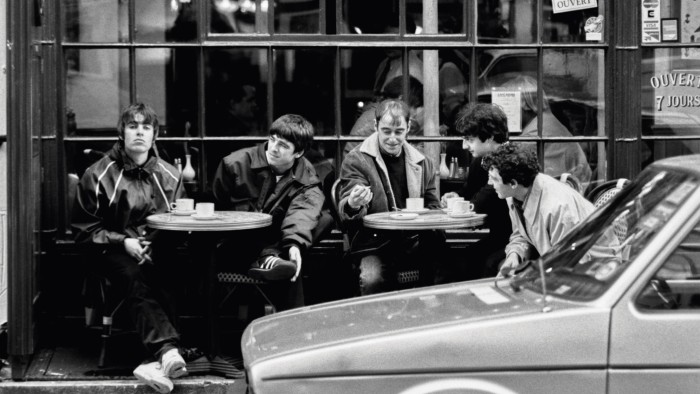
The best description of Oasis to be found in the clutch of books arriving on the eve of their reunion tour comes courtesy of a teenage Pete Doherty. Yet to be a rock star himself with The Libertines, Doherty was interviewed as a television vox pop in 1997 on the day that the Manchester band’s third album Be Here Now came out. “I subscribe to the Umberto Eco view,” he said to camera, “that Noel Gallagher’s a poet and Liam’s a town crier.”
That was not actually Umberto Eco’s view. The celebrated Italian writer, who picked Bach’s “Goldberg Variations No 22” as his favourite track on Desert Island Discs, kept any thoughts about the Gallagher brothers to himself, so far as I can tell. But the observation itself is spot on.
With his intense rasp of a voice, Liam does indeed sing as though conveying urgent news to massed throngs in a town square, even when he is actually telling them to do a white line in the sunshine. And although Noel’s rhyming-dictionary approach to lyrics (“I can see a liar, sitting by the fire”) has drawn much mockery, there is a powerful yearning for connection and meaning in his best writing. That is why so many phrases from Oasis songs, to adapt one of them, have slipped inside the eye of our mind.
Doherty’s bon mot turns up in John Robb’s Live Forever, one of a number of titles jostling for attention as the Gallagher brothers make their long-awaited comeback. The interest is not just an outburst of 1990s nostalgia. Britpop’s flagship band are synonymous with the decade due to two colossal albums, their 1994 debut Definitely Maybe and its 1995 follow-up, (What’s the Story) Morning Glory?. Since their acrimonious split in 2009, however, younger generations of fans have emerged. On the day when their reunion was announced last August, they were the biggest gainers on Spotify’s daily global artists chart, rising to number 20.
Their break-up was tempestuous. After years of fraternal feuding, Oasis finally combusted before a Paris show amid smashed guitars, threats of violence and — the element of bathos is typical — a thrown plum. Their return seemed improbable in 2019 when Noel ruled out sharing a stage again with his “moron” sibling. But here we are: the reassembled Oasis, with Paul “Bonehead” Arthurs as the only other original member, will open their world tour at Cardiff on Friday. The town crier and the poet are reconciled. What message do they bring in 2025?
For Robb, a veteran hand in Manchester’s rock scene, both as musician and journalist, Oasis stand for a vanished past. He claims that their break-up after a backstage fight between the brothers, apparently instigated by Liam hurling the plum, brought an end to “the last great British rock ’n’ roll band in the high-decibel British canon that started with the Beatles”.
It is a typically tub-thumping description, but Oasis saw themselves similarly. An early cassette tape of demo recordings in 1993 had a cover showing a Union Jack swirling down a plughole. “It’s the greatest flag in the world, and it’s going down the shitter,” Liam explained bluntly. “We’re here to do something about it.”
From the vantage point of 2025, that sentiment could belong in a Reform campaign leaflet. But there was more, or perhaps less, to Oasis’s jingoism than today’s sullenly resurgent political version. Their pride in the flag was narrowly focused on rock symbolism, riffing on the use of the Union Jack by successive waves of youth subcultures, from mods and The Who to punks and The Sex Pistols. At once patriotic and subversive, this was an alternative form of British pageantry to Trooping the Colour.
Oasis’s revival of that tradition fuelled complaints that they were merely imitators. For Keith Richards, speaking in 1997: “Oasis basically copy Beatles/Stones sixties-ish sort of thing.” (In response, Liam challenged the Stones guitarist, and Mick Jagger too, to fisticuffs at noon on Primrose Hill.) One copying dispute led to an out-of-court settlement after objections were raised to the similarity between the early single “Shakermaker” and The New Seekers’ 1971 hit, “I’d Like to Teach the World to Sing (In Perfect Harmony)”, which was popularised by use in a Coca-Cola advertisement.
There is no disputing the likeness — but as a song, “Shakermaker” stomps all over the jingle whose tune Noel borrowed. If there were any light fingers, they were artful too. Similarly, Oasis’s reputation as hooligans was not altogether accurate. The Gallagher brothers were justly notorious for brawling with each other amid a fusillade of lager cans and swearing. But their depiction as uncouth opposites to Britpop rivals Blur, the London art school yin to their northern yobbo yang, was a media concoction. In reality, Oasis were no less conscious of style and presentation.
Their logo, created by the graphic designer Brian Cannon, was distinctive, a black boxed rendition of their name done in the style of Decca Records’ logo in the 1960s. Cannon and his company Microdot also made the covers for Definitely Maybe and Morning Glory; the staged tableau in the former was influenced by a painting by Jan van Eyck. Clothes and hairstyling were vital to their image, especially for the peacock Liam. “Stillism” is his term for his static posture at the microphone — neck cords straining, mouth like a letter box, head tilted upwards — as though founding a new form of performance art.
“We’re going to be the biggest band in the world,” the tyro singer told David Beckham in the early 1990s, handing the midfielder a tape of Oasis’s earliest songs while working part-time as a car washer at Manchester United’s ground. As a teenager, Liam had been consumed by football, until a blow on the head with a hammer during a fight awakened him to music. “It’s like when people come out of comas and start speaking Japanese or Russian,” he reasoned. “Somebody knocked the music into him,” Noel commented. “That person’s got a lot to answer for.”
He shares his younger brother’s ardour for United’s rivals Manchester City, but songs were his main obsession, hunched over his guitar in solitary practice. They mostly grew up in Burnage, a district in the south of Manchester. Noel was born in 1967, the same week that Sgt Pepper’s Lonely Hearts Club Band came out. Liam followed in 1972. They and older brother Paul were raised by Irish immigrants. Robb recounts Noel and Liam’s claims that their father Tommy was a bully and his two eldest sons developed childhood stammers. Liam, as the youngest, escaped his bullying. Peggy did a flit with her children one night in 1984 to start a new life in the Burnage council house where she still lives.
There is much for pop-psychologists to rake over here. PJ Harrison, a passing music-industry acquaintance of the Gallaghers, does so effectively in Gallagher: The Fall and Rise of Oasis. There is no direct input from either brother. Instead, Harrison produces a rapidly sketched but plausible portrait of inward, calculating Noel and needy, angry Liam. Both are portrayed as a complicated mix of bravado and vulnerability.
There are deep reserves of mutual grievance between them. (Liam once broke Noel’s stereo in their shared bedroom by drunkenly urinating on it.) But the pair also have an intuitive understanding. Owen Morris, producer of Definitely Maybe and Morning Glory, marvelled at Liam’s ability to instantly pick up the vocal melodies that Noel created for him.
Morris helped to devise Definitely Maybe’s jumbo jet sound, the inexorable roar of laddish escapism (“Cigarettes and Alcohol”) and terrace-anthem epiphany (“Live Forever”). It made them stars. A year later, Morning Glory turned them into superstars. With Noel’s gift for melodicism coming to the fore, it sold 22mn copies worldwide, birthing modern standards such as “Wonderwall” and “Champagne Supernova”. Two outdoor gigs at Knebworth in 1996 before 250,000 people (2.5mn applied for tickets) sealed their ascent to rock’s pantheon.
The “rise” in the subtitles to Robb and Harrison’s books was vertiginous. The “fall”, meanwhile, was really a falling-off. Be Here Now was talked up as a masterpiece, but Noel now refers to its blaring, hammering sound as “my coke record”. Drugs and alcohol exacerbated the volatility between the brothers. Their music also became caught between Noel’s ambivalent desire to experiment and Liam’s adamant desire to keep the flame burning.
A Sound So Very Loud, by music journalists Ted Kessler and Hamish MacBain, is hamstrung by this long period of stagnation. It is a chronological song-by-song history of the band, modelled on Ian MacDonald’s Beatles book Revolution in the Head. Having failed to evolve as their idols did, Oasis are unsuitable candidates for the treatment. The authors gamely put one foot in front of the other as they plod through uninspiring songs: “But as a moment in time, it is fine”; “The bass line remains very good”; and so on.
Robb races through the band’s last decade with breathless boosterism but telling haste. Haphazardly rendered in the gonzo style popular in the British music press and lad mags of the 1990s, his book benefits from Noel’s involvement as interviewee, and also Robb’s granular knowledge of Manchester’s music scene. Meanwhile, Harrison usefully tracks the brothers’ post-Oasis careers and the toxifying feud between them. He speculates about the financial motive for their reunion. Each brother, according to Harrison, might receive as much as £100mn. (Other estimates put the figure at £50mn each.) He also wonders whether Noel might also use the tour to leverage a sale of his publishing rights, which could net as much as £250mn.
None of these books will dethrone Paolo Hewitt’s Getting High (1997) as the go-to Oasis biography. But they are replete with entertaining quotes from both Gallaghers. “There has never been a more reliably excellent interviewee,” Kessler and MacBain say of the brothers. Here is Noel, on his younger sibling’s reaction to studio advice: “Every time I say to Liam, ‘You might want to try to back off on that,’ the words he hears in his head are, ‘Your two sons are lesbian Nazis.’” Or Liam, on Noel’s resemblance to a cat: “He’s arrogant, sticks his arse up, comes and goes as he pleases, stands apart, just surveying everyone.” Their endlessly fascinating double act is the reason why Oasis’s reunion is propelled by more than money or nostalgia.
Live Forever: The Rise, Fall and Resurrection of Oasis by John Robb, Harper North £22, 432 pages
A Sound So Very Loud: The Inside Story of Every Song Oasis Recorded by Ted Kessler and Hamish MacBain, Macmillan £25, 384 pages
Gallagher: The Fall and Rise of Oasis by PJ Harrison, Sphere £22, 320 pages
Ludovic Hunter-Tilney is the FT’s pop critic
Join our online book group on Facebook at FT Books Café and follow FT Weekend on Instagram, Bluesky and X
Read the full article here