

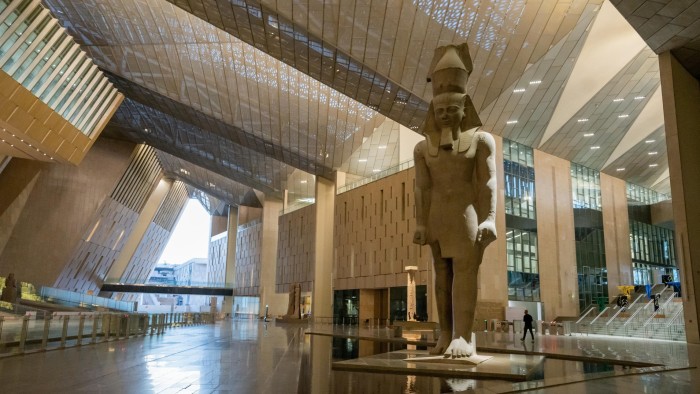
A red-granite colossus of Ramses II, the 13th-century BC “king of kings”, rises three storeys from a triangular pool in the atrium of the new Grand Egyptian Museum, just west of Cairo. This Grand Hall, open at both ends to obviate the need for air-conditioning, has a 21st-century sophistication more readily associated with “starchitect” museums in the Gulf. Its triangular portals, framed by hieroglyphics in the translucent alabaster facade, glow gold at sunset.
The 80-ton statue of a king was moved to the GEM site from outside Cairo’s central railway station in 2006, during the rule of Hosni Mubarak — the 30-year president who conceived the museum in 1992 and was deposed in the 2011 Arab Spring. “After the 1952 revolution expelling the British army from Egypt,” the label reads, then prime minister Gamal Abdel Nasser had brought it from Memphis. “The symbolic link between the two Egyptian military strongmen, ancient and modern, was clear.”
Also clear from the captioning is that if successive modern regimes have used pharaonic history to project their own power, this intelligently curated collection contains the tools to deconstruct it. Like all good museums — and the GEM has the makings of a great one — it provides food for critical thinking as well as wonder.
Announced as the world’s largest museum devoted to a single civilisation, it is a radical concept for museology in Egypt: high-tech and visitor-oriented. Designed by Dublin-based Heneghan Peng Architects, construction began two decades ago. Operated by the private construction company Hassan Allam Holding, the museum incorporates covered avenues of mainly Egyptian-owned shops and restaurants, a children’s museum and virtual-reality hall. Ambient music plays in the atrium. A Grand Staircase culminates in panoramic windows on to Giza’s pyramids 2km away.
Most of the GEM’s collection has been open to the public since last October. After protracted delays due to the Covid-19 pandemic and the war in Gaza, the ceremonial state opening and unveiling of the few unopened galleries, scheduled for next week, were abruptly postponed until later this year owing to the Israel-Iran war.
A stately procession from downtown Cairo is yet to bring the final treasures, including Tutankhamun’s death mask, from the pink, neoclassical Egyptian Museum in Tahrir Square — which yielded almost a third of the GEM’s 100,000 artefacts. The plan echoes the Pharaohs’ Golden Parade of 2021, a son et lumière motorcade of 22 royal mummies, brought in nitrogen-filled caskets from the Egyptian Museum to the new National Museum of Egyptian Civilisation in Old Cairo, where Abdel Fattah al-Sisi, Egypt’s president since 2014, received them with state pomp. Beyond the political theatre, young archaeologists I spoke to credit that televised event with spreading pride in their heritage among a new generation of Egyptians.
A state ceremony for world leaders this week might have proven embarrassing diplomatically. Last month, the UN Working Group on Arbitrary Detention concluded that the imprisonment of British-Egyptian writer and activist Alaa Abd El-Fattah, a leading pro-democracy voice in the 2011 revolution who has been detained for most of the past 17 years, violates international law, thereby highlighting the plight of Egypt’s estimated 70,000 political prisoners.
Abd El-Fattah is a global cause célèbre and his present hunger strike — and that of his mother, who has required hospital treatment in London — have drawn high-level pleas, including from UK prime minister Keir Starmer. If the illegally detained Briton is not safely freed, besides making it problematic for some leaders to attend the GEM’s grand opening, it could risk tainting it with adverse global headlines, potentially deterring both tourists and investors. The delay enables the regime to reconsider its priorities.
The 500,000 sq metre museum (larger than the British Museum in London or New York’s Metropolitan Museum) cost $1bn ($1.4bn today), including $750mn in concessional loans from the Japanese government. Ahmed Ghoneim, its chief executive since October, tells me it sends a “political signal that Egypt is capable not only of preserving its . . . antiquities, but, most importantly, giving them a state-of-the-art display [with] cutting-edge technology.” Sidestepping the possible corollary of restitution, he says, “the display is complete.”
The vertical gallery of the Grand Staircase is a splendid crash course in the “power of Egyptian kings” through art and iconography. Ramses II, who ruled for 66 years, is represented arm-in-arm with gods such as the lion-headed Sekhmet — the king’s always the tallest crown. A colossal granite statue from Luxor has the 12th-dynasty Senwosret III with age-withered face on a muscular body, dual-messaging, the label suggests, to project both wisdom and youthful strength. Heavy stylisation cedes to realism in a colossal sandstone head of the revolutionary Akhenaten — who abandoned polytheism for a sun-god cult — with narrow face and sensual lips.
The trappings of royal power and divine status — blue-and-gold striped nemes headdress, shendyt kilt, double crown — can clearly be adopted by anyone to claim legitimacy. In a red-granite statue from Luxor, Queen Hatshepsut had herself portrayed as a man with false beard and kilt “in full ‘kingly’ style”. The Roman emperor Caracalla, who visited Egypt in 215AD, sports Roman curls with a pharaonic nemes.
At the summit, the 12 semi-open-plan galleries are divided chronologically into four periods with three thematic threads: society, kingship, beliefs — from a prehistoric hand-axe from about 700,000BC to Graeco-Roman Egypt in 400AD. The central story may be, as one former minister put it, “how 30 dynasties over a few thousand years created one of the earliest states in history.” But there are multiple narrative paths, from the rise and fall of kingdoms and empires, to trade, settlement and migration, writing and the afterlife.
In sight of Khufu’s Great Pyramid, with those of his son Khafre and grandson Menkaure, pyramid dynasties (beginning with King Djoser’s earliest step pyramid at Saqqara in 2700BC) are traced partly through tomb artefacts. As at the Acropolis Museum in Athens, there is great poignancy in viewing objects so close to where they were found. The royal bedroom furniture of Khufu’s mother, Queen Hetepheres, includes a golden armchair with lion’s-paw feet, inscribed, “Mother of the King of Upper and Lower Egypt”. Her inlaid silver bangles, when silver was more valuable than gold, suggest trade with Greece. Though her body was likely destroyed by tomb raiders, the mummified organs survive in a travertine canopic chest.
Identity is touched upon through Nubian influence on the New Kingdom (King Thutmose IV was “very fond” of his wig of tight curls), while the fusion of Greek and Egyptian art is expressed in a more naturalistic Ptolemaic statue from Alexandria of the priest Hor. Most popular are objects such as a crocodile mummy and the never unwrapped mummy of Sambathion, her exquisite gilded mask with Roman curls. Also striking is the reverence for cross-legged scribes with their scrolls.
One corner of the museum displays the entire contents of King Tutankhamun’s tomb. More than 5,600 artefacts are reunited for the first time since they were uncovered by Howard Carter in 1922. At the museum’s Conservation Centre, which opened in 2010, its longtime director, Hussein M Kamal, tells me that many objects have never been shown before — from the boy king’s gilded outer coffin and all six chariots to his newly reconstituted leather-and-linen armour.
Altogether, 57,000 artefacts have been conserved at the centre’s 19 laboratories with 120 conservators (more than half of whom are women) and almost 90 curators. Two wooden solar barques, meant to ferry the royal dead to the afterlife and found beside the Great Pyramid in 1954, are now in a separate building. Described by Eissa Zidan, general director of conservation programmes, as the “biggest and oldest artefacts on Earth”, one was restored before going on public display in 1982. From ramps, visitors to the GEM will now be able to watch the other being reassembled by conservators from 1,650 pieces.
The fact that the solar boats and two Tutankhamun galleries are strictly off-limits to the press and public until the ceremonial opening is symptomatic of both the feared, top-down authority that governs this state museum, and what is riding on it for the regime, both for vital tourist revenues and legitimacy at home.
The Lebanese artist Ali Cherri, who recently created work for the Museo Egizio in Turin, Europe’s largest museum on ancient Egypt, told me earlier this year: “Al-Sisi is trying to restore another authoritarian regime using ancient history, the GEM and the pharaoh’s parade — these are all tools of power. Museums are tools of power everywhere, but [in Egypt and Syria] it’s more visible how they are keystones in authority-making.”
On the staircase, a victory stela praises Ramses II: “The land is in fear of him, the chiefs are crushed . . . their bodies are broken.” Another proclaims Ramses IV deserving of kingship, having “brought back maat (truth and justice) to the land”. Infinitely rich and thoughtfully curated, the GEM inspires both marvelling and meditation, not least on what a great civilisation means.
visit-gem.com
Find out about our latest stories first — follow FT Weekend on Instagram, Bluesky and X, and sign up to receive the FT Weekend newsletter every Saturday morning
Read the full article here