

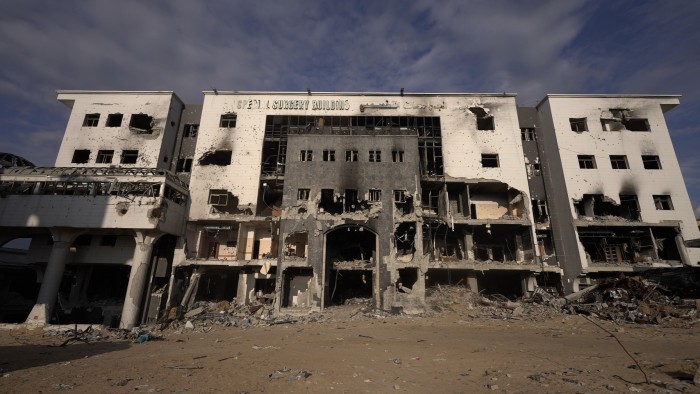
This is the documentary that the BBC didn’t want viewers to see — or, to be more precise, didn’t want them to see on its channels.
Some background. In Britain, the big global issues seem now often to shrink to arguments over the national broadcaster’s coverage. True to form, the military siege of Gaza has been reduced to a political siege of the BBC.
This week the UK’s chief rabbi said confidence in the BBC had fallen to a low, after footage of a rap-punk duo chanting “Death to the IDF [Israel Defense Forces]” at the Glastonbury Festival was broadcast.
Critics on the left, meanwhile, have accused the BBC of censoring evidence of Israeli brutality. The corporation removed one documentary, Gaza: How To Survive a Warzone, from iPlayer in February after its child narrator was revealed to be the son of a Hamas official.
In the aftermath, it decided not to broadcast another documentary, Gaza: Doctors Under Attack, because it “risked creating a perception of partiality that would not meet the high standards that the public rightly expect of the BBC”.
That second documentary finally aired last night on Channel 4, a publicly owned but more risk-taking broadcaster. Its narrative is stark: doctors have been killed, detained and tortured during Israel’s military offensive, which followed Hamas’s October 7 massacre. Medics may even have been specifically targeted.
You can feel almost immediately that Gaza: Doctors Under Attack, made by independent production company Basement Films, is not a BBC film. It isn’t ponderous and caveated in the way once might have expected had it aired, as once intended, on Panorama.
“From the first day of the war, Israel attacked the one thing Palestinians needed most: its healthcare system,” says British reporter and narrator Ramita Navai.
First come the direct Israeli strikes. Israel hit al-Shifa, Gaza’s main hospital, claiming there was a Hamas command centre underneath. The filmmakers say Israel failed to provide “sufficient evidence” of this and has prevented an independent investigation. In April, the Israeli military killed Palestinian Red Crescent medics, falsely claiming their ambulances did not have their lights on. A video found on one dead medic’s phone contains the tragic last words: “Forgive me, mum. I swear I only chose this path to help others.”
After the strikes come the detentions. When Israeli troops have stormed hospitals, many medics have been detained. We see footage of men stripped to their underwear near a hospital, although it’s not clear who they are. The film focuses on one military detention site, Sde Teiman. A former worker there says that Gazan medics were detained mainly because they had witnessed Israeli hostages being transported and treated, and that abuse of them was encouraged.
In the documentary, medics make allegations of torture, which tally with other accounts. One says that he was refused treatment by Israeli doctors. An Israeli doctor, speaking to Navai under anonymity, admits: “I am an accomplice.” The doctor goes on to say that there isn’t even a need to cover up wrongdoing, because Palestinians have been dehumanised in Israeli society, starting before October 7. “You can do almost whatever you want when it comes to Gazans.”
Some Palestinian medics have died in detention, including Adnan al-Bursh, an orthopaedic surgeon. A year later, al-Bursh’s body has still not been returned to his family. Others have been released without charge, among them Khaled Hamouda, who lost 12 relatives, including his wife and daughter, in an Israeli strike on his home, and who testifies that he was tortured.
The filmmakers reveal that two of the medics featured, al-Bursh and Hamouda, had expressed support for the October 7 attacks. This is not discussed in detail. The implication is that even such support would not make them legitimate targets. This is surely right, but it also leaves some complexities underexplored, including that we don’t know how freely other Gazans who appear in any documentary speak.
Israel didn’t respond to some of the film’s allegations, such as why it apparently targeted Hamouda’s family. In general, the military and the prison service say they act legally; the military has emphasised that Hamas is embedded in civilian infrastructure. Navai, the reporter, notes that Israel reported killing Mohammad Sinwar, Hamas’s military leader, in an air strike on a bunker under the Gaza European Hospital in Khan Younis in May.
The documentary emphasises that Gaza’s healthcare system has been destroyed, and the experience embodied in its doctors has been lost. By focusing on medics, it seeks to break the horror into a digestible piece for western audiences. But the enormity of the conflict is still evident in the shots of devastated landscapes. The images of dead and terribly injured children will stay with me. So too the footage of medics digging shallow mass graves in the sand.
Ben de Pear, the film’s executive producer, wrote before broadcast: “why should there only be a handful of UK documentaries about Gaza? Why won’t US media commission anything? Why can we watch on our phones the death of tens of thousands, but not on our TVs?”
He added that the BBC’s subservience to politics is “ruining” the corporation. That criticism has been echoed by more than 100 BBC staff members, who have anonymously signed a letter attacking the corporation’s coverage.
The BBC may have had its reasons not to broadcast this documentary. But it needs to find ways to tell Gazans’ stories with similar bravery and starkness.
Streaming now on Channel 4 in the UK
Find out about our latest stories first — follow FT Weekend on Instagram, Bluesky and X, and sign up to receive the FT Weekend newsletter every Saturday morning
Read the full article here