

I was sitting in the front of a pick-up. Wedged between the driver and me was Ed Tucker-Brown, the gearstick between his knees. Tucker-Brown’s job was to change gear when the driver pressed the clutch. He had little to do, though, given we rarely got out of first.
We plunged through swamps, the bonnet disappearing under muddy soup. We inched our way down vertiginous, rutted slopes of crumbling laterite soil, often on three wheels, and then had to winch ourselves up the other side. We crashed through subhumid forests. Farmers sitting on their zebu-drawn carts — the only other wheeled transport we saw in the three hours it took us to cover 50km — watched us from the shade of tamarind trees.
“If I make roads, the white man will only come and take my country,” Madagascar’s King Radama I declared in the early 19th century, as the island battled colonialism. It seemed as if the legacy of the royal decree was still being felt.
We were driving from the grass strip in Soalala, on Madagascar’s north-west coast — where I’d landed after a 90-minute charter flight from the capital, Antananarivo — to the remote 220 sq km Tsingy de Namoroka National Park.
I’d read that, since man’s arrival on Madagascar, thought to be between 1,500 and 2,000 years ago, more than 90 per cent of the forest that once covered the entire island has disappeared, mostly destroyed by impoverished subsistence farmers — Madagascar is the world’s fifth-poorest country. They slash and burn, a technique called tavy in Malagasy, to build rice paddies and produce charcoal for fuel.
Even more alarmingly, some estimates suggest 40 per cent of the forest has been lost since Madagascar gained independence from France in 1960, during which time the population has increased more than fivefold to 30mn.
In the week I was spending on what some biologists call “the eighth continent” — 90 per cent of all its plants and animals are found nowhere else — I would be visiting two new lodges with a strong conservation ethos. Both are hoping to bring an economic benefit to an island the size of France that saw fewer than 320,000 foreign visitors last year and where the vast majority of its inhabitants live on less than $2 a day.
Given that so much of the forest, and the life it sustains, has been lost, getting to the remaining pristine pockets requires a strong sense of adventure and an even stronger 4×4.
“Fewer outsiders have visited this place than summit Everest in a year,” Tucker-Brown told me, as we crashed through a thick field of roof-high wild mint, the fragrance filling the truck.
Last year, Welsh-born Tucker-Brown, 49, opened Namoroka Tsingy Camp, on the edge of the park, the first and only accommodation in the area. “There have been about 40 visitors to the park since 2019,” he told me.
We finally arrived at the camp: seven surprisingly luxurious tented rooms set around an outdoor dining area embraced by slabs of tsingy, the otherworldly limestone karst that gives the park its name.
After a shower to scrub off the laterite, we set off for a walk in the park, which has six distinct ecosystems, including dry deciduous, riverine gallery and bamboo forests, tsingy and the Marosakabe cave system, stretching for more than 100km and believed to be the largest in Africa.
Having made us work hard to get there, the national park delivered its treasures thick and fast. There were towering baobab trees, with their swollen trunks and sparse, stubby branches — six of the nine species in the world are endemic to Madagascar, and the other three are thought to be escapers. The floor was scattered with elephant-foot plants; with their grey, distended trunks spreading out across the soil, flecked with bright yellow flowers, they looked like living rocks.
That so much of the flora and fauna is endemic is the result of the break-up of the Gondwana supercontinent about 180mn years ago, with Madagascar drifting away from mainland Africa, leaving the plants and animals to evolve in isolation.
“Originally, I was going to call this camp the Ark Project, because it feels like we can really help stop the decline in this contained, remote spot,” said Tucker-Brown, who had first come to Madagascar in 2006 and fallen hard for the country, its people and its wildness. He now employs more than 150 people from the Sakalava, the local ethnic group, in the camp, improving the roads and building firebreaks so that the tavy is contained.
We walked on. Giant Malagasy chameleons, 60cm long, sat on branches and watched us through eyes like rotating gun turrets. Giant Madagascan velvet geckos, their mottled skins perfect camouflage on the tree trunks, hissed at us to keep walking. Around us flitted Madagascan sunset moths, their iridescent patches of every rainbow hue making them resemble flying kaleidoscopes.
There were also many snakes, on the ground, climbing trees — giant hognose, pencil, ground boa constrictors, two metres long and as thick as my arm — all thankfully harmless to humans, as well as huge golden orb weaver spiders, whose silk is so strong that the Madagascan royal family once made Queen Victoria a pair of stockings from it.
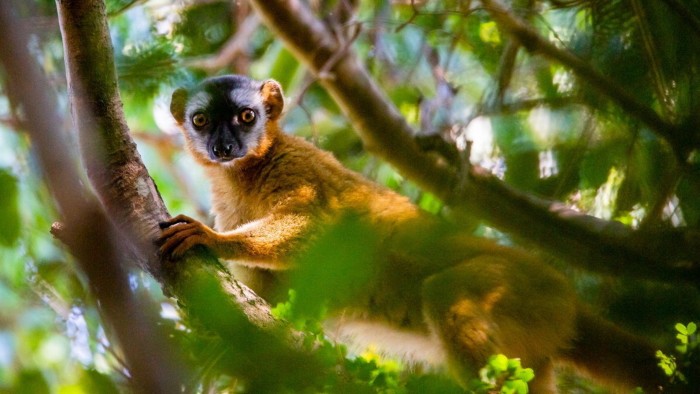
Mention to friends that you are visiting Madagascar and the first thing they’ll say is “lemurs!” (obviously their children will shout “King Julien!”). I thought they might be hard to spot, but, no, there they were, critically endangered Von der Decken’s sifakas, one of the 10 lemur species found in the park. (There are thought to be more than 100 species in total in Madagascar and more being discovered all the time.)
The lemurs were huddled together in groups of four or six, staring down at us from the canopy with seeming bemusement; creamy teddy bears with jet-black faces and “eyes limpid amber, in which the pupil floated like a glittering jewel”, as William S Burroughs described them in his 1991 Madagascar-adventure novella, Ghost of a Chance.
Tucker-Brown explained how lemurs — like much of the “stranded” flora and fauna of Madagascar — are effectively living fossils. Belonging to a primate group called prosimians, lemurs were evolutionarily superseded by monkeys on mainland Africa 35mn years ago and driven to near-extinction. A few stowaways, perhaps curled up in hollow logs, managed to get across the Mozambique Channel to Madagascar, where, without competition, they remained true to the species’ original form.
We emerged from the forest into a vast clearing of tsingy, where it looked as if sci-fi animators had created a megacity on a monochrome planet — towering shards of grey limestone soaring from a crevassed floor. Tsingy means “where one cannot walk barefoot”; it was formed at the bottom of the sea until, millions of years ago, seismic activity thrust the limestone upwards and erosive acid rain did its work.
We dropped below the surface, into a deep karst canyon, below rock formations resembling immense winged gargoyles. We donned head torches and entered the cave system, largely unexplored. We found the bones of pygmy hippos and giant lemurs in the soft sediment — both animals among the long list of Malagasy megafauna wiped out when humans finally made it to Madagascar. Huge crocodiles are believed to live deep within the caves, Tucker-Brown said, “and God knows what else. Perhaps undiscovered species.”
That night, over zebu lasagne, and under a staggering display of stars (the nearest light pollution is Maputo in Mozambique), Tucker-Brown told me about the environmental work funded by a €50 per-person-per-night conservation levy, and about the young Malagasy researchers from Wildlife Madagascar, a US non-profit, who live in the camp.
He is also building an airstrip to transform the logistics in the area. If you don’t tackle poverty and education, he said, then nothing else will work. “Everybody is working together to save this area, this wild space in the middle of nowhere,” he said. “That’s why it feels like an ark. The whole of Madagascar should be an ark, and maybe it’s too late for that, but we have to try.”
From Namoroka, I flew, via Antananarivo, to the island of Nosy Boraha, commonly called Île Sainte-Marie, a 50km-long, 7km-wide strip of land, 8km off mainland Madagascar’s east coast, dense with rainforest and fringed with deserted, white-sand beaches overhung with coconut palms. It was a cliché of a tropical island, a sense only heightened when I found a pirates’ cemetery, complete with 17th-century coral graves inscribed with skull and crossbones motifs.
I was here to visit another new and remote project with conservation and sustainability at its heart. So, after a 45-minute drive north on smooth asphalt, then for another 30 on a hideously rutted assault course of a track, complete with rickety plank bridges, that would have made old King Radama swell with pride, I arrived at Voaara.
There to greet me was Philippe Kjellgren, 57, another European who lost his heart to Madagascar — in his case when he lived here as a teenager while his father worked on the mainland. “It was one of the most beautiful places I’d ever seen,” he said.
Swedish-born Kjellgren had spent his working life travelling extensively, reviewing 3,000 of the world’s finest hotels for his PK’s List website. But Madagascar kept calling him back, so in the remote north of Sainte-Marie, he bought 45 hectares of land and, along with his Canadian wife Vi, built a barefoot luxury hotel, which opened in 2024.
“Over 90 per cent of our staff are Sainte-Marie locals who have never had a job,” says Kjellgren. They are working with conservation groups to reintroduce critically endangered turtles, replanting trees and encouraging the ending of tavy. While I was there, a biologist from the Durrell Wildlife Conservation Trust, a Jersey-based conservation charity, was visiting.
Voaara has seven solar-powered oceanfront bungalows and a villa, each with traveller-palm thatched roofs and driftwood beams from nearby beaches. As you might expect from a man who compiled what Forbes referred to as the “Michelin Guide equivalent for the luxury hotel world”, everything is exquisite, from the indoor-outdoor bathrooms, with granite basins and toiletries made by Sainte-Marie-based brand Anoka, to the handmade, down-topped sheep’s wool mattresses and crisp linen sheets, to the prints of local life by celebrated Malagasy photographer Pierrot Men.
The restaurant, with its steeply pitched roof inspired by the rova architectural style seen in the royal palace in Antananarivo, has a menu designed by Spain’s vaunted Aleixandre Sarrion and expertly executed by Malagasy chef Jean Notia Vincent. It uses fruit and vegetables from Voaara’s kitchen garden and, naturally, the abundant larder of the Indian Ocean.
I walked for hours along the beach and saw not a soul, then spent the rest of the afternoon snorkelling on the reef. That evening, I met Kjellgren at the beach bar, also built of driftwood. We ordered cold Madagascan Three Horses beer and watched the sun melt into the sea.
Kjellgren told me that, from June to September, 7,000 humpback whales gather in the waters here after migrating from Antarctica to breed and calve. “And with so few tourists, you can have them to yourself,” he said.
As night fell on the mainland across the channel, there was not a single light to be seen. “We don’t have kids,” Kjellgren told me. “So, this is our legacy.”
A dog ran up to us, licked my hand. “This is Lost,” Kjellgren said. “He was a stray, so we took him in.” Lost, I asked?
“Yes,” Kjellgren laughed. “Lost in paradise.”
Find out about our latest stories first — follow FT Weekend on Instagram, Bluesky and X, and sign up to receive the FT Weekend newsletter every Saturday morning
Read the full article here