

Astrid Andersen had never imagined she would end up moving back to Vejle, her small Danish hometown a two-hour train journey outside of Copenhagen, but life has a funny way of playing out in circles. “It’s very strange,” she laughs over a video call. “I moved to London when I turned 18, I felt like I belonged somewhere [other than my hometown].”
The designer, 40, trained at the Royal College of Art and launched a namesake menswear label in London in 2011, which was lauded for its luxury take on sportswear. That landed her collaborations with Fila and Topshop as well as a spot on the LVMH Prize shortlist in 2015, while tracksuits rendered in silk florals or lace and tweed became favourites of rappers A$AP Ferg and Drake. “To be celebrated that early is quite overwhelming; it was a very intense experience,” she recalls.
After Brexit, she moved her studio from east London to Copenhagen, but as she grew older, the brand started to feel less relevant to her. “I never used to wear it, the odd times I did I felt very weird. It was logo-heavy, it would have my name on it, knitted in a jacquard,” she explains.
She shut down the brand in 2021 and is now pursuing her career’s second act with Stel, a label focused on core wardrobe staples such as button-down shirts, hoodies and jeans that have been deconstructed and edgily reimagined for contemporary wear. The name means “structure” in an industrial sense — “like the body of a bike,” she explains, “but also a set of something you collect”.
Stel is carried by Selfridges and END in London and priced in the contemporary sweet spot: a crisp white layered shirt is £155 and wool pleated trousers are £265. Garments have been designed for flexibility, with adjustable waistbands in trousers and ties on jackets to alter how something hangs. “There’s design integrity behind each piece,” she says. “It’s more about the philosophy of what I want to do, than my name, who I’m hanging out with or what’s cool.”
This time she has investor backing. Her business partner is Anders Freund, who owns MSCH Copenhagen, a Danish contemporary label. Andersen has been able to plug into his operations, enabling her to concentrate on design. Neatly, Freund is based in Vejle, the town she grew up in, instigating her homecoming and allowing her to have family support from her parents and brother. The brand ethos stemmed from “combining who I am now as a 40-year-old mother with two kids. I have a need for a different pace.”
Andersen is one of a small but growing cohort of seasoned designers launching new labels that are both intensely personal and acutely focused on what women want to wear. In a fashion landscape where youth and newness is venerated, they are testaments to the value that experience brings.
London-based Nataša Čagalj, 56, spent decades in the top ranks of luxury brands before she launched her own label, Souvenir Stand. “It’s a cliché story, but during lockdown I [realised] I wanted to do something that was just mine,” she says.
Čagalj obtained her fashion BA in Slovenia before coming to Central Saint Martins to study under the late Louise Wilson, the legendary tutor who also taught Alexander McQueen, Phoebe Philo and Christopher Kane. She consulted for Victoria Beckham, was Alber Elbaz’s right hand at Lanvin and worked as head of design at Stella McCartney before becoming creative director of Ports1961 from 2014 to 2019.
Souvenir Stand has become an insider hit in London and snapped up by retailers in Japan, including Takashimaya, Thenime and Framework. It’s known for its colourful one-of-a-kind shirts, each adorned with colourful patches of vintage crochet lace sourced from eBay and fairs. Čagalj is half-Croatian and half-Slovenian, and the brand plays into her heritage. “When I go to Croatia I visit these ladies that sell lace, all my aunties [give them to me].”
The website is like a high-end resort shop, with the one-of-a-kind shirts (priced from £530) sold alongside crochet-knitted bags (from £320), cotton slip dresses with lace yoke inserts (£350) and scrunch-down weekend bags in tangy plaids (£290). In a landscape of identikit brands it is a quietly unique proposition, the fruits of a career spent working with the best fabric mills and the honing of an expert eye.
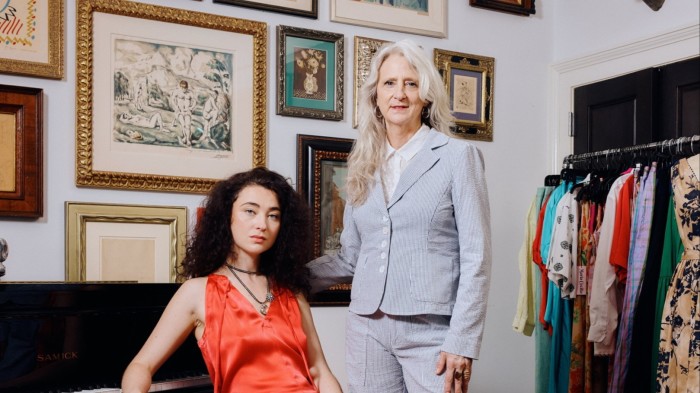
Over in New York, Nanette Lepore, 61, has switched from running her eponymous company in an eight-story building on 35th Street in New York’s Garment District, to being a one-woman show working out of her West Village brownstone, where she has to pack down her rails when her husband or daughter need the space back.
Lepore launched Maria Cecilia NYC, a combination of her grandmother’s name and her own middle name, in 2023. “It’s growing slowly, which is OK with me. It took almost 10 years to get Nanette Lepore into a profitable business,” she says over a video call from her home, where those rails are stacked behind her.
At its height in the early 2000s, her namesake brand was stocked in almost every major American department store and boasted a turnover of around $160mn. But after stumbling through the financial crisis, it ended acrimoniously with a sale to Bluestar Alliance in 2014 which Lepore alleges undercut the mainline runway collection with cheaper licensed product, resulting in a litigious exit from the business in 2020.
“I spent three years licking my wounds [but] I love working, I love making clothes here in New York.” She went back to basics, running around on foot to her old suppliers to make a small number of pieces. At first she started tapping into the ’90s Lepore corset tops her daughter Violet Savage, who models for the label, was hunting for on eBay, but as she started finding customers — like minded, mid-life women looking for special but serviceable pieces — she’s expanded the range.
“I’m trying to figure out the perfect boho, easy dress with a sleeve that everybody can wear,” she says. There are also soft florals across bias skirts ($275) and slips ($395) which should charm fans of Lepore’s original brand, and a cool wide leg jean with oversized cargo pockets that has been a hit ($350).
Her biggest thrill is dressing clients in salon-style events at home, which brings in 70 per cent of sales (the other 30 per cent comes in via the website). “I love working with [them]. They are all cool accomplished women . . . actors, art directors, judges, bankers and even a few scientists, and that keeps me inspired.” She has even whipped up a few judicial robes at the request of a client.
“I feel so lucky to be able to start over and make beautiful clothes.”
Follow us on Instagram and sign up for Fashion Matters, your weekly newsletter about the fashion industry
Read the full article here