

Unlock the Editor’s Digest for free
Roula Khalaf, Editor of the FT, selects her favourite stories in this weekly newsletter.
“Who is dead?” asks Leporello. “You or the old man?” It’s a question that is usually played for laughs, but Robert Icke is not the first stage director to take it at face value. Director Claus Guth served us a dying Don Giovanni in Salzburg back in 2008. After all, the archetypal lover is clearly hungry for life in the face of his own mortality. Icke takes it a step further, and has the protagonist collapse of a heart attack in the opening bars.
Mozart’s operas are core repertoire in Aix-en-Provence; this is the eighth production of Don Giovanni to be staged at the summer festival. It is also the British theatre director’s first attempt at opera, a high-risk endeavour at the best of times. Clearly Aix was at pains to provide Icke with everything he needed; the result (at the Grand Théâtre de Provence) is a meticulously wrought rethink of the operatic blockbuster.
In fact, Icke’s work is so refined that at times it is hard to work out what he is trying to say. But it seems to boil down to this: Don Giovanni does not kill the Commendatore. Don Giovanni is the Commendatore. As the old man lies dying, his life flashes before his eyes — the women he seduced, those he raped, the lives he destroyed, the little girls (one of them probably his own daughter) whom he abused. Don Giovanni is Bluebeard and Jeffrey Epstein rolled into one; but he is also the capitalist patriarchy itself, a relentless machine objectifying women, appropriating their emaciated bodies to satisfy a joyless compulsion to consume.
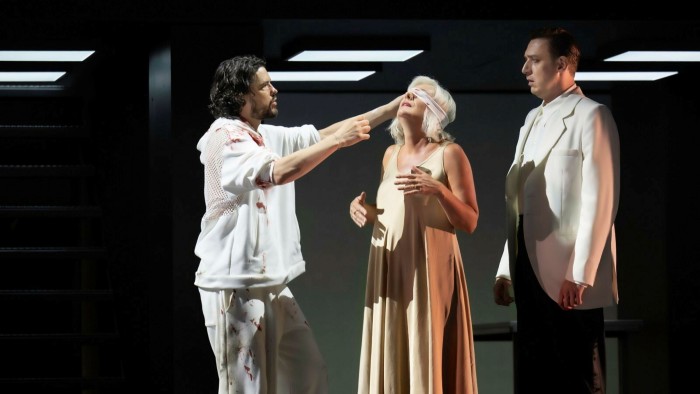
Designer Hildegard Bechtler has created a purgatorial waiting room of black space and billowing beige curtains, part luxury penthouse, part hospital, part nightmare. Are all the men incarnations of Don Giovanni? Masetto is no angel; Ottavio is one long sin of omission, so ineffectual that Donna Anna finally howls at him in frustration.
Perhaps the opera should be called Donna Anna, because she becomes its central figure, the woman whose victimhood is carried and processed with such intensity, courage and honesty that we are all transformed in the crucible of her trauma. This is largely thanks to Golda Schultz’s phenomenal account of the role, a performance with such depth of emotion and musical sophistication that we all begin to breathe with her. The auditorium erupts when she takes her curtain call; this is her night.
The rest of the performers are strong, from Andrè Schuen’s lithe and urgent Don Giovanni through Krzysztof Bączyk’s chillingly detached Leporello to Magdalena Kožená’s desperate Donna Elvira. Madison Nonoa’s Zerlina is anything but innocent, while Amitai Pati’s Ottavio is both introverted and complicit.
Conductor Simon Rattle has a flair for the garish, and he draws out the opera’s macabre moments with evident relish. The Bavarian Radio Symphony Orchestra responds with plush playing, but the whole frequently feels leaden. Why so slow and heavy? Rattle must have his reasons, but it’s hard not to feel that fleeter tempi would lend momentum to an already grim interpretation.
Maybe this is why Aix’s new Don Giovanni falls just short of being thrilling; but this is certainly an intriguing examination of a work that will never lose its relevance.
★★★★☆
To July 18, festival-aix.com
Read the full article here