

Unlock the Editor’s Digest for free
Roula Khalaf, Editor of the FT, selects her favourite stories in this weekly newsletter.
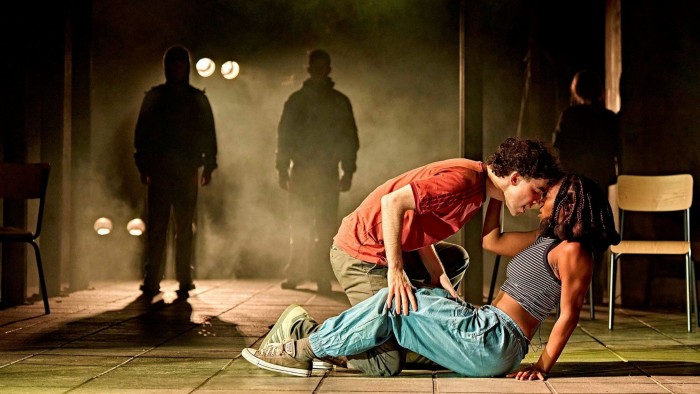
For all the summertime charm of open-air theatre — the nodding roses, the picnic baskets, the Moon peeping over the trees — it can also be an experience that draws us a little closer to those early audiences in the nascent democracy of ancient Greece. The team at Regent’s Park lean into that association with their ambitious, if uneven, staging of Malorie Blackman’s seminal YA novel, Noughts & Crosses. In Tinuke Craig’s production (using Dominic Cooke’s 2007 adaptation) there’s a constant chorus of adults — lurking, watching, shifting from foot to foot — whose forbidding presence expresses the weight of a divided, oppressive society.
Blackman’s novel depicts a country scarred by racist segregation and endemic injustice but where it’s the Black population — the Crosses — who hold all the power and privilege, and who dominate the impoverished white people — the Noughts. That simple twist, making a familiar pattern unfamiliar, succinctly exposes afresh the way systemic discrimination perpetuates inequality, prejudice and cruelty. On stage the divisions leap into stark relief, with the well-dressed Crosses literally on high, parading around the upper tiers of Colin Richmond’s deliberately ugly set of brutalist concrete towers, while the tracksuit-clad Noughts creep about below. Tiny, revealing details speak volumes — a white schoolgirl given a sticking plaster too dark for her pale skin, for example.
Unease swirls around the central teen couple, Sephy (a Cross, and the wealthy daughter of the deputy prime minister) and Callum (a Nought, with a struggling family), whose star-crossed relationship will, like Romeo and Juliet’s, be crushed by outside forces. Callum wins a scholarship to Sephy’s elite school, offering a possible route to success — a route scorned by his disaffected brother, Jude (Alec Boaden), who wants to smash the system, not join it. When Jude joins the underground Liberation Militia, who seek that overthrow the system through force, things get very nasty. Corinna Brown and Noah Valentine bring a winning freshness and openness to Sephy and Callum, their bright physicality and keen energy gradually snuffed out by circumstance.
This is a terrifically timely show to be staging now. But the piece struggles, as so many page-to-stage transfers do, with compressing the weight of narrative. There’s a lot of story to get through, which means that scenes are brief and episodic, dialogue is burdened by exposition or blunt, emphatic statements and there is little room for nuance or character development. A climactic kidnapping feels particularly rushed and clunky, losing its emotional impact.
There’s moving work from Chanel Waddock as Callum’s sister, left deeply damaged after a racist attack, and potently understated performances from Kate Kordel as his conflicted mother and Amanda Bright as Sephy’s mother, blotting out quiet desperation with bottles of Chablis. It’s a show that’s at its best when it embraces theatre’s powerful storytelling tools to meet the original and reassert its resonance — such as Ingrid Mackinnon’s eloquent movement direction, which sends the ensemble spilling out into the dark shrubbery of the park.
★★★☆☆
To July 26, openairtheatre.com
Read the full article here