
Girl from the North Country theatre review — Bob Dylan musical is older but still forlornly beautiful

Unlock the Editor’s Digest for free
Roula Khalaf, Editor of the FT, selects her favourite stories in this weekly newsletter.
We’ve had eight years to get used to the sheer remarkable fact of a Bob Dylan jukebox musical, let alone one that turned out to be so good. The masterstroke of writer Conor McPherson was not to treat this like Mamma Mia! — a slate of hits forced to fit a feelgood story — nor to make it a biography of Dylan, as last year’s film A Complete Unknown did. Instead, he gave us a dark and melancholy play in which reworked Dylan deep cuts — recondite 1970s ballads, shonky 1980s synth numbers — sit delicately alongside lyrical dialogue, the two sometimes barely interacting at all.
It worked: the initial 2017 production at London’s Old Vic led to West End and Broadway runs as well as several tours. Now, with cast members assembled from those various outings, the show fills the difficult summer slot at the place where it started, a venue that’s increasingly a London home for McPherson, whose latest play, The Brightening Air, premiered here three months ago.
After so many cycles it does feel as if Girl from the North Country has shrunk in the wash a little. Minutely diminished, the play’s constant unrolling of tragedies is a little more wearing now, more difficult to ease into, though it remains a remarkable piece of work.
McPherson puts us in Dylan’s birthplace of Duluth, Minnesota. It’s the Great Depression, and everyone’s feeling down. In the boarding house of Nick and Elizabeth Laine — she has dementia, he’s trying to hold things together with foreclosure imminent — sad characters drift in and out. Their son has no job, their adopted daughter is pregnant, and they’re all running away from something, most not fast enough.
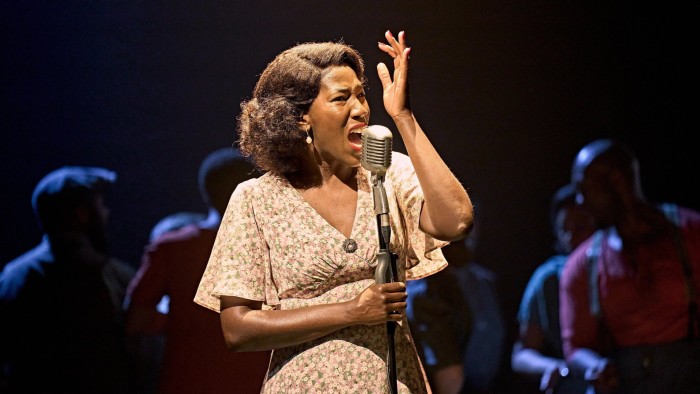
McPherson, directing too, turns these scenes into tableaux cut through with melancholy speeches and Dylan numbers. Weird song choices such as “Jokerman” and “Tight Connection to My Heart” (a delicate, haunting highlight as sung by Justina Kehinde’s Marianne) seem to blow in from another dimension, maybe offering oblique insight into a character’s psychological state, maybe not. “Portraiture”, McPherson calls it: characters standing front-on — it’s a very front-on production, often awkwardly so — and singing directly to the audience. Mood is what binds the whole venture; a pervasive sadness, desperation, not a place of happy endings.
Rae Smith’s period-faithful costumes and set, gloomily lit by Mark Henderson, root us in place and time and help create the crackling tension that McPherson explores in the script: racism and unemployment, disease and hunger, a tinderbox in miniature. On top of that, he adds characters with cognitive decline and learning difficulties, things that need very careful handling, which they don’t always get. Less finely wrought moments stumble into stereotypes and, now eight years old, the show feels a shade more effortful.
But there’s still so much to adore here, not least Katie Brayben as Elizabeth, almost bent double as she howls a devastating version of “Forever Young”. When a character breaks into song, the ensemble stand in silhouettes upstage, clustered around microphones singing harmonies, while stunningly understated arrangements from Simon Hale — fiddle, piano, guitar — give old songs haunting new life. In those moments, quibbles fall away, leaving just the forlorn beauty of it all.
★★★★☆
To August 23, oldvictheatre.com
Read the full article here