

Unlock the Editor’s Digest for free
Roula Khalaf, Editor of the FT, selects her favourite stories in this weekly newsletter.
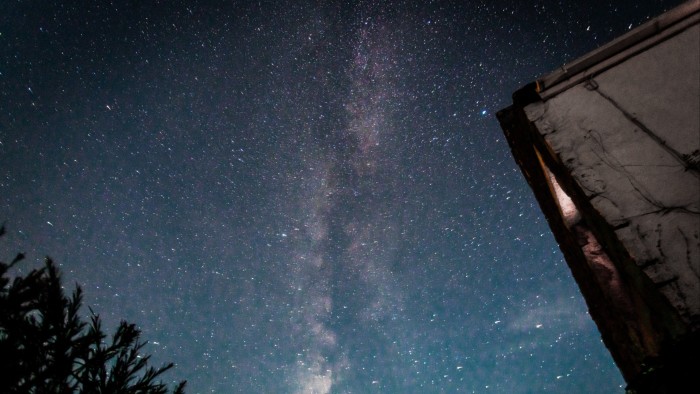
Arifa Akbar is afraid of the dark. At the opening of Wolf Moon we meet her on the island of Sark, off the coast of Normandy, where the night skies are so black that the darkness is “hallucinatory”. She has journeyed to Sark in order to face her fear and to explore the contours of a life-long fascination with the night.
In Wolf Moon we follow in her footsteps as she meets the people of the night — theatre workers, nightclub bouncers, carers and medics among them — and as she explores night-time’s physical and imaginative spaces.
The result is a rich kaleidoscope of a book in which a series of visions emerge from the shadows. An essay on the transcendent glory of Berlin club culture sits alongside a reflection of Muslim religious practices of feast and fast; the streets of London’s theatreland appear in paper proximity to the nocturnal devotions of an order of Shropshire nuns.
Akbar spends a night shadowing workers in a nursing home as they move silently from room to room, tending to patients in the unseen hours; another evening, she observes the professional practice of adult entertainers in Lahore.
Akbar herself is a creature of the city, cycling home in the small hours of the morning along lamplit London streets — until like women across the country she is compelled to rethink her own position in relation to the dark as she watches grainy footage of Sarah Everard being ushered towards a waiting police officer’s car.
Wolf Moon tells a series of stories usually occluded by darkness. Akbar builds a relationship with Tina, a homeless woman who reveals a world in which women cat-nap in the day and stay awake all night in order to protect themselves from attack. She meets Maria, a security guard who has spent a lifetime working as a waitress from 9-5 and then as a doorwoman through the night in order to earn enough money to care for her disabled sister.
Akbar’s sister Fauzia flits in and out of the story as Akbar traces the roots of her own vexed relationship with sleep. Akbar’s first book Consumed: A Sister’s Story told the story of Fauzia’s death from undiagnosed tuberculosis.
In Wolf Moon, she explores another familial relationship as she traces her father’s descent into dementia and the origins of his fear of the dark back through a life shaped by decades of night-shift work to a childhood among the myths of pre-partition India. In those myths the dark is a dangerous place, populated by violent djinns and daayans.
“His sisters made sport out of terrorising him with these stories,” Akbar recalls. “But maybe their menace chimed with the greater political disturbance and threat rising around his home, which culminated in an explosion of violence in 1947, when his family was forced to leave Shimla for Pakistan following Partition.”
Akbar’s father appears in the present-day of Wolf Moon as a resident of a care home, a place in which the fabric of his nights remains a mystery to his family. His silent presence at the heart of the story exemplifies Akbar’s approach to a subject that is both unknowable and amorphous. She is open to the imaginative possibilities of the night — to its terror and shape-shifting, and its potential for dreamers.
But ultimately hers is a story about people rather than dreams. Those who people the night may not always be visible to those who sleep soundly but their stories are rich and complex and infinitely varied. With those people ranged in her mind’s eye Akbar finds that the dark is less frightening. She ends as she began, amid the infinite skies on Sark, but now blackness does not mean fear but instead “an enchanted inheritance, as big as my imagination”.
Wolf Moon: A Woman’s Journey into the Night by Arifa Akbar Sceptre £16.99, 256 pages
Join our online book group on Facebook at FT Books Café and follow FT Weekend on Instagram, Bluesky and X
Read the full article here