
Director Athina Rachel Tsangari on her pungent rural drama Harvest: ‘You can smell the milk’

Early in her directing career, Athina Rachel Tsangari told an interviewer, “I’d like to make a film that works like smell.” Now she has done so. The Greek filmmaker has adapted Harvest, the 2013 novel by English writer Jim Crace — a rural period tale whose richly evocative prose is ripe with the odours of pig, leaf mould, ale and puke. Tsangari’s film is no less aggressively whiffy.
“It’s the most important sense for me,” she tells me when we meet at her London publicists’ office. “There’s a history of disappeared smells that we don’t have any more. This book evokes those — you can just imagine that there’s shit everywhere, orgiastic nature untamed, without pesticides, without organised agriculture.”
She reaches for her bag and pulls out a brown chunky-knit wool sweater that she acquired the day before while screening Harvest in Oban, the part of western Scotland where it was shot. “Smell this,” she says. I take a sniff, and get a delicate but distinct bouquet of Hebridean sheep. “It’s faint now because it rained, but you can smell the milk.”
The fascination of Tsangari’s Harvest is that it doesn’t quite smell right — at least not by the familiar odour palette of British period drama. Crace’s story is about a village community abruptly experiencing catastrophic change, triggered first by the appearance of three distrusted outsiders, then by the arrival of a wealthy, ruthless man exerting his claim on the land; the era is undefined, but is probably a point between the 16th and 18th centuries.
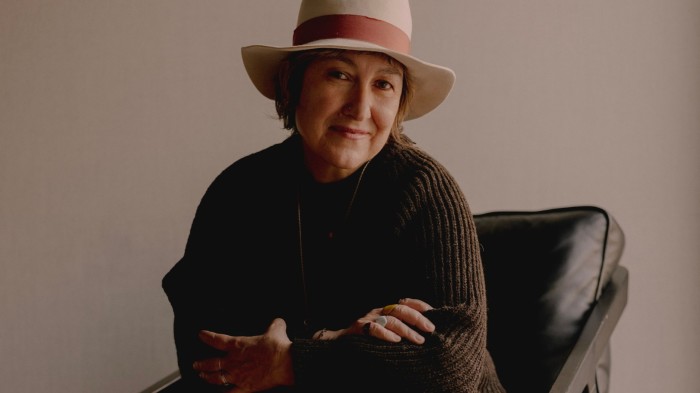
Tsangari’s version, sharply capturing the novel’s tones of violence and dread, is clearly set in Scotland — but the period is tantalisingly nebulous, thanks to liberal use of anachronism. The film’s wildly diverse headgear, for example, includes medieval toques, Edwardian bowlers and the odd Stetson-like number — which would support the director’s description of Harvest as “a revisionist Western — in my head, that’s the kind of genre that I was deconstructing.” Her own hat today is a broadbrimmed beige fedora, a flourish of bohemian swagger.
With its sequences of village ceremonies, some stately, some riotous, Tsangari’s film feels less like a conventional screen drama than a populous, anarchic piece of outdoor theatre. Indeed, Tsangari, who was born in Athens in 1966, says her roots are in drama. “I come from Beckett, Brecht and Ibsen. I come from Euripides and Aeschylus. I was watching theatre voraciously when I was very young, going to the ancient theatre at Epidaurus.”
The Harvest project was originally initiated by one of its producers, Joslyn Barnes, who wrote the original script (Barnes’s previous writing credit was for last year’s Oscar-nominated adaptation of Colson Whitehead’s Nickel Boys). Tsangari took Harvest in an entirely different direction, says the film’s British producer, Rebecca O’Brien. “She takes what she’s got and then she changes it to suit the atmosphere around her. She attracts everybody into her lair, then they deliver this weird thing. She’s an alchemist, really.”
What that means in concrete terms, Tsangari says, is an extended process of movement-focused rehearsal with a large, partly non-professional ensemble, taking in some 70 people. “We always dance the film first. We never talk about the script.” It all goes towards the creation of a temporary community very much like the one shown on screen. “Everyone was helping for the village to get ready — dying fabric with local plants, shearing the sheep, learning how to scythe. It was a commune, basically.”
Among the ensemble, only a few people got to read the script at all — which left participants genuinely surprised by the turns that the narrative took day by day.
Tsangari emphasises that her directing approach is democratic, and involves her talking as little as possible: “There’s no hierarchy between main cast and secondary cast. I don’t consider anyone extras. I’m not intervening in any way — they own it. By the end of the first week, their relationships are there, they’re much more interesting than in the script. They talk to each other, and the fact that I don’t talk to them really makes them in charge.”
There are, however, well-known leads in the foreground, notably Harry Melling as a sympathetic but ineffectual laird; and Caleb Landry Jones as protagonist Walter, a figure who is both insider and, increasingly, outsider in the village. The Texan actor is known for performances that bristle with flagrant eccentricity (Antiviral, Nitram, Dogman), but in Harvest, while he is first seen skinny-dipping and chomping bark off a tree, this is perhaps his most restrained, even muted performance — and a very affecting one.
As Tsangari tells it, she basically showed Jones the landscape and left him to his own devices: “Caleb never talks, he just disappears into his part. You cannot tell him what to do, because he’s actually in trance. He enters a film, he has the accent, the body language — and he was like that until the day he left. We never saw Caleb — we were just with Walter.”
Scottish agrarian conflict might seem alien territory for a Greek director, but Harvest echoes Tsangari’s own rural experience: summers in her youth working on her family’s farmland in Thessaly: “It’s the bread basket of Greece, where you have the big fields, cotton, wheat and barley.” The land had been her family’s for more than a century before being taken over by the state for the construction of a motorway; you can see how that loss might have fed into Harvest.
Tsangari made her name with films very different from her latest in theme, feel and scale. Her second feature Attenberg (2010) was at once glacial and exuberantly absurdist, combining a sombre cogitation on mortality with bizarre animal imitations (the title derives from a mispronunciation of “Attenborough”) and angular dance/walk sequences somewhere between Pina Bausch and John Cleese. Her follow-up Chevalier (2015) was a caustic seabound comedy of male competitiveness.
Her films might seem unconnected, Tsangari says, “but at the same time, they’re all about power and dispossession, whether it’s class or gender. I refuse to have a style — I’m against the tyranny of style, I find that quite patriarchal, actually.”
Attenberg and Chevalier established Tsangari as a central figure, along with Yorgos Lanthimos, in a shortlived but wildly imaginative boom in independent Greek cinema. She was a producer on Lanthimos’s early films Kinetta, Dogtooth and Alps, while he acted in Attenberg: other directors such as Syllas Tzoumerkas (A Blast) and Argyris Papadimitropoulos (the mesmerisingly bleak holiday drama Suntan) were less commercially successful, but feted on the festival circuit.
For Tsangari, the real fuse for that movement was not a film by her or Lanthimos, but a less celebrated 2003 feature, Matchbox by Yannis Economides — “an incredible film; a chamber drama, everyone shouting at once. Very raw, very unapologetic.” Her own Greek role models were two largely neglected women directors, Tonia Marketaki and Frieda Liappa — “incredibly strong directors, both dead now, after being completely mistreated by Greek cinema.”
These days, she says, lack of economic support from the government has left the country’s filmmakers stranded. “There’s a jeopardy in Greek cinema not being able to support its own native language.” As a result, Tsangari, like Lanthimos, has been an international director for many years; between Chevalier and Harvest, she worked in the UK on the BBC’s ménage à trois drama series Trigonometry (2020). Meanwhile, she is keeping a couple of long-cherished projects alive, one of which she describes as “science fiction screwball noir. I really want to shoot it in English and Greek, and I’m not sure it can happen in my country.”
Currently, Tsangari is based in Los Angeles and teaching at the California Institute of the Arts. “For now. I’m a nomad,” she declares. But she’s also enjoying her unlikely new status as a Scottish filmmaker. “I have another film, a smaller, quieter script, that I’d like to do in the Hebrides. So we’re going back home.”
‘Harvest’ is in UK cinemas from July 18
Find out about our latest stories first — follow FT Weekend on Instagram, Bluesky and X, and sign up to receive the FT Weekend newsletter every Saturday morning
Read the full article here