

Latin is a dead language, as dead as dead can be.
First it killed the Romans. Now it’s killing me.
This mutinous mid-20th century classroom doggerel will chime with generations of schoolchildren who have had to tackle the complex prose of Tacitus or have been force-fed Latin irregular verbs. Its implicit contention that the classics are no longer relevant has had all the greater resonance in the past decade; the discipline has been in the spotlight, if not the dock, accused of being elitist and out-of-touch. So how then to explain why publishers and film producers are happily filling their schedules with stories of Greece and Rome?
In essence, the anti-classics argument runs as follows: the subject matter is Eurocentric, imperialist and patriarchal — in short outdated. The popularity of the meme asking “How often do you think of the Roman empire?” chirpily fed this narrative. The broad conclusion was that men, by and large, were more fascinated by — if not admiring of — imperial Rome than women. While humorous, it was seen as another item on the 21st-century anti-classics charge sheet.
Expanding on all this, the distinguished Austrian historian Walter Scheidel has rolled a literary hand grenade into classics faculties. In his latest book What is Ancient History?, he calls for a revolution in the teaching of classics. Departments that seek to address the whole of Greek and Roman life and thought, from language and literature to history and philosophy, should be broken down into their constituent parts, he says. In particular, he argues, Greek and Roman history should be one part of a global ancient history syllabus.
Scheidel’s inquiry into how Greece and Rome came to be on an academic “pedestal” and to dominate western establishment thinking in the colonial era is unflinching — and peppered with intriguing historical detail. He partly dates the trend to early 19th-century German scholars and writers such as Goethe and Humboldt turning away from the ethos of the then European superpower Napoleonic France. “For good measure French was eliminated as a mandatory subject [in German schools],” Scheidel writes. “Out with the archenemy, in with the ancients.”
In an earlier book Scheidel made the provocative case that the fall of Rome was essential for the birth of Europe. His overarching argument here that western curriculums should pay more attention to the deep history of the Near East, say, or South Asia is incontestable. And yet classics departments need not be too defensive over what is something of a j’accuse. Many have been thinking hard for years over how to attract and adjust to new audiences.
Also, however much faculties may or may not need to keep rethinking their approach, you only have to stroll through a bookshop or look at movie listings to see that the stories told by the great Latin and Greek writers retain a stunning hold on contemporary imagination.
In recent years publishers have seized on feminist reimaginings of Homer and the legend of the Trojan war. Pat Barker’s retelling of The Iliad through the eyes of Briseis, a Trojan princess-turned-slave-girl of the Greek warrior Achilles, and Madeleine Miller’s Circe are among several novels to have shifted the authorial gaze and breathed new life into these old stories via the largely unexplored perspective of the female characters.
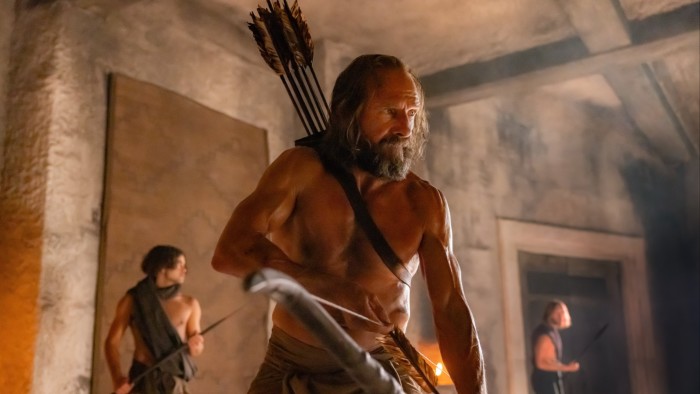
Now, it seems, we are in a new age of The Odyssey, with two star-studded films and an(other) important new translation. The Italian director Uberto Pasolini’s bleak rendering, The Return, which casts Ralph Fiennes as the battered eponymous hero, and Juliet Binoche as Penelope, his long-abandoned wife, came out this summer. Christopher Nolan’s take, assumed to encompass the full tale, is due next year, with Matt Damon in the lead role.
The Odyssey may lack the pitiless focus and tragic intensity of The Iliad. The former unspools over 20 years and on a vast canvas around the Mediterranean, whereas The Iliad unfolds over just a short period on the dusty plain outside Troy. But The Odyssey is unquestionably the more modern of the two in narrative and outlook, an observation that fuelled the long-running historical question as to whether the two epics really were composed by the same poet.
In the popular mind, The Odyssey is seen as the ultimate journey of adventures and self-discovery, via trial by monsters, temptation and more. But it is less well known that over two-thirds of the drama unfolds on the island of Ithaka, where Odysseus’s wife Penelope and son Telemachus have waited and waited for his return from Troy as dozens of suitors vie for the chance of filling his place. This is very much a story of marital and filial relationships. Pasolini’s film bypasses Odysseus’s wanderings and begins with his arrival home.
As Daniel Mendelsohn writes in the introduction to his new translation, “despite the gripping quality of the adventures, most of The Odyssey either takes place at or is preoccupied by Ithaka, home.” The tension over the relationship between humans and the gods has retreated from its central position in The Iliad to be replaced by a focus on human relationships. “The marital crisis, the coming-of-age crisis and the political crisis are elaborately interwoven throughout,” he writes.
Mendelsohn, a New Yorker essayist and academic, is the author of a deeply moving memoir about teaching Homer, fathers and sons and more, based on retracing Odysseus’s journey with his own ageing father. He has gone one step further in his affinity for the epic, with the latest Penguin Classics translation, a remarkable piece of writing that hews closely to the hexameters of Homer’s original.
His translation reads as an elegant, more languorous if not traditional complement to the acclaimed 2017 translation by the British-American classics professor Emily Wilson. With its brisker iambic pentameters, it was hailed for its modern sensibility. Reviewers saluted not just her pace and poetry but also her choice of words, including the use of the word “slave” instead of the more standard “maidservant”, to confront the poem’s patriarchal heart. Her translation chimed all the more with public sentiment, given that it was published soon after the launch of the #MeToo movement. Her recent translation of The Iliad was also widely lauded.
So why the enduring resonance? Robin Lane Fox, reader in ancient history at New College, Oxford (and the FT’s gardening columnist), likes to make a bravura case for how a life without reading Homer is a life unlived. But he also deploys more than romance to explain his life’s mission, highlighting two of his many adamantine defences of Homer and the classics in this or any age. First: Homer and then the Greek dramatists are the foundation stones of western literature. Second; the ideas of the classical philosophers over how to live a life, along with the Greek and Roman debates over how to run a state, are as relevant as ever.
The latter point is all the more pertinent now amid wrenching debate over the health of global democracy, not least in America under Donald Trump. In a recent interview with the FT, John Bolton, the veteran Republican hawk and former Trump adviser turned arch-critic, sought to reassure the president’s opponents explicitly via the history of the late Roman Republic. Trump, he said, was neither Sulla, Catiline, Pompey, nor Caesar, whose actions hastened the Republic’s demise.
In this context, Josiah Osgood’s Lawless Republic, a history of those dramatic years via the life of the great orator Cicero, is timely and essential reading. In his epic trilogy, the novelist Robert Harris made the wily schemer into a character who would have fitted in Westminster in the turbulent past decade. Osgood, professor of classics at Georgetown University, has written the non-fiction complement. Time and again as you read his account, parallels with America’s rancorous politics come to mind.
Demagoguery, the politicisation of the courts, ineffective campaign finance rules — all these issues bubbling away in Washington played out in Cicero’s time, albeit with higher stakes; Cicero lost his life for backing the wrong side. “If a senator had enough money and the right connections could he place himself beyond the reach of law?” Osgood reflects via Cicero’s prosecution of the corrupt magistrate Verres.
When addressing Cicero’s own ambitions, he writes: “campaign finance was a contentious issue because the line between generosity to voters and bribery could be hard to draw.” Has anything changed? (Osgood writes with precision and a light touch. He is, to be clear, no ivory-tower Latin elitist. In a debate at the FT Weekend Festival he merrily saluted the second Gladiator film, gory romp as it is, for keeping Rome in the public eye.)
Traditionally classics courses were made up of literature, history and philosophy. Publishers have delivered their share of cod classical philosophy in recent years; just look for slim volumes by the checkout with the word Stoic or Epicurus in the title. But the introspection of the Covid years, the distractions of the digital world and the prevailing political uncertainty have all encouraged a renewed searching look at the big questions. Few have taken this on with more gusto than Agnes Callard, essayist, philosopher and author of Open Socrates: The Case for a Philosophical Life.
Callard first came to the attention of the University of Chicago as a 21-year-old student when she decided to be a latter-day Socrates. She would walk up to students at random posing big questions, whether about art, courage or the meaning of life. Hers is a gem of a book, serious and clever yet funny and playful too. She has no time for Tolstoy and his conclusion that the examined life was not worth living. Nor, unsurprisingly, does she think much of the “15-minute life” which most of us pursue, addicted as we are to our smartphones.
“So what is Socrates?” she asks. “Is he the gadfly who leaves people stunned, bereft, lost and confused or the midwife who helps birth their beautifully clear idea-babies?” We know what she thinks. We cannot all be expected to live a philosophical life but she makes an excellent case for it, and as she does, she encourages a rethink of much you may take for granted.
Scheidel is careful to stress that he is very much in favour of the classics thriving, and he may be right that classics departments need radical change. But he should be careful of the potential consequences of his campaign. Latin and Ancient Greek may be dead, but their writers are very much alive and we are all the better and more questioning for it.
Alec Russell is the FT’s foreign editor
What Is Ancient History? by Walter Scheidel Princeton University Press $29.95/£25, 328 pages
The Odyssey by Homer: A new translation by Daniel Mendelsohn Penguin Classics £30/University of Chicago Press $39, 560 pages
Lawless Republic: The Rise of Cicero and the Decline of Rome by Josiah Osgood Basic Books $32/£25, 384 pages
Open Socrates: The Case for a Philosophical Life by Agnes Callard Allen Lane £25/WW Norton $35, 416 pages
Join our online book group on Facebook at FT Books Café and follow FT Weekend on Instagram, Bluesky and X
Read the full article here