
Tony Hawk’s Pro Skater 3+4 review — updated skateboarding games offer bittersweet nostalgia

Unlock the Editor’s Digest for free
Roula Khalaf, Editor of the FT, selects her favourite stories in this weekly newsletter.
When it arrived in 1999 for the original PlayStation, Tony Hawk’s Pro Skater didn’t just reforge skateboarding games but sports games as a whole. Skateboarding legend Tony and his pro skater pals, including Kareem Campbell and Elissa Steamer, pirouetted across expansive settings (such as a school and mall), ollying from gap to grind rail before dropping into a vert ramp to perform big-air tricks, including Hawk’s famous 900 (two and a half revolutions). This outlandish, freewheeling take on the sport honoured both the considerable skill of its premier athletes and their undeniable cool.
The key was how California studio Neversoft approached the sport: it cared more about vibe than simulation (although the studio went to great lengths to motion-capture Hawk so the tricks at least looked real). Across three more classic entries, Neversoft refined and expanded the original’s vision, bottling the sport’s unruly MTV and Jackass-adjacent personality to a soundtrack of hard rock, punk and hip-hop, all while leaning into an increasingly absurdist sensibility (in the third game, players cavort on a cruise ship). For those of us with an aversion to scraping our knees on concrete, these games were God-sends: an invitation to enjoy the activity and captivating subculture from the safety of the sofa.
Now, more than two decades on, we have remakes of the third and fourth entries in the series (following remakes of the first two in 2020). Booting up Tony Hawk’s Pro Skater 3+4 feels just as it did on the PlayStation 2. Opening level Foundry remains a magnificent playground of clanging surfaces and deadly molten metal, albeit with cutting-edge graphics that ensure the game looks as good on new HD screens as it does in treasured memories.
Functionally, the game plays identically to its source material: ie, in proudly arcade fashion. If you enjoyed the originals, let the muscle memory kick in: within a few minutes, you’ll be stringing massive combos across entire levels without breaking a sweat. Airport is still the pick of the bunch: an elegant strand of skate lines that evokes a Sonic game as much as skateboarding.
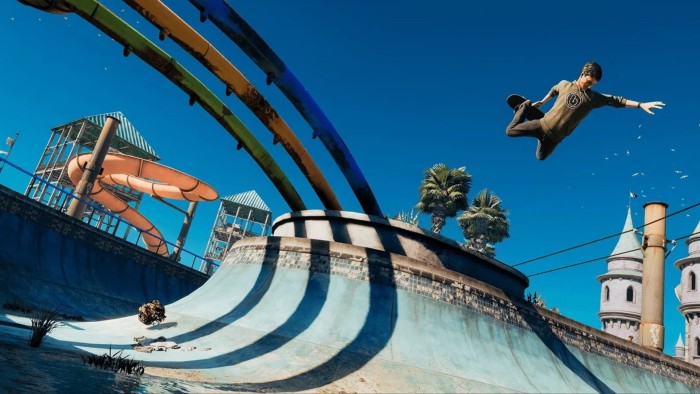
But there are changes. For a start, the soundtrack has been updated (apparently under the direction of Hawk himself). Classics such as AC/DC’s “TNT” are out; now we have the hyperpop stylings of 100 Gecs and Irish alt-rock by way of Fontaines DC. The biggest change is to the open world-lite fourth entry and the ditching of its Career Mode; in its place are a two-minute timer and a list of goals, just like in the first three games. Of the handful of new levels, Waterpark, full of emptied-out pools, is the lolloping, topsy-turvy standout.
And yet, for all the quality-of-life tweaks and modernised sound and visuals, this is perfectly calibrated nostalgia, albeit with a bittersweet tang. When one looks back to the turn of the millennium, it’s clear that these games helped usher in a new wave of vibrant, expressive sports titles that honoured their subjects with gusto and imagination: the likes of snowboarding title SSX Tricky and basketball game NBA Street. Tony Hawk’s and its followers offered irreverent takes on sport in full 3D.
Today, realism is king. In the likes of EA Sports FC (formerly the FIFA football series) and NBA 2K, strands of hair and beads of sweat are illuminated by stadium lights and balls bounce with pinpoint physical realism. These games make us follow the many rules and regulations of their chosen sports while perhaps subscribing to a narrower idea of sporting excellence. In their slavish commitment to replicating the audiovisual presentation of broadcast television sports, they are — whisper it — a little dull.
The beauty of the Tony Hawk’s games was their flexibility: players could find their own swaggering skate style in settings that rewarded speed and exploration. Every piece of guttering was an opportunity to grind; every table and set of steps was an opportunity to get air; above all, each level was a puzzle which subtly rewired a player’s conception of space, just like the real sport. In the early 2000s, these games felt ahead of the curve; it’s a testament to their design and anarchic attitude that they still do.
★★★★☆
On Nintendo Switch, Nintendo Switch 2, PlayStation 4 & 5, Windows, Xbox One and Xbox Series X/S now
Read the full article here