

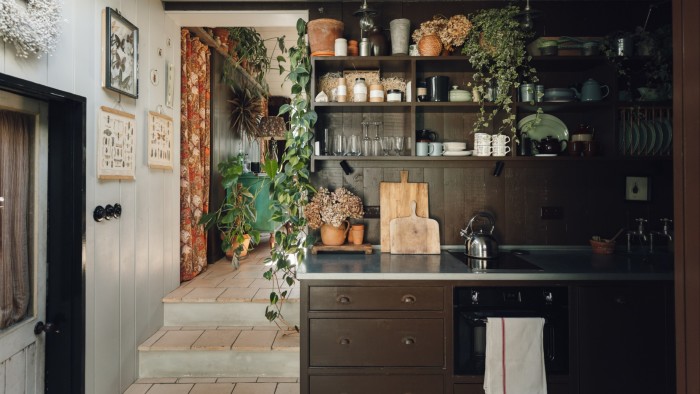
In the tiny Norfolk hamlet of Hunworth, software company director Ana Perez doesn’t have to go far to work on her side hustle — only to the bottom of her garden. There, she has turned the 18th-century gardeners’ cottage into an atmospheric, quintessentially English escape. The living room is dominated by a huge, stone fireplace with bellows, a stack of firewood and two easy chairs; curtained doorways lead to an antique four-poster bed that you have to climb up into; steps down to a Tadelakt-covered walk-in shower. Fabrics are rose-strewn, paints are the deliciously sludgy hues of the earthy countryside. Spinks Nest may be small, but its success has gone global — featured and celebrated as a holiday rental far beyond British shores.
More of us are renting out second homes, or even cabins and tree houses in the garden. In Britain alone, data released this month by Visit Britain shows a 7 per cent increase in the number of short-term rental properties available, with 481,563 properties on sites including Airbnb, Booking.com, Vrbo and TripAdvisor during May. Added to that are those on upscale booking sites: boutique companies including Kip Hideaways, Onefinestay and Canopy & Stars all report increased supply, with Canopy & Stars recording an 850 per cent increase in shepherd’s huts alone.
But when there’s no shortage of places to rent for a weekend away — a report by Savills found a 9 per cent supply growth across the UK between December 2023 and December 2024 — making a property stand out requires a “combination of thoughtful design and a real sense of place”, says Sarah de Vere-Drummond, co-founder of Kip Hideaways, whose bookings for the first six months of 2025 are up 28 per cent on the same period last year. “Guests want to feel transported.” And there are numerous design routes to that feeling of escape.
One is the handcrafted and homespun, which de Vere-Drummond highlights in two hand-built huts in Essex on her books. Owned by Ffion Francis and Ollie Speck, they sit on three acres of wild-flower meadows in their back garden beside a wild swimming pond. “The owners created everything from scratch, from hand-sewing the furnishings to digging out the pond,” she says. It’s a similar handcrafted vibe at River Cabin in the Scottish Highlands, where the owner — who grew up there — “spent years restoring a 1950s fishing hut into an off-grid retreat, [overseeing] every detail from spring-fed showers to a porch inspired by the American deep south”.
Savills reports a 242 per cent increase in web searches for “unusual places to stay” in 2024 compared with 2023 — and huts and cabins, which often lean into this homespun vibe, are at the top of searches. That, in turn, is driving sales of shepherd’s huts: Plankbridge, which supplies huts for hospitality brands such as The Pig Hotel group, says 50 per cent of its sales are now for guest accommodation, such as its best-selling model, the “Guest House” (£54,800). At Aller Dorset, the bespoke Plankbridge shepherd’s huts all have outdoor baths. For two of them, which cost £245 per night in high season, “we upped the game and created tiled bath areas, like a bathroom with no roof”, says owner Catherine Earp. “My husband thought I was nuts, but they have been the most popular and are almost fully booked for the summer.”
For Bianca Fincham, founder of fashion and lifestyle PR agency Fincham Communications, striving to match the expectations of guests who might otherwise choose to stay at The Newt in Somerset, Estelle Manor in Oxfordshire or Beaverbrook in Surrey is the aim. Her Georgian house in Penzance, Cornwall, sleeps 10 (with a separate cabin that sleeps a further two) and is furnished with top-of-the-tree fixtures and fittings: a Bertazzoni range, Aarke kettle, Sabre cutlery, Astier de Villatte vases, Original BTC lighting — alongside antiques and beautiful linens.
“Often people would say ‘just get an Ikea bed’,” Fincham says, “but we knew we couldn’t scrimp on the important aspects.” That meant a custom-made Nicola Harding NiX bed, British bedding brand Floks mattress, duvet and pillows, and Beata Heuman lights — even in the cabin, which adjoins the house.
It’s not without risk: “We had a gorgeous huge cream rug in the living room that had so many spills on it,” she sighs. They eventually had to get rid of it. But the investment in design has paid off: while Cornwall and Devon are “saturated with overpriced offerings”, according to Savills, and occupancy rates here are down according to Visit Britain, by comparison, Fincham has solid bookings for the whole of summer, when rates are £6,212 a week, via Boutique Retreats. “Post Covid, everyone was staycationing, but now attracting guests is harder, so offering something special is key,” she says.
The power of upscale design to attract the best-paying (and most appreciative) holidaymakers is something that fashion boutique owner Kyong Millar recognises. When she and her husband bought a 500-year-old property in Provence four years ago they threw everything at the renovation (which they managed from their home in Utah), adding a stone-lined plunge pool in the courtyard, a kitchen with a Lacanche range and antiques from local markets. Their finished project — Maison de Frédéric — sleeps eight and costs €12,000 a week and has so far hosted all American guests.
In the Belgian city of Ostend, the design focus at the two-bedroom sea-view apartment owned by couple Albane Paret and Micha Pycke — founders of PR and communications agency Club Paradis — is next level. The space, designed by Paret, is kitted out exclusively in collectable pieces, with a focus on Belgian talent, from celebrated duo Muller Van Severen to emerging name Amber Dewaele. The scheme will be overhauled annually, and not only can guests stay there, they can also shop there; all the furniture and objects are for sale.
For many other rentals, specificity of location is also the design cue. In Italy, Scarlett Conlon’s adopted town of Abruzzo is the inspiration for the one-bedroom apartment she rents out in the 19th-century Palazzo Magnarapa; she has styled it with mid-century furnishings and local Abruzzese and Italian art. It is “all aimed at providing the most authentic experience possible” for her guests.
Similarly, West Cottage in Dungeness, a short walk along the shingle beach from Derek Jarman’s cottage, leans into the ruggedness of its surroundings. Owner Kathryn Morris has decorated the early 20th-century cottages, either side of a former lighthouse, in a simple Shaker style. Colours are muted, all simple creams and blues; fabrics are natural linens and woven raffia. Walls are mostly bare of art to let the views speak for themselves.
“The buildings have very simple, elegant proportions, and a solidity that feels calming and protective in such a wild extreme environment,” she says. Many of her repeat guests “say they feel particularly inspired and focused here, and come to write or paint, or just walk on the beach and breathe”.
“What we do is all about the place,” agrees Charlie Gladstone. Celebrating his property’s storied history is the sweet spot at the 18th-century Hawarden Castle in Flintshire, Wales — his home. It’s where his great-great grandfather William Gladstone, former British prime minister, once lived, and whose library is still perfectly preserved in the main house. The family recently renovated the castle’s west wing to allow up to 10 guests to stay, and decorated it in the colourful, maximalist style they enjoy, as well as dotting it with sketches, letters and diaries from another family member, the photographer Cecil Beaton (Charlie’s great uncle).
Sharing personal, historical stories is paramount, he says. “It offers real depth to the stay,” he believes. It’s also an exercise in trust. A painting by JMW Turner hangs on the landing, and personal ceramics and art line the shelves and walls. “My general view is one of faith in human nature; if you treat your guests well, they treat you well,” he says. “It’s about mutual respect.”
Find out about our latest stories first — follow @ft_houseandhome on Instagram
*
Read the full article here