

There are few destinations that have hosted both Jesus and James Bond. With its arid landscape and millennia-old cave dwellings, Matera, an isolated city built on a rocky outcrop in Italy’s Basilicata region, doubled for biblical Jerusalem in Mel Gibson’s 2004 film The Passion of the Christ. Then, in 2021, Daniel Craig’s Bond began his swansong, No Time to Die, with a high-speed chase through its ancient streets.
Even after the blaze of 007 publicity, however, Basilicata remains comparatively under-the-radar, Italy’s least-visited region apart from diminutive Molise. Tourists heading south are more likely to choose neighbouring Puglia, which gets four times as many visitors, despite Matera’s status as one of Europe’s oldest and most fascinating cities, and one of the country’s greatest tales of rebirth.
My husband and I have been drawn not by a film but a new hotel, the Vetera Matera, in one of the city’s two cave districts, Sasso Barisano and Sasso Caveoso. The oldest caves date back to the Paleolithic era and, over the millennia, they were gradually expanded as residents burrowed deeper into the limestone hillside, creating a honeycombed city. On a tour of the Sassi districts arranged by the hotel, we climb up and down stone staircases, along swooping pathways and past stone facades. Our guide Silvio Scocuzza, a native Materano, points out ammonite fossils in walls and bell-shaped cisterns that ancient residents used to harvest rainwater.
The city grew into a strategic hub — the capital of Basilicata in the 17th century and home to aristocratic families who built palazzos on the ground above the Sassi, using the caves mostly for the production and storage of olive oil, wine and cheese.
But when Basilicata’s capital moved to Potenza in 1806, Matera became severely impoverished and, over the next two centuries, the caves were used as homes by poor farming families, who moved into the dark airless spaces with their livestock to use as a heat source. “They needed large families to survive,” Scocuzza says. “Children had to be put to work.”
The Italian government evacuated some 16,000 residents of the Sassi in 1952, citing overcrowding, unsanitary living conditions and widespread disease, rehousing them in new developments on the outskirts of the city. Matera, with an infant mortality rate of 44 per cent, was known as “the shame of Italy” and for the first time in thousands of years, the Sassi lay empty. “It was like a bombed city,” Scocuzza tells us.
We poke our heads into an abandoned cave, and later a museum, each showing where families of typically nine or 10 were housed. It is unimaginable that people were living in such quarters without sanitation — or natural light — in living memory. “They survived by spending a lot of time outside, working and socialising,” Scocuzza says.
Exploring Matera today, the turnaround is extraordinary. Materani began returning to the Sassi in the ’80s, driving revitalisation efforts that were eventually aided by the Italian government. In 1993, the Sassi, along with the rock-cut churches on the surrounding Murgia plateau, were granted world heritage status by Unesco as the most outstanding, intact example of a troglodyte settlement in the Mediterranean region.
Around 2,000 residents now live in the Sassi, some of whom we see outside their homes hanging laundry and tending to plants, though the caves have mostly been transformed into museums, galleries, shops, restaurants or hotels. Our bolt-hole for the weekend, the Vetera Matera, opened in April and is the longtime project of a local dentist, Michele Iacovone.
“He is very proud of being Materan and wanted to show Matera to the rest of the world”, says Marco Cagnetta, the hotel’s general manager. The five-star hotel and spa is the most ambitious hotel project ever undertaken in the Sassi, an amalgamation of several neighbouring properties — the first purchased 18 years ago — encompassing historic buildings, caves, terraces and courtyards (including the main courtyard which was once the outdoor living space for some 100 cave dwellers). Construction on the hotel started eight years ago, and in 2023, Iacovone brought on Gruppo Bellevue, a family-owned hospitality group, to see it through to completion and manage the day-to-day operation.
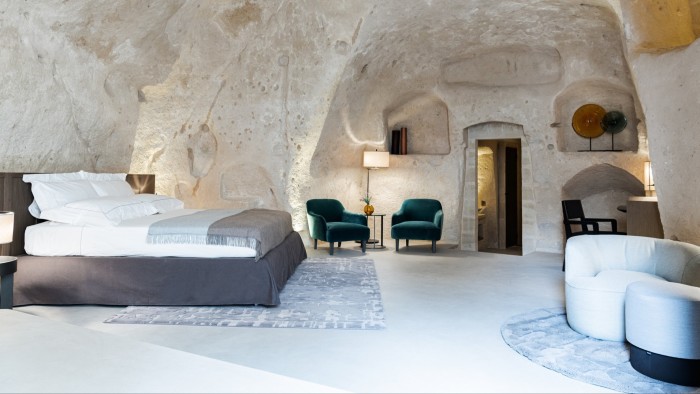
The 23 rooms, eight of which are suites, are all unique, spread between caves and above-ground rooms with large windows in “new” buildings that date to the 16th century. It is the troglodyte set-ups, however, that are truly staggering — a melding of thousands of years of history and sensitive, modern design. Our room descends underground in tiers, stylishly decorated with neutral-coloured furnishings, low-lighting and original shelves that had been carved into the limestone walls. The very deepest level, which once would have kept livestock, holds an L-shaped, spa-style pool.
“When the reconstruction was started, you could touch a wall and it would crumble, because it was so full of water and humidity,” Cagnetta says. “One reason the renovation took so long is because it took ages to dry out the stone.” Putting in electricity and plumbing were another challenge, which sometimes required drilling through five-metre thick walls, while complying with strict heritage rules. “Italian [bureaucracy] is slow, but in Matera, everything is even slower,” Cagnetta says.
The next morning, we meet our hiking guide, Cosimo Burgi, another Matera native who worked abroad as a geologist before returning to set up a sustainable tourism business. “[Materans] carry the ‘shame of the nation’ title, but when I started travelling and meeting new people, I realised that what we have here is very special,” he says.
We descend into the surprisingly verdant canyon below Matera, crossing the Gravina river by suspension bridge and climbing the opposite side of the Murgia. Here and around Matera, some 150 churches are carved into the calcarenite rock, some primitive (just caves), others far more elaborate, with vivid frescoes or panoramic views of the city across the canyon.
Gazing across to the Sassi, Burgi says, “When I was a kid I was forbidden to walk there . . . it was a place for drug addicts, full of rubbish and used as a dumping site.” Today the clean stone streets glisten under the spring sun.
We finish our walk at San Falcione, a complex rock church with arches and faded frescoes of its titular saint, before taking a 20-minute taxi to the Crypt of the Original Sin. Known as the Sistine Chapel of Matera, its 8th-century frescoes — colourful Old and New Testament scenes painted across the walls and ceiling — are some of the best-preserved in the region and remarkable examples of early Christian art.
The land here, on the outskirts of Matera, is more familiar Italy, with olive trees, vines and golden fields of durum wheat, the main ingredient in pasta. Some say Basilicata, one of Italy’s top producers of durum, may be the birthplace of the Italian staple. With this culinary legacy, it’s surprising that of Italy’s 20 regions, Basilicatan (also called Lucanian) cuisine is one of the least known. It is certainly a blind spot for me, despite a life-long dedication to cibo Italiano, so back in town, we link up with Claudio Latorre, a Materan sommelier and food guide, to remedy this ignorance.
At our first stop, a truffle hunter’s shop, we munch on toasted bread topped with heaps of delicately shaved tartufi, harvested in Basilicata’s forests. The flavours are gentler than the varieties found elsewhere. “Not like gasoline,” Latorre says proudly.
Afterwards, we settle in at an osteria for a glass of white wine, made with the indigenous Aglianico grape, and an array of local salumi, cheese and bruschetta with artichoke, tomato and turnip pastes. There are also cruschi peppers, a beloved Basilicatan snack: long red peppers that are dried in the sun, then fried, and eaten like crisps.
Despite the abundance of pasta, we learn that it is bread that is the most cherished carbohydrate. Pane di Matera has been baked here for thousands of years and is characterised by its enormous size (up to 10kg) and mountainous shape. We meet a local baker, who teaches us how to knead, fold and cut the dough.
“Materans made 5kg of bread once a week — it was the majority of the diet. They couldn’t afford anything else,” Latorre says. Dough was brought to a public oven, stamped with a family’s initials, and cut three times along the side for the Holy Trinity. “When people are broke they become very religious and superstitious,” Latorre says. “We were a couple of centuries behind other civilisations.”
Matera still seems an otherworldly place, its history and traditions both preserved and restored. Rumour has it that Gibson is scouting locations here for his next Christian epic, about the resurrection. It is a theme Materans know all too well.
Find out about our latest stories first — follow FT Weekend on Instagram, Bluesky and X, and sign up to receive the FT Weekend newsletter every Saturday morning
Read the full article here