

Unlock the Editor’s Digest for free
Roula Khalaf, Editor of the FT, selects her favourite stories in this weekly newsletter.
The South African surfer-turned-winemaker Duncan Savage has made a career out of finding great vineyards that have been neglected or overlooked. One day, though, on a recce to Cinsault vineyard on a sheep farm in Darling in the Western Cape, he realised he was completely lost. When he called the farmer, for the third time, asking for directions, the owner blew his top: “He said, ‘Volg die fokken telefoon lyn’ [follow the fucking telephone line],” recalls Savage. “Our first meeting was rather brief, but over time we became the best of friends.”
The wine that resulted, Follow the Line, has since become a totem for the South African new wave — a movement that’s been venturing off the beaten track in search of old vines that were previously just blended away in mass-produced bulk wines, but which are now being reappraised.
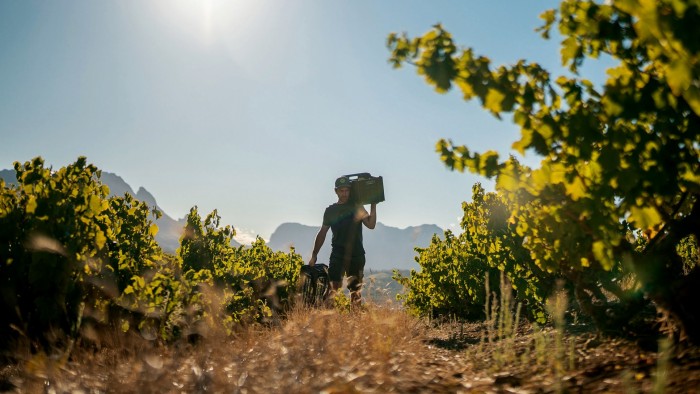
Old vines tend to produce lower yields but fruit that’s more concentrated and complex. Because of their more fully developed root systems, they’re also better equipped to endure climatic extremes like drought. A lot of the oldest Garnacha/Grenache vines in South Africa are in the Piekenierskloof — a rugged plateau in the Citrusdal mountains about two hours north of Cape Town. New wavers, including Savage, Blank Bottle’s Pieter Walser and Eben Sadie, all come hunting here. The launch of Swartberg Wingerde by Rudiger Gretschel, a vinous hitmaker who helped shape Boekenhoutskloof, Chocolate Block, Krone and Reyneke, has further raised its profile.
“I grew up in the Namibian desert,” says Gretschel, “so the wildness of Piekenierskloof speaks to me. It has always been my dream to own a vineyard here — I like this idea of hardy things thriving in the heat.” Gretschel’s 1,055ha estate (most of which is uncultivated shrubland) is so off-grid it even eludes Google Maps (when I visit, he meets me at a nearby truck stop). His HQ is a little white-washed cottage, without electricity, mobile or WiFi. “I try to visit with my wife and children as much as we can — there is a peace and wholeness here.”
Gretschel’s pride and joy are two plots — one Garnacha, the other Palomino — dating back to 1966, which he bottles as a pair of single-variety wines called Holism. When I visit these vineyards in summer, the air is shimmering with heat; the ankle deep sand is so hot I can feel it scorching the soles of my shoes. But cool Atlantic breezes prevent the grapes from being over-cooked — “they give the wines lift and lightness,” says Gretschel, “and make it possible to make something quite delicate.”
Back at the cottage, in the shade of an oak tree, we settle down to taste, accompanied by birdsong and the occasional bark of a baboon. The 2023 Holism Palomino parries the heat with thirst-quenching notes of nashi pear, green grape, white flowers and a subtle saltiness. The 2023 Garnacha has a fabulous perfume of wild strawberry, pepper and black mint. “What else can you stick in the ground, not water for 60 years and get fruit from like this?” says Gretschel. “It is a miracle.”
Equally revelatory are the wines of Damascene, an Elgin-based producer that buys fruit from “marginal sites” across the Western Cape. “It’s on these sites, where almost everything would struggle to survive, that vines really show their full potential,” says winemaker Jean Smit. “Very few of these vineyards are pretty, because they’ve been hammered by high winds, poor soils — they’re diamonds in the rough.”
Damascene’s beautifully turned portfolio of regional wines throws terroir into sharp relief. A 2023 Chenin Blanc from the granitic mountains of Swartland has a tropical vibrancy and a silky texture. A Chenin from the more mixed soils of the Stellenbosch hilltops, by contrast, leans towards crisp green apple, nectarine and an appetising pithiness. Three Syrahs from Stellenbosch, Swartland and the Ceres Plateau show different facets of the grape – from aromatic and spicy, through to brooding and muscular, and lushly fruity.
Tracking down vineyards this good takes dedication and time. You have to win the owner’s trust. “We talk about weather and the soil, but people are also part of the terroir,” says Smit. “What they talk about in the vineyards 1,000m above sea level is completely different to what they talk about in Stellenbosch — it’s a totally different mindset. You don’t just turn up and tell a farmer whose been on that land for generations what to do. When we start working with a new vineyard, I just listen for the first couple of years.”
@alicelascelles
Read the full article here