

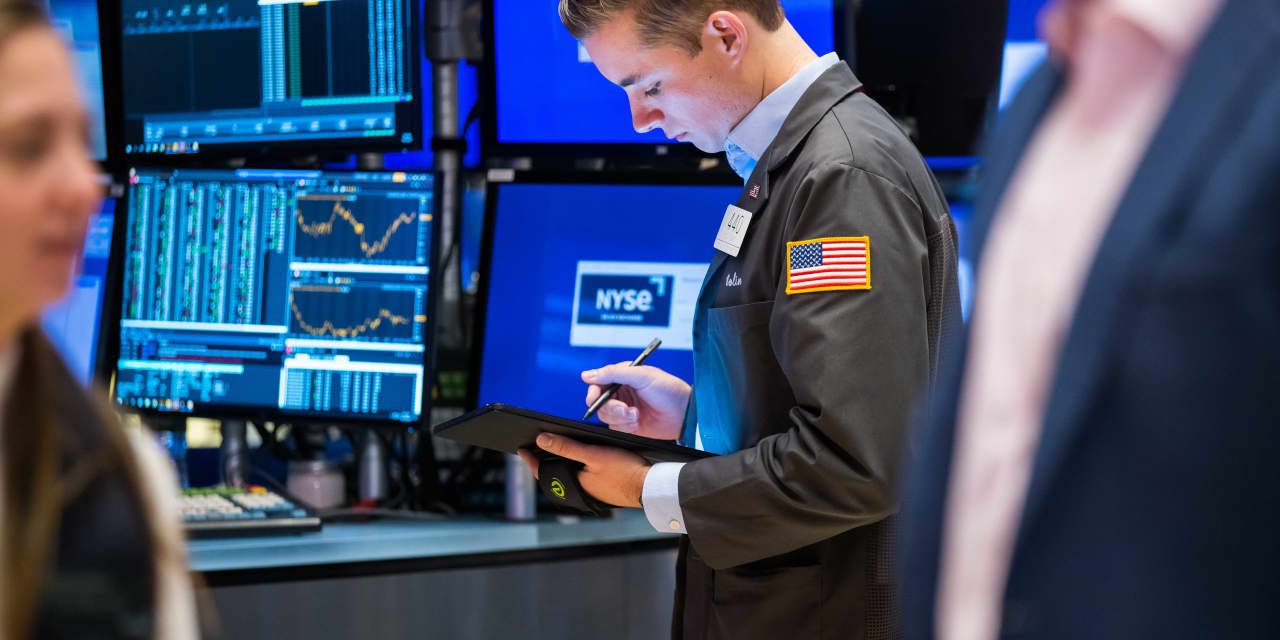
Stock trading became a fad during the pandemic before petering out. Now the cohort of traders is quietly coming back into the fray.
Retail-trading fluctuations can be an indicator of how strong or weak market sentiment is. When the volume of retail trading is too high, and stock market sentiment is too positive, a rising stock market may be in for challenging times ahead.
In the summer of 2020, the five-day moving average of retail orders as a percentage of daily share volume for the 1,500 largest stocks on the
Russell 3000
hit just over 14%, according to Morgan Stanley. That’s the highest level since at least 2016, marking a peak in activity. At the time of the retail trading peak in 2020, the stock market had soared from its pandemic-bottom. Stocks were becoming a polarizing—and widely discussed—public topic, since the economy had still not recovered. But interest rates were falling and well-known technology stocks were leading the market higher, igniting people’s interest in the market.
Then, even though retail trading moderated, it remained elevated for a while. For much of early 2021, during the meme stock craze, the five-day moving average of retail trading as a percentage of overall volume hovered around 10%, compared with the average of about 8% since 2016.
From that time, retail trading faded. An ailing stock market in 2022—that was the year of the bear market—threw cold water on stock-trading as a fad. The Federal Reserve was lifting interest rates to cool down inflation, and what had become a hot economy. By late 2022, the five-day moving average of retail trading had slipped to 7% of overall volume.
Now retail trading is quietly making a comeback. Morgan Stanley’s data show that retail trading as a percentage of volume has been trending higher all year, with the five-day moving average creeping back up to about 11%.
The renewed enthusiasm isn’t particularly surprising. This year, the stock market is once again providing reasonable returns. The Russell 3000 is up 13% for the year, while the
S&P 500
is up about 14%. There’s a longstanding view that too much retail trading can often signal that the stock market is too hot—it has become increasingly expensive this year—and that gains could dry up if there are any economic disappointments.
One caveat, to be sure, is that retail traders have looked fairly smart this year. The five-day moving average of retail orders by dollar value hit about $1.8 billion in February this year, up from a low of around $750 million in January, according to VandaTrack data, so those dollars have seen strong returns this year. With the S&P 500 now nearly 6% off its 2023 peak of 4,607.07, set in July, the five-day moving average has recently dropped to about $900 million. Still, those retail orders as a percentage of total daily trading volume remained elevated.
And even though everyday traders have looked savvy this year, it’s still not wise to follow their trends when trading hits extreme levels. Overall, retail trading is coming back, and it’s when such activity hits particularly extreme levels that folks should be skeptical about the stock market.
Write to Jacob Sonenshine at [email protected]
Read the full article here