
The luxury Algarve villa that is a tribute to one of Hollywood’s favourite modernist architects

By Anthony Paletta
David O’Shea, founder of Dublin-, New York- and London-based architecture practice ODOS, has designed a range of notable residential and commercial projects — from the reimagined Monasterevin whiskey distillery to Dublin’s Mayson Hotel. But he had an itch to do something different.
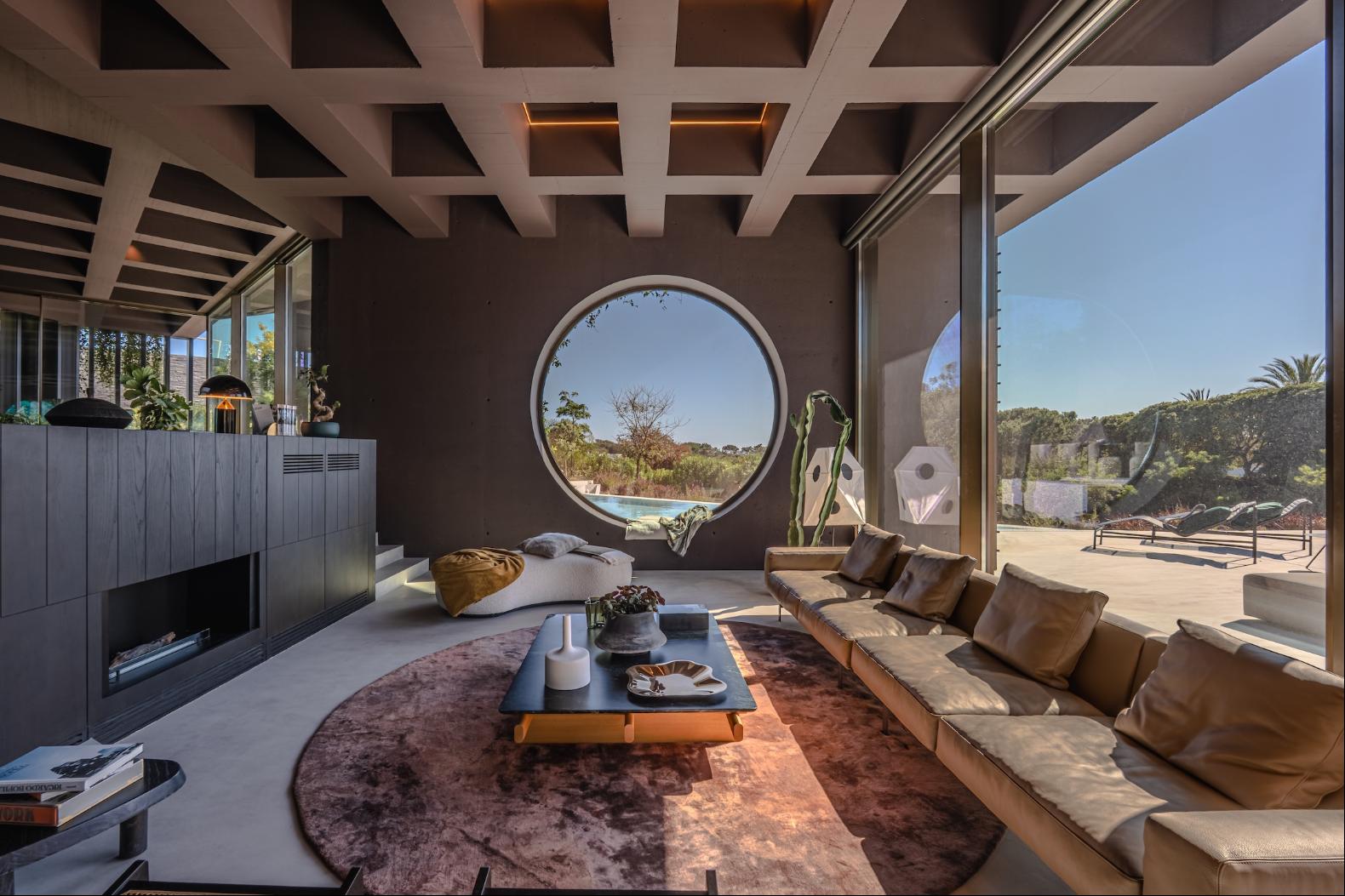
“What lit a fire under me was meeting James Goldstein in his house in Los Angeles in 2016,” he says. The Sheats-Goldstein House — built for Paul and Helen Taylor Sheats in 1963 and later bought by Goldstein in 1972 — is one of southern California’s most well-known houses, seen in films such as The Big Lebowski and Charlie’s Angels: Full Throttle. Designed by architect John Lautner, a Frank Lloyd Wright protégé, the building has a playful, futuristic design: angular concrete blends with glass walls, while the living room’s coffered ceiling features drinking-glass-style skylights.
Goldstein and Lautner continued tweaking the house over many years up until the latter’s death in 1994. The process of working together was what inspired O’Shea. “We [Goldstein and O’Shea] were chatting about his work with Lautner and nothing I experienced in my orthodox architectural practice seemed to resemble the sheer joy he experienced.” Although he had no client to work with, he resolved to try to capture this frisson, to attempt to put “a Goldstein hat on and a Lautner hat on”.
A site was identified in 2018, at the Quinta do Lago estate in the Algarve in Portugal, a climate well-suited for Lautnerian California-style caprices. O’Shea set out to do things he had not done before.
“It was the first building I’d ever designed using three-dimensional modelling,” he says, a task that was “challenging”. Without a client to say yes or no, it required great deliberation and was a leap into the unknown in terms of materials. “I know more about concrete now than I ever did, but that was a learning process.”
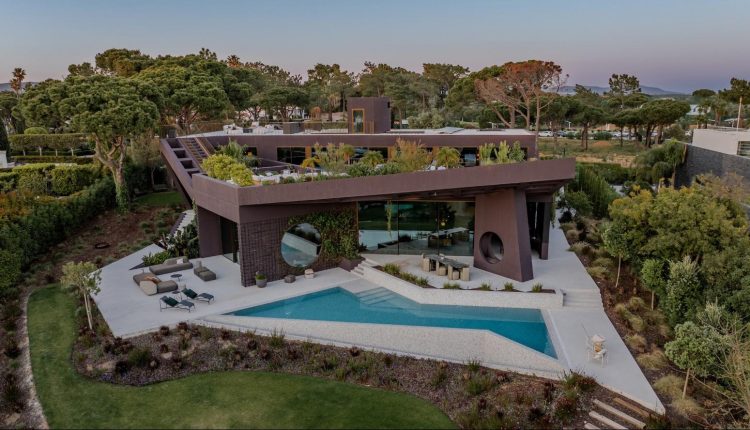
The resulting six-bedroom house, on the market for €24.5mn, plays with triangular geometries — doffing its hat to Sheats-Goldstein with a sharply sloping roof. There are courtyards that draw nature inside and an artisanal feel despite all the concrete. This is partly down to the finish of the concrete. “It was bush hammered by one man. I think it took him about six months to do the whole house — inside and out,” he says.
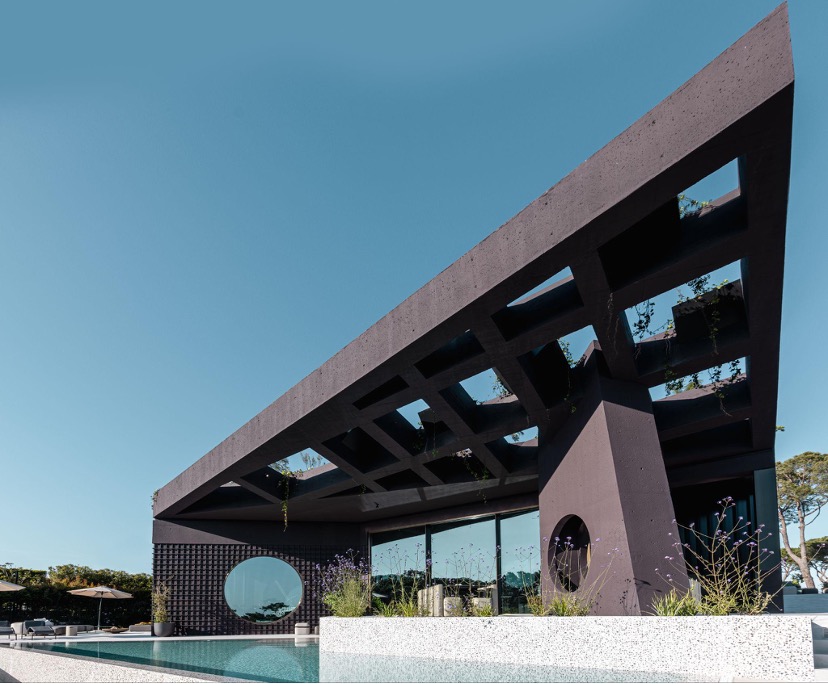
Known as Blackbird — because of its dark hue — the house is a departure from others in the area that tend to be “all-white golf course style villas”, O’Shea says. The dark colour provides a backdrop to nature: “you can see everything against it from bees to insects to lemons”.
Other unusual features include singling out spaces that are often afterthoughts — a sunken home office has a copper canopy and hanging plants. “You can sit there and meditate or sketch, or do some work in the morning sun,” he says. Bathrooms were another focus. “I love designing toilets actually. They always seem incidental . . . but we’ve tried to make them kind of an experience, a place you might want to be in.” One guest bathroom features a banana grove view.
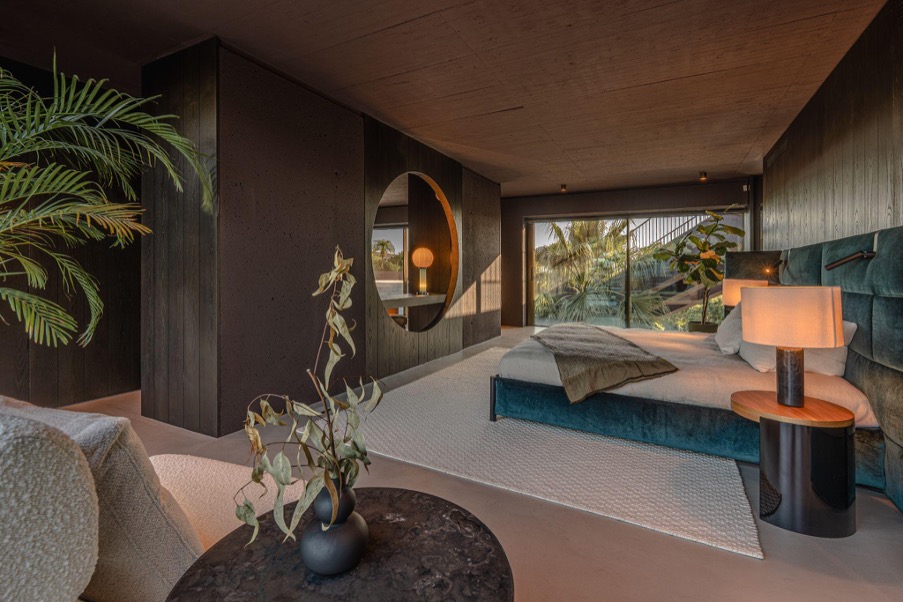
Accustomed to working in more northern climates, O’Shea embraced the prospects of interplay between lush Mediterranean foliage and concrete forms. “I always think of Lautner’s Elrod House and the role that planting played in it,” O’Shea says, with the building and nature forming “a lovely balance”. At Blackbird, plants were sourced from a wide variety of locations around Portugal and even the Azores to expressive and scenographic effect. They grew far more quickly than anything in Dublin. “To see a house changed through natural growth was something I’d never seen on any of my projects, something so voluminous.”
Another first was the effect of the light in a different geographic region. “I couldn’t foresee the Portuguese light,” he says. “It’s fantastic.” Striking spaces such as the triple-height entry hall maximise the light as it shifts throughout the day, “from purple at sunrise to the golden glow at sunset.”
Photography: Savills
Read the full article here