

At designer Jonathan Anderson’s eagerly awaited menswear debut at Dior in June, A$AP Rocky, Daniel Craig and Robert Pattinson wore striped, collegiate-style ties. It was no coincidence — all three had been dressed by Dior — and similar iterations appeared on the runway over untucked striped shirts and cargo shorts or apple green chinos, sometimes flipped back to show off the Dior label underneath. Craig teamed his red and blue tie with jeans, a simple striped shirt and a tweedy single-breasted blazer, and found himself immediately hailed as a pin-up for the return to menswear of American prep.
The show gave fuel to a wider reset in menswear. There hasn’t been an era-defining look in the category since the luxury sportswear boom of the 2010s, where brands such as Givenchy and Louis Vuitton elevated a street-influenced sports aesthetic to high fashion, with a blend of tailoring and hype sneakers.
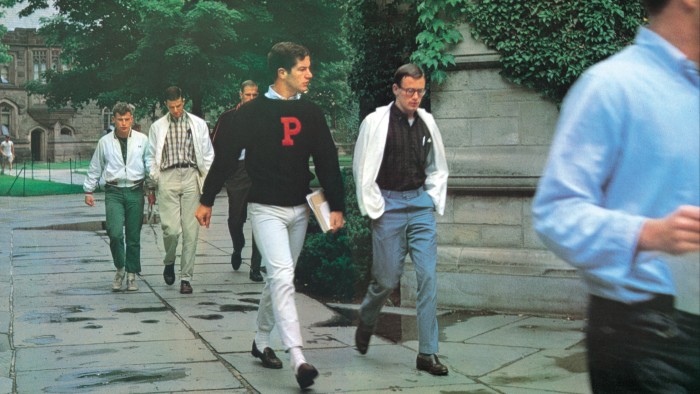
Anderson’s debut mixed the hallmarks of prep style with more formal tailoring pieces that referenced the Dior archives. The opening look was a Bar jacket paired with voluminous cargo shorts that referenced a Dior dress of 1947. Later, a model walked out in crisp white dinner shirt and navy chinos, a bubblegum-pink cable-knit sweater thrown nonchalantly over his shoulders. Many of the models wore loafers and white crew socks, a look that was ubiquitous on Ivy League campuses in the 1950s and ’60s.
Just over a week later in Paris, new Celine (and former Polo Ralph Lauren) designer Michael Rider delivered an appealing co-ed collection of oversized rugby shirts, loafers, ties and blazers, adding further impetus to the prep-is-back narrative. Like Dior, this Celine iteration gave off immediate fashion energy, but without feeling terribly hard to imagine people wearing it immediately.
“There’s a clear return to preppy in menswear, and it feels both timely and timeless,” says Simon Longland, buying director of fashion at Harrods. “Men are gravitating towards a more refined, versatile style — one rooted in heritage but reimagined with fresh energy. What we’re seeing now isn’t just American collegiate or Ivy League: it’s a broader, more nuanced interpretation through British tailoring and French sophistication.”
Longland cites both Anderson’s Dior and Rider’s Celine as “subtly weaving preppy codes — blazers, striped shirting, relaxed silhouettes — into collections that feel both polished and lived-in”. He notes that brands long associated with this aesthetic, such as Ralph Lauren, are updating it by embracing natural fabrics and, notably, a broader use of colour. Harrods is already seeing strong traction with customers. “This isn’t a fleeting trend.”
The look is already making its way off the runway. At the menswear shows in June, editors, buyers and stylists were sporting boat shoes and polos, many from Miuccia Prada’s Miu Miu. Her distinctive interpretation of the style, which first appeared on the catwalk for spring/summer 2024, has been a strong commercial success. Sales rose 93 per cent year-on-year in 2024, pushing annual revenue past the €1bn mark for the first time.
Elsewhere at the men’s shows, designer Willy Chavarria (who used to work at Ralph Lauren) combined strong politics with pastel sweatshirts, slouchy chinos and relaxed blazers in stone and navy. “Preppy intentionality” read the Wales Bonner show notes about a polo shirt collaboration with John Smedley. Dunhill’s melange of high society Britishness and the style of singer Bryan Ferry delivered Madras check blazers, colourful slacks and natty cardigans with dog intarsias. Meanwhile Craig Green, British fashion’s great experimentalist, reimagined Fred Perry polo shirts as matching sets with towel-inspired tunic shaped tops and wide-cut, draped shorts.
The Ivy League look originated between the first and second world wars when young men, inspired by the off-duty wardrobes of the British aristocracy, embraced a uniform of tweed jackets, cashmere jumpers and plain-front trousers on the campuses of Princeton and Dartmouth. The look migrated to Hollywood in the 1950s and ’60s via the likes of Paul Newman and Gregory Peck. Take Ivy, a photography book from the mid-1960s by Teruyoshi Hayashida, documents campus students wearing Madras blazers, khaki Bermuda shorts, jeans and penny loafers, while Ralph Lauren and Brooks Brothers gave the 1980s iteration of preppy commercial clout.
“The casual sportswear core of the preppy aesthetic lends itself very well to weekend wear and the off-the-clock relaxed wardrobe of today’s menswear customers,” says Bruce Pask, senior director of men’s fashion at Saks Fifth Avenue and Neiman Marcus. He lists key pieces including navy blazers, wide-legged chinos, rugby shirts, CVO (Circular Vamp Oxford) sneakers and boat shoes, which appeared in numerous collections.
“There has always been an aspirational aspect to the iconic preppy style — a pleasant nostalgia and optimism tied to the mid-century American collegiate lifestyle,” says Pask in reference to what might explain prep’s renewed appeal, particularly in an America that’s pitching institutions such as Harvard against the Trump administration. “The focus on the style of an idealised past can feel like a welcome escape.”
“The prep look is returning because we’re in a state of uncertainty,” offers Teo van den Broeke, editor-in-chief of Esquire UK. “Masculinity is a little lost right now. There is something solid about prep as a look. But there’s also a disarming softness to it that plays into the new idea of masculinity we’re trying to forge: bookish and dependable rather than boorish and domineering.”
Van den Broeke says this prep reboot is about a certain ease and comfort. He points to Dior’s pleated tweed coats, pastel sweaters by Auralee and Armani, and lo-fi sneakers by Prada and Brunello Cucinelli. “Even pyjamas shown at Dolce & Gabbana and Saint Laurent felt preppy somehow — the kind of thing Bunny Corcoran [a character in The Secret History by Donna Tartt] might have worn under a greatcoat after a misspent night on the quad.”
“I think there is a feeling of wanting to be a part of something again — a group, a uniform, a shared identity,” says Craig Green. Green’s collaboration with Fred Perry appealed to the designer because it’s a brand he recognises as having a long history of dressing a wide range of subcultural groups, from 1960s Mods to the 1990s Britpop scene. “There is something powerful about clothing that brings people together and signals belonging,” he says. “The idea of a more collective energy feels right again.”
Read the full article here