

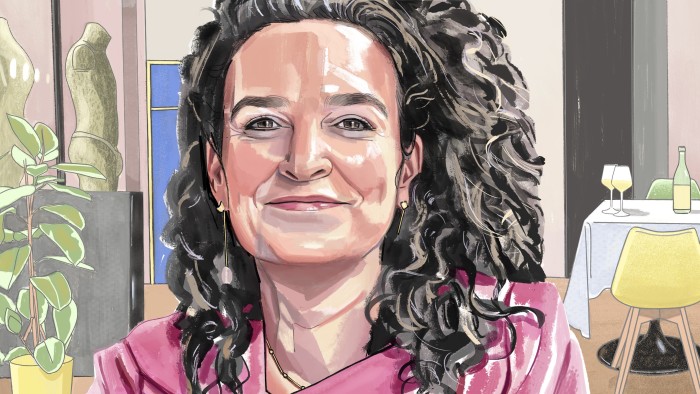
Just as our lunch date is due to start, the waiter arrives with a message: my guest will be delayed by 25 minutes.
Mafalda Duarte sweeps in only eight minutes later, having made good time after her appointment at the UK foreign office overran. She is in London as a stopover en route to Portugal after a trip to Brazil, where she met officials involved in the planning of this November’s UN COP30 climate summit.
Duarte is the head of the Green Climate Fund, the $21bn investment vehicle of the Paris agreement, the landmark global accord signed almost a decade ago to tackle climate change. As the world’s largest multilateral climate fund, the GCF is tasked with driving green investments to developing countries.
We are lunching at Studio Gauthier, a vegan restaurant by French chef Alexis Gauthier. More relaxed than his fine-dining venue Gauthier Soho, the restaurant at the BFI Building off London’s Tottenham Court Road pitches itself as “fun, chic and stylish”. It could be a description of Duarte.
The 49-year-old economist, who has worked near Seoul since joining the GCF two years ago, says she meets with the foreign office “every time” she’s in London. The fund is financed mostly by wealthy nations, and the UK is “the largest contributor”, she says, having pledged almost $5.1bn.
What she doesn’t say is that, had last year’s American election turned out differently, the US could be the GCF’s biggest donor. Under Barack Obama and Joe Biden, the US pledged $6bn to the fund, of which $2bn has already been provided.
The GCF was one of the earliest victims of President Donald Trump’s sweeping attack on climate action following his re-election. He rescinded the outstanding $4bn, the first time any country had done so, pulled the US out of the Paris agreement for the second time, ripped up legislation aimed at greening the economy and took an axe to USAID, the development agency, which had been involved in climate projects globally.
Since then, Duarte has been ringside as global trade tensions have offered politicians ample distraction from climate action. Meanwhile aid budgets, traditionally the source of many GCF contributions, are being slashed in favour of defence.
If a stereotype of the climate community is the wearing of hemp clothes in drab shades of green and brown, Duarte is the antithesis. Her fuchsia top is striking against her masses of dark curls, while her off-white trousers and towering stilettos appear impractical for a day running between meetings in London. Her nails are perfectly manicured, her jewellery tasteful.
Surrounded by olive green velvet booths and polished concrete, and sitting by the doors to the outside terrace, Duarte admits she has never been to the restaurant before. Her team, she says, chose it because they know she likes to “experiment with new things” and prefers a plant-based diet. But as she browses the menu, she appears unsure. “It’s very different,” she says. The North African tasting menu advertised on the website is only offered at dinner, which leaves us with a hodgepodge of options including vegan sushi and burgers.
As the waiter arrives, Duarte says she doesn’t drink alcohol. I park my plans for a glass of wine, replicating her order of a virgin passion fruit colada instead.
Duarte cut out alcohol about two years ago for “health reasons”, though she is “not absolutist about it”. She takes a similar approach to veganism, where “for special occasions like Christmas” she will eat fish.
But meat, which she stopped eating seven years ago, is entirely off the menu “for climate reasons”. Cattle are the biggest agricultural source of methane, a potent greenhouse gas. The logging of forests to make way for farms is also a big contributor to climate change.
“I’m not one of those that goes around and says, ‘You guys all have to stop eating meat.’ Not at all. I just say if people could reduce their consumption, it could be very beneficial from a climate perspective.”
Today she opts for herbes focaccia, while I order the padron peppers. We decide to share an 11-piece vegan sushi set and asparagus nigiri. Just as the waiter is leaving, Duarte asks for chickpea fries. “I’m really intrigued by those.”
Duarte grew up in Portugal with an electrician father and accountant mother. “I don’t come from a wealthy background,” she says. She shares her name with the hero of the eponymous Argentine comic strip, a curious young girl who cares about world peace. Duarte says she wasn’t named for the character Mafalda, but is a “big fan . . . I am not as talented as she is”, she says, laughing.
But, like the character, Duarte was always interested in global issues, she says, studying international relations in Portugal, followed by a master’s degree in international development and economics at Bradford university. This took her to Africa for the first time, for research in Angola.
“That hit me really hard. One thing was to read about poverty, but the other thing was to witness poverty like that,” she says. The disparity between how refugees were living in camps and then “going to the houses of the ministers . . . and the military elites” was such a “stark difference” that it “impacted me quite profoundly”.
She later moved to Mozambique, where she worked in the civil service. Her husband followed her: they have been married for 25 years. “He gave up his career for me,” she says.
Since then, Duarte’s work at organisations including the African Development Bank and the World Bank has taken their family around the world. Their eldest daughter, 22, was born in South Africa, and twin girls, 13, in Tunisia in the aftermath of the Arab spring.
Our starters arrive. “I can see from these portions that we have ordered a lot,” she says. Her focaccia is “good”, she says. The peppers — which need more searing, in my opinion — are served on a bed of whipped vegan feta. It is tasty, but feta it is not.
Duarte’s pivot from development to climate champion was both accidental and predictable. The world’s poorest countries are disproportionately affected by climate change, despite having low historical greenhouse gas emissions. It became clear to her that “climate is going to jeopardise development and it’s going to exacerbate inequality in the world”.
Developing countries are also “going to be the ones determining whether or not we meet 1.5C” above the pre-industrial temperature, the lower limit of the Paris agreement, she says. Responsibility for the historic emissions lies primarily with rich countries, but emissions are rising fastest in developing countries as they industrialise and demand for energy soars.
But climate relations between rich and poor countries are difficult, especially since a fight over finance at last year’s UN COP29 climate summit in Azerbaijan.
While developed countries agreed to take the lead in providing at least $300bn a year to developing countries by 2035, economists say $1.3tn a year is needed in international climate finance. A plan to reach the higher number is due to be put forward at COP30 in Brazil later this year. “This is an opportunity to restore some trust,” says Duarte. The GCF has both developed and developing countries on its board.
The conversation turns to voters. Despite polls indicating widespread concern about climate change, western governments that have put climate action high on their agenda often suffer. In the UK, the Labour government’s pro-green energy policies are frequently attacked by opposition parties, which claim they will drive up costs.
Duarte quickly pushes back at what she calls an “attempt at conveying the climate agenda as anti-poor”, adding: “Actually, investments aligned with climate are a pro-poor agenda. These are the people who are already suffering the most from the impacts of climate change.”
More needs to be made of the health impacts of climate change, she adds, such as the spread of species of mosquito that carry dengue fever — typically found in the tropics and subtropics — to Europe because of warmer weather.
“We need to be capable of making people understand what’s at stake, why we cannot wait to act more decisively and what are the consequences of not acting more decisively.”
If greenhouse gases continue to rise, there will be more and more climate disasters — and subsequent GDP hits, she adds. “There’s no way that governments will be able to respond effectively.” The International Chamber of Commerce estimates that extreme weather events have cost the global economy around $2tn over the past decade.
For many countries, more climate disasters will mean big trade-offs. “What are we not going to invest in because we are responding to disasters?”
Duarte is still eating the focaccia when our main courses arrive. “I’m just slow,” she says to the waiter. We juggle dishes around the table to make room.
The chickpea fries, which look like cassava, “are really good, but they’re very dense”, says Duarte. The asparagus nigiri is delicious, the best dish of the meal. The rest of the sushi is Instagrammable, but we are less enamoured. Duarte ignores the sushi with the fake tuna and salmon, instead focusing on the options with vegetables.
During the meal, she has shied away from mentioning the US. But I press her on Trump’s decision to rescind the $4bn pledge and the challenge of the US retaining a seat on the GCF board, despite the president calling climate change a hoax.
The US and the GCF have found common ground in efforts to make the fund more “efficient and impactful”, she replies cautiously, part of a “reform agenda” that Duarte began two years ago.
The GCF, like other multilateral financial institutions such as the World Bank, has long faced criticism for being too slow and clunky. Reviewing a potential project could take up to two years, a figure the fund wants to cut to nine months. It has already reduced the time between board approval of a project and first disbursement of money from 22 months to four and a half, says Duarte.
She begins to speak more freely: “Of course, we disagree with the decision of pulling money out of climate and out of the GCF, because we do think it is important and is actually aligned with the US interests.
“We don’t disagree with the position that institutions need to be more responsive, that the system needs to be reformed, and that institutions need to become more effective.”
The US was in attendance at the recent GCF board meeting, which was “very successful”, she adds. The board approved record investments of more than $1.2bn across 17 projects, including an early warning system in the Maldives and several agricultural initiatives. The fund now has a portfolio of 314 projects amounting to $18bn in GCF investments, or $67bn including co-financing. She has set a target that the GCF should manage $50bn by 2030. Countries have already promised almost $30bn, paying in $21bn so far with most of the rest due by 2027.
But with the US pulling back, Duarte has called on more countries across the world to contribute to the GCF. The fund is also weighing up possible new contributors, such as philanthropy, or whether to go to capital markets.
No country other than the US has pulled money, but Duarte admits that future so-called replenishment cycles, where countries pledge money, could be tricky.
The aid cuts are bad on “many fronts”, she says, arguing they are “not aligned with the climate goals” or efforts to “promote development and prosperity”.
At the same time, the devastation of climate change is becoming clearer, she adds. In the US alone this year, there have been destructive wildfires in Los Angeles, widespread flash floods, including in Texas where more than 130 people died, and repeated heat domes that have affected hundreds of millions of people.
“Scientists keep monitoring what’s happening [when it comes to climate change and] their message is, ‘It’s worse than we thought.’ The window of opportunity for investing and reversing [climate change] is narrowing.”
She is also focusing on how to better “mobilise the private sector”, looking at using GCF money to de-risk investments in developing countries, where issues such as foreign exchange or political uncertainty can leave investors nervous. Most of the money for climate investments will have to come from the private sector, she says.
We move on to being a woman in climate finance. Under her predecessor, the GCF was plagued by scandals surrounding its working culture, facing allegations of widespread racism, sexual harassment, abuses of power and inappropriate relationships at the fund.
Since the accusations, the fund has put into place new procedures, she says. “Culture is something that takes time to change. But I’m very clear what the organisation needs to stand for.”
She says that while she has not yet had “a case like this come to me from an investigation”, if one does, “I will be making very bold decisions.”
We try to catch the eye of our waiter, who is laden with sushi and cocktails. Fifteen minutes later, Duarte is talking about her work on finding new sources of income while running the Climate Investment Funds (CIF), as I mutter: “We’re never going to get these coffees.” The waiter arrives apologising, and we order an Americano and tea.
When the World Bank was in need of a new president in 2023, Duarte’s name was frequently mentioned, though she wasn’t interested at the time, she says. Now two years into a four-year term at the GCF, which can be extended for a further four, Duarte says she will reassess her next move in about a year’s time. “At the moment I’m very happy.”
But with Trump in the White House, wars and trade tensions, as well as scientists increasingly warning the world is likely to surpass 1.5C, I ask if all is lost. “It’s glass half full,” she replies.
Governments are “prioritising different things at the moment”, but progress is being made. When the Paris agreement was signed, the world was on course for a temperature rise of 3.4C above the pre-industrial level, she says, but in the decade since, this has come down to as low as 2.5C.
“We need this transition to be much faster. We need a different scale of investments . . . we need to work with the levers that will get the governments to make the right decisions.”
Our lunch has now lasted almost three hours and Duarte is, once again, running late for her next meeting. Throughout our conversation, she has stressed the need to remain hopeful, appearing to remain optimistic even in the face of big challenges. “Hope is really important,” she says.
Now she has a smaller challenge. She looks at the map on her phone, weighing up whether to get a cab.
“It’s actually really not that far. I might just attempt to walk there. Even with my high heels,” she says laughing, travelling in hope.
Attracta Mooney is the FT’s climate correspondent
Find out about our latest stories first — follow FT Weekend on Instagram, Bluesky and X, and sign up to receive the FT Weekend newsletter every Saturday morning
Read the full article here