

Unlock the Editor’s Digest for free
Roula Khalaf, Editor of the FT, selects her favourite stories in this weekly newsletter.
How best to tackle the urgency and enormity of the climate crisis onstage? We’ve recently had Kyoto, immersing the audience in the groundbreaking 1997 climate conference, Weather Girl coming at it through blistering black comedy, and A Play for the Living in a Time of Extinction, Katie Mitchell’s lament on species loss, powered by onstage cyclists.
Mike Bartlett’s provocative, pithy but patchy new drama focuses on individual moral responsibility and the personal dilemmas thrown up by the scale of the issue. It’s closest in style to Albion, Bartlett’s earlier state-of-the-nation play set in a garden, and, like that work, draws from Chekhov. Here, as in The Cherry Orchard, a group of people cluster on a piece of land that becomes symbolic of the seismic change going on around them. In Juniper Blood, that patch of earth is a farm in rural Oxfordshire, where middle-aged couple Philip (ironically nicknamed Lip because he rarely talks) and Ruth are aiming for organic self-sufficiency.
But what starts out as the sort of set-up beloved of glossy magazine features — rustic alfresco dining with locally sourced wine — unravels into a series of blazing arguments about principle versus pragmatism, idealism versus compromise and the effectiveness of individual action in the face of global capitalism.
Lip (Sam Troughton, magnetically strange and surly) digs himself further into his stance, increasingly convinced that the only solution is to go back to a life of simple survival, living off-grid and off the land. Hattie Morahan’s increasingly strained and exhausted Ruth, struggling with bills, missing deliveries and her partner’s dogged determination, urges compromise. Things reach crisis point when she becomes pregnant and Lip, who has now flipped into full-on conspiracy theory, refuses to countenance medical attention.
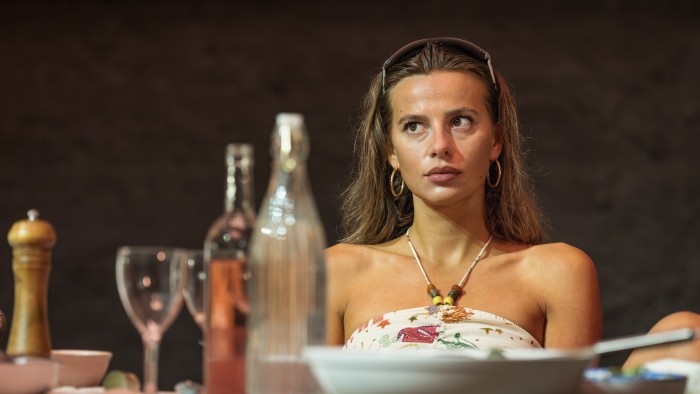
Orbiting the two are neighbour Tony (Jonathan Slinger), who runs a big commercial farm, Ruth’s needy, needling ex-stepdaughter, Milly (Nadia Parkes), and Milly’s friend Femi (Terique Jarrett), who is heading for a degree in contemporary rural ecology at Oxford. Everyone has a view and the debates aren’t pretty.
The result is a great ethical workout, grappling with multiple pressing arguments and playing ping-pong with your sympathies, but as a play it’s less effective, too often favouring debate over drama, with characters becoming mouthpieces for points of view. Femi in particular barely exists as a person and is saddled with great slabs of argument, and though Jarrett invests him with a wry sense of humour, it’s a pretty thankless role. Meanwhile, making Lip such an obdurate weirdo rather undermines his arguments.
Bartlett is a witty writer and there are some fabulous lines. “Thought I was a disastrous prick. Turns out none of it’s my fault!” declares Slinger’s very funny, surprisingly touching Tony after having therapy. There are also some great twists, including one breathtaking moment of stagecraft involving a shovelful of soil. James Macdonald’s production, on a hyper-real set from ULTZ that includes real grass but is contained within a box, hums with troubling menace, invoking cheery sitcom The Good Life one minute and folk horror film Midsommar the next.
Macdonald and lighting designer Jo Joelson leave the lights up on the audience and the play admirably battles with questions that face us all. It’s a bold attempt to confront one of the issues of our day, if not Bartlett’s best play.
★★★☆☆
To October 4, donmarwarehouse.com
Read the full article here