

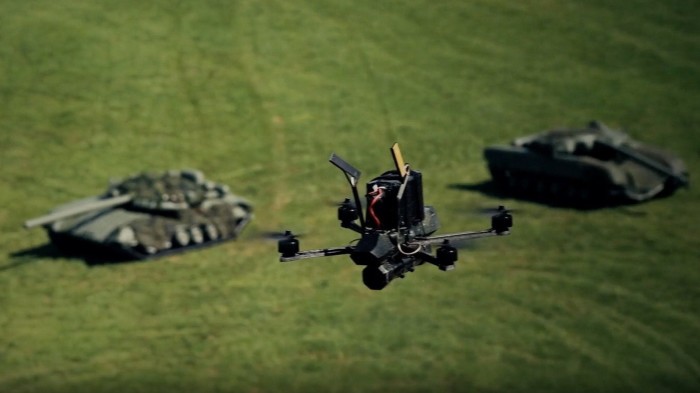
AI-powered drone swarms are set to transform the battlefield, with companies launching cutting edge software set to make unmanned weapon attacks which overwhelm enemy defences more deadly.
In this next iteration of drone warfare, groups of unmanned weapons use artificial intelligence to co-ordinate with each other to attack enemy positions.
The advent of swarming was a “very big moment”, said Lorenz Meier, chief executive of Auterion, a US-German start-up which recently unveiled a “drone swarm strike engine”.
The technology, dubbed Nemyx, transforms individual drones into a single, co-ordinated force. Powered by Auterion’s operating system and delivered as an app, the system allows any compatible drone to join the swarm through a simple software upgrade.
The new software has yet to be used on the battlefield, but Auterion is shipping 33,000 of its artificial intelligence drone “strike kits” to Ukraine by the end of this year as part of a contract with the Pentagon. It said these systems could be upgraded with Nemyx to be deployable in co-ordinated swarms.
“[Militaries] know that it will saturate their defences,” said Meier, adding that they were “all talking about swarming, they are all wary of swarming”.
The swarms allow a single soldier to control multiple drones, allowing attack strategies that automatically seek to outfox and overwhelm enemy defences.
“The whole idea of swarms is that you are force multiplying. You’re leveraging the single human” said Gundbert Scherf, co-founder of Helsing, which announced its AI driven swarm technology last week in partnership with German software firm Systematic, using the latter firm’s software.
The first large scale experiments with drone swarms started in 2016 with the US Navy F-18 hornets dropping microdrones. China has also showcased large-scale swarms since 2017.
Since the Russian invasion in 2022, a number of Ukrainian companies have experimented with drone swarms, notably Swarmer, a Kyiv based company which says its technology has been used in 82,000 combat operations.
Serhii Kupriienko, the CEO and co-founder of Swarmer likens an intelligent swarm to a living organism in which drones communicate with each other, decides autonomously how to fly and execute operations.
In one experimental combat operation last year, the Ukrainian military used Swarmer’s software with a swarm of drones which approached Russian positions and independently determined the moment to launch an attack.
“Autonomy and automation are the rule,” said Kupriienko. Swarming technology “responds in real time to new human commands and priorities, changing circumstances and newly discovered information”, he said.
Militaries have already been using swarm tactics to great effect. Russia, for example, has learned to group attacks with its cheap, long range Shahed drones against Ukrainian cities, overwhelming Ukrainian defences and increasing overall hit rates.
The latest software, however, can make swarming tactics even more deadly, allowing attack drones to learn. There was no real intelligence involved in the “comms relays” where multiple drones are controlled by a larger drone which relays radio signals to extend the attack range, said Helsing’s Scherf.
With their massive archive of drone footage which is useful for training artificial intelligence models, Ukrainian defence tech groups believe they have a crucial edge over their foreign rivals. Only Ukrainian companies have access to a classified database of combat drone data known as the Universal Military Dataset.
“Drone swarming has long been treated as an ambitious goal” said Eveline Buchatskiy, managing partner of D3, a venture capital company in Kyiv which invests in military technologies.
Ukraine’s “unprecedented volume of combat data available to train autonomy models” were “the essential building blocks for swarming”, she said.
Michael Holm of Systematic said the trend for drone makers is run on open software systems which makes them easier to co-ordinate. “We’re talking weeks, days and weeks, to integrate and make the swarm operational, not years and months.”
Critics of the AI powered systems warn that the algorithms that run swarms could push the boundaries of human control over weapons, leading to a greater portion of combat decision making handed over to artificial intelligence.
Fully autonomous weapons in which there is no human input, are restricted under international law.
“We’ve of course built autonomy in, but we’ve always made sure that the human is in the loop,” said Scherf. “This is very much where companies [are] built around European values, and European doctrine.”
With swarms requiring individual drones to be in constant contact with each other, a leading challenge for the technology is electronic warfare, where navigation and communications frequencies used between drones are jammed, warned experts.
Beyond the battlefield, swarming algorithms could be used in logistics, agriculture and emergency response. Multiple drones working together could inspect pipelines, plant crops, or search disaster zones far more efficiently than single units.
Start-ups in Silicon Valley, Shenzhen and Tel Aviv are already experimenting with swarms for warehouse automation, firefighting and crowd monitoring. Analysts note, however, that the commercial potential depends on regulators developing standards for safety and data use.
Read the full article here